


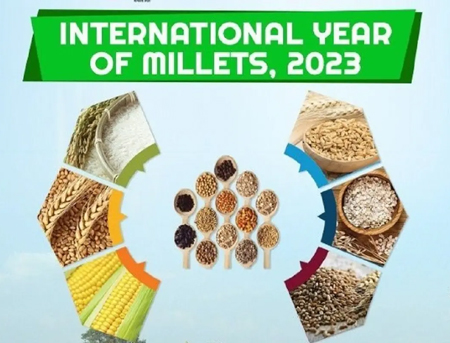
International Year of Millets 2023
10 January 2023
The Government of India sponsored the proposal for International Year of Millets (IYM) 2023 which was accepted by the United Nations General Assembly (UNGA). The declaration has been instrumental for the Government of India to be at the forefront in celebrating the IYM. Prime Minister of India Narendra Modi has also shared his vision to make IYM 2023 a ‘People’s Movement’ alongside positioning India as the ‘Global Hub for Millets’.
Recognising the enormous potential of Millets, which also aligns with several UN Sustainable Development Goals (SDGs), the Government of India (GoI) has prioritized Millets. In April 2018, Millets were rebranded as “Nutri Cereals”, followed by the year 2018 being declared as the National Year of Millets, aiming at larger promotion and demand generation. The global millets market is projected to register a CAGR of 4.5% during the forecast period between 2021-2026.
What are millets:
Millet is a common term for categorising small-seeded grasses that are often called Nutri-cereals. Some of them are sorghum (jowar), pearl millet (bajra), finger millet (ragi), little millet (kutki), foxtail millet (kakun), proso millet (cheena), barnyard millet (sawa), and kodo millet (kodon). An essential staple cereal crop for millions of smallholder dryland farmers across Sub-Saharan Africa and Asia, millets offer nutrition, resilience, income and livelihood for farmers, and have multiple uses such as food, feed, fodder, biofuels and brewing.
Significance and benefits of millets:
Millets are nutritionally superior to wheat and rice owing to their higher protein levels and a more balanced amino acid profile. Millets also contain various phytochemicals which exert therapeutic properties owing to their anti-inflammatory and anti-oxidative properties. Further, besides being climate resilient, millet grains are rich sources of nutrients like carbohydrates, protein, dietary fibre, and good-quality fat; minerals like calcium, potassium, magnesium, iron, manganese, zinc and B complex vitamins. Most importantly, millet production is not dependent on the use of chemical fertilizers.
There are many activities planned throughout the year to celebrate the International Year of Millets
TDS