


BEIJING
South African Armed Forces Day 2024
South African Embassy in China
22 February 2024
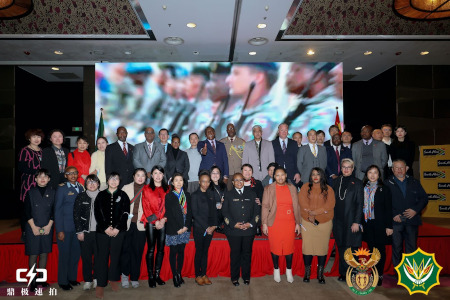
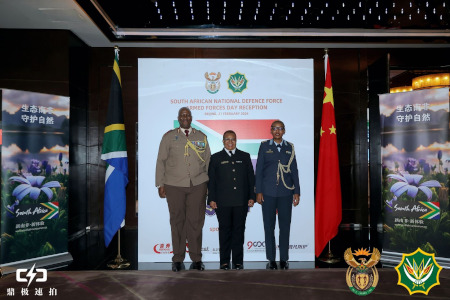
The Embassy of South Africa in China commemorated South Africa’s Armed Forces at a reception in Beijing on 21 February. This date has several significances for South Africans who will celebrate 30 years as a free nation this year.
Considering that the armed liberation struggle against the brutal, racist and unjust regime of the Nationalist government of South Africa came to an end, it was imperative to reconcile and reconstitute the opposing forces into an entity that serves the constitutional democracy that South Africans voted for in 1994. The reintegration of the freedom fighters and the South African Defence Forces began in 1993 and is now a unified South African National Defence Force.
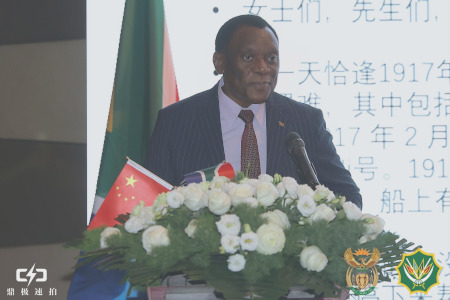
Addressing the gathering which included Deputy Chief of the Logistics Department of the PLA Navy, Rear Admiral Tong Shenghai, Chairperson of BMAC Col. Gottlicher Bernd, South African Defence Attache, Brigadier General William Bucibe, Defence Attaches represented in China and acknowledging the South African Minister Plenipotentiary, Mahdi Basadien, Ambassador Siyabonga Cwele of South Africa to China delivered his remarks titled 'We have learned from the past, today we stand ready, and confident of the future we want.”
“In 2012, our President, in his capacity as the Commander-in-Chief of the South African National Defence Force (SANDF), proclaimed that 21 February each year will be observed and commemorated as our Armed Forces Day. It is a day on which the South African population honours and express gratitude to the men and women of the South African National Defence Force for their indelible sacrifices endured while upholding the Constitution of the Republic, defending its territorial integrity, and protecting its people.
The sinking of the SS Mendi is one of the worst maritime disasters in United Kingdom waters of the 20th century, yet few in the UK have heard of it. The larger ship initially did not stop to help the SS Mendi and it’s beleaguered, drowning passengers and crew. It took less than half an hour for the SS Mendi vessel to sink. This action led to an investigation of Captain Stump of the SS Darro that resulted in a mere license suspension for a year.
Like many thousands of others from across the British Empire, they were travelling to support the war effort, as Britain and her allies were running out of people and supplies. From history we have learnt that the prevalent view in Britain then was an absolute belief in the superiority of the white man. Although it was deemed necessary to conscript and recruit from the Caribbean, Africa and India, there was uneasiness at the prospect of putting weapons into the hands of colonial subjects.
.
It is under this backdrop that we have conquered the demon of racism and false superiority and stand behind all our men of the SANDF. The SANDF is a symbol of national prestige. Today our men and women in the SANDF walk tall among the nations. We conduct military readiness drills with armed forced from Africa, developed and developing nations. From all corners of Africa our presence contributes to peace, saving lives and supporting development. During peace time at home the SANDF is always on the side of its people, using their skill in humanitarian relief of natural disasters and assisting the poor communities to overcome local challenges, and preserve life. They have become the pride of the nation.
Since 2013, the SANDF has hosted an Armed Forces Day (AFD) to commemorate the lives of those who lost their lives in the patriotic service of their country and to celebrate and showcase SANDF capabilities. The event rotates around the country allowing each province an opportunity to interact with the SANDF.
Our relations with the People’s Republic of China dates back to 1953 when Walter Sisulu, as the Secretary General of the the African National Congress and Duma Nokwe visited China as part of their tour to the socialist countries to explore their systems and support to our struggle for liberation. However, it was in November 1961 that the first group of uMkhonto weSizwe combatants arrived in Beijing for military training. The group was led by Raymond Mhlaba and included Andrew Mlangeni, Wilton Mkwayi, Peter Mthembu, Steven Naidoo and Joe Gqabi. It is significant to note that while Raymond Mhlaba assisted Nelson Mandel in drafting the constitution of the MK, the group was instructed to go abroad two months before the official launching of the the MK. Most of their military science training was in Nanjing Military Academy, South China.
Andrew Mlangeni recalled the excitement of the group when they had an unannounced visit to their room by the gigantic, dignified and commanding figure of the great leader Mao Tse Dong as their guest. He went on to say “Mao was flanked by six companions including his deputy in the Chinese Communist Party, Deng Xiaoping, and two other heavyweights, Premier Zhou Enlai and Minister of Foreign Affairs Chen Yi. Deng and Zhou were Mao’s trusted diplomats at the time. Chen was one of the most experienced military and political leaders in Mao’s inner circle.” The day for this historic visit was carefully selected to coincide with the 1st of August 1962, a significant day in Chinese history, the Army Day, which commemorates the founding of the People’s Liberation Army in 1927.
In 2023, South Africa and China celebrated the 25th anniversary of the establishment of diplomatic relations which cover political, economic and security/defence cooperation between the two fraternal countries. The armed forces of the two countries have established Defence Committees which oversee and work to strengthen military-to-military cooperation. High-level People’s Liberation Army (PLA) delegations have visited South Africa, with reciprocal visits by South African National Defence Force personnel to China including the visit to the PRC by the Chief of South African National Defence Force in 2023.
The two sides have achieved fruitful exchanges and cooperation in fields such as joint training and exercises, academic education, medical and health care, and equipment technology.
You may recall that towards the end of 2023, the SA Defence Industry held a virtual seminar on Promoting Investments in the South African Defence Manufacturing Industry. I would like to take this opportunity to invite interested companies which are interested in investing in SA defence industry to contact the South African Embassy in Beijing. I am confident that the Defence Office in the Embassy will be more than willing to assist you.
With our joint efforts, we can succeed in advancing China-South Africa relations to new heights including exchange of bilateral investments in the defence industry.
Bilateral cooperation between the two countries demand of us all to make new and greater contributions to the “building of a community with a shared future for mankind”.
Let me conclude with the courageous words of Reverend Isaac Dyobha’s his final address as he led those who could not make it to a lifeboat of SS Mendi into a death dance and said "Be quiet and calm, my countrymen. What is happening now is what you came to do ... you are going to die, but that is what you came to do ... I, a Xhosa, say you are my brothers ... Swazis, Pondos, Basotho ... so let us die like brothers. We are the sons of Africa ..."
We will always remember them.”
Embassy of South Africa in China