


South Africa's G20 Presidency
Health Department convenes first G20 Health Working Group meeting
23 January 2025
The Department of Health will convene the first virtual Group of 20 (G20) Health Working Group meeting on Friday, 24 January 2025, as part of the country’s G20 Presidency activities planned for 2025.
“The objective of this meeting on health is for South Africa to present its G20 Health Working Group priorities to the Member States and other invited stakeholders to be informed about the country’s priorities and also to make inputs accordingly,” the department said in a statement.
The mandate of the Health Working Group is to improve global health by addressing health challenges, building resilient health systems, and promoting equitable access to health services.
This virtual meeting will focus on the theme: ‘Accelerate Health Equity, Solidarity, and Universal Coverage’ and will include representatives from all G20 Member States, invited non-Member States and international organisations.
The health priorities identified within the broader South African G20 Presidency will form part of the deliberations on the day and include the strengthening of primary healthcare as a pathway towards Universal Health Coverage (UHC), the Pandemic Prevention Preparedness and Response, and strengthening of health and care workforce.
The leaders will also focus on stemming the tide of non-communicable diseases and science and innovation for health and economic growth.
“This will be the first of the planned meetings, both in-person and virtual, scheduled to take place throughout the year across the country,” the department explained, adding that the outcomes of these technical working group meetings will inform part of the discussions at the meetings for G20 Health Ministers culminating in a G20 Health Working Group declaration.
South Africa assumed the G20 Presidency, being the first African country to do so, on 1 December 2024.
SAnews.gov.za
SA hosts G20 Framework Working Group meeting
15 January 2025
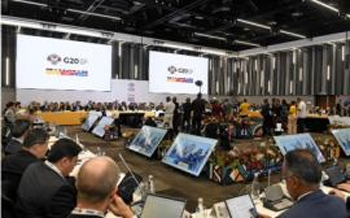
Technical meetings under the Group of 20 (G20) Finance Track have begun this week with a meeting of the Framework Working Group (FWG). This after South Africa kicked off its G20 Presidency with the hosting of the G20 Sherpa and Finance Track Meetings in December 2024.
“The National Treasury and the South African Reserve Bank are jointly responsible for overseeing the work of the G20 Finance Track.
“The mandate of the FWG is to promote strong, sustainable, balanced, and inclusive growth, and does so by identifying, monitoring and assessing global macroeconomic risks, vulnerabilities and uncertainties and recommending suitable policy responses to global shocks and cross-cutting global challenges,” National Treasury said in a statement.

The G20 is a grouping of developed and developing countries which together form a powerful bloc representing at least 85% of the world’s Gross Domestic Product and some 75% of international trade – making the FWG critical.
“The first day of the meeting [on Monday focused] on the main headwinds to global growth, ongoing supply and demand risks to inflation, and the main fiscal risks to growth and inflation. It will also discuss the economic outlook for Africa.
“The second day [Tuesday] of the meeting discussed the draft FWG work plan for 2025, which includes priority areas identified by the South African Presidency,” the statement continued.
South Africa’s outlined priorities include:
• enhancing global economic resilience in light of growth risks like fragmentation and macroeconomic imbalances;
• strengthening macroeconomic foundations and growth reforms in light of climate change and
• assessing labour productivity, technological development and demographic change
This week’s FWG meeting is the first of four to be held.
“The remaining three meetings for this Working Group are scheduled for April, June and September, in person, in venues across the country.
“The outcomes of these meetings will inform discussions at the meetings of the Finance and Central Bank Deputies and Finance Ministers and Central Bank Governors,” the statement concluded.
The G20 Leaders’ Summit is expected to be held in the latter half of 2025.
SAnews.gov.za
Financial injustice a hindrance to Africa’s development
7 January 2025
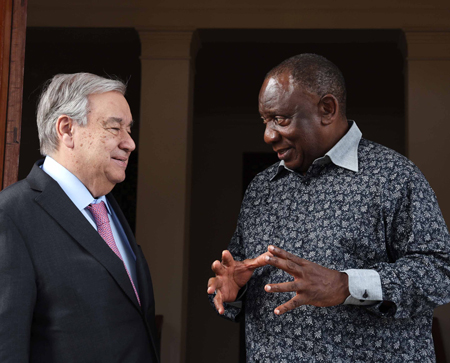
The transformation of global financial institutions remains critical in addressing Africa’s mounting debt challenges, as they perpetuate financial injustice, says United Nations (UN) Secretary-General António Guterres.
“The G20 must lead in delivering financial justice. Financing is fundamental -- from inclusive economic growth, to supporting industrialisation and food security or addressing inequalities,” Guterres said during the closing session for the Joint Sherpa-Finance and Central Banks Deputies' Meeting, held in Johannesburg, on 11 December 2024.
Guterres explained that global financial systems "load" countries with debt service costs, while denying them access to sufficient low-cost financing to fight poverty, inequality and hunger and advance the Sustainable Development Goals (SDGs).
According to the UN, in 2022, public debt in Africa reached USD 1.8 trillion.
“Developing countries must be represented fairly in their governance. These institutions must also protect economies, particularly from global shocks. It is time to mend the global safety nets that were discovered during the COVID-19 pandemic that they were no longer fit for purpose.
“This continent’s potential is without question. Africa is home to a young and growing population, rich cultural and natural diversity, and a tremendous entrepreneurial spirit. But this enormous potential continues to be held back by injustices that are deeply rooted in the history of colonialism.
“Injustice in worsening climate chaos - which Africans did virtually nothing to cause - that fuels floods, storms, hunger and deadly droughts. I stand side-by-side with President Ramaphosa and the people of Africa in this fight for justice on all fronts. Africa needs financial justice,” Guterres said.
In September, world leaders adopted the Pact for the Future, which includes commitments for ambitious reforms to make the international financial architecture representative of today’s global economy and put the needs of developing countries front and centre.
The pact covers a broad range of issues including peace and security, sustainable development, climate change, digital cooperation, human rights, gender, youth and future generations, and the transformation of global governance.
“It calls for action to move forward with an SDG Stimulus… to substantially increase the lending capacity of Multilateral Development Banks to make them bigger, bolder and better to support developing countries.
“... And to mobilise more international and domestic resources, public and private, for vital investments. Last week I appointed a group of leading experts to galvanize international support for action on debt, and I’m delighted that Trevor Manuel will be part of this important work,” he said.
As part of the work for South Africa’s G20 Presidency, Guterres participated in the first series of the more than 130 meetings that will precede the G20 Summit in 2025.
On 1 December 2024, South Africa assumed the Presidency of the G20, which comprises many of the world's largest developing and developed economies.
The G20 was established to tackle pressing global economic and financial issues. Together, G20 members account for around 85% of global gross domestic product (GDP) and 75% of international trade.
The G20 comprises 19 countries including Argentina, Australia, Brazil, Canada, China, France, Germany, India, Indonesia, Italy, Japan, Republic of Korea, Mexico, Russia, Saudi Arabia, South Africa, Türkiye, United Kingdom, and United States and
two regional bodies, namely the European Union and the African Union.
The grouping therefore plays a critical role in influencing global policy making and fostering global economic stability.
South Africa's G20 Presidency is the fourth consecutive emerging market Presidency, and it is also the first African Presidency, followed by the admission of the African Union (AU) as the second permanent African member.
SAnews.gov.za
First G20 Sherpa meetings 'robust'
10 December 2024
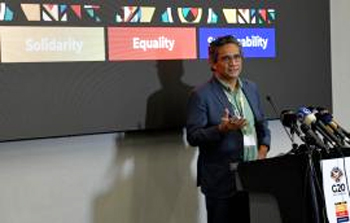
South Africa’s Sherpa for the G20 and Director-General of the Department of International Relations and Cooperation, Zane Dangor, has described the first Sherpa meeting of South Africa’s Presidency of the G20 as “very successful” and “robust”.
The first Sherpa meeting was held at Investec in Sandton on Monday and Tuesday, this week.
“We’ve just completed the first Sherpa meetings, so it’s day two of plenty. It was a very successful Sherpa meeting. The discussions were robust but very inclusive.
Speaking at a media briefing on Tuesday, following the conclusion of the two-day meeting, Dangor was upbeat that the discussions were fruitful.
“We started yesterday [Monday] with [International Relations and Cooperation Minister Ronald] Lamola opening the Sherpa meeting and we outlined… that the theme of our [G20] Presidency would be ‘Solidarity, Equality and Sustainability’. Minister Lamola just outlined, for example, how we are going to amplify the voices of the Global South as part of our Presidency,” he said.
According to Dangor, during the first Sherpa Track meeting, discussions centred on various subjects, including “significant discussions” for a review of the "G20 at 20".
“[There was] support for the fact that this is timely, that we need to assess what the purpose of the G20 is, what is the
mandate of the G20 and what are the agreements that have been made on the various tracks over the last 20 years, what has been achieved and what has enabled that achievement.
“We must also look at what has not been achieved and what are the disabling factors. A methodology for that review will be developed so that we ask the right questions, get the right answers, and do the proper analysis, so that by the time we get to the end of our Presidency [of the G20] in November, we can give them clear recommendations on how to improve the G20,” he said.
The South African Sherpa emphasised that the review “does not formalise the G20”.
“The G20 members seek to remain informal so that levels of flexibility are maintained and also to make sure that it doesn’t seek to compete with formal multilateral institutions like the [United Nations] and the [African Union] and others where you have formal secretariats,” he said.
Other subject matters given much attention include mobilising finance for a Just Energy Transition, as well as food security.
“This has just been reinforced by the Sherpas that this is a very important issue that we must focus on in the working groups, and that the Sherpas must also delve deeper into the issues of climate change and financing the green transition.
“[There were] recommendations… on how we can ensure that we focus on food security at the regional and global level, thereby complimenting what [previous G20 President] Brazil has already started,” Dangor said.
SAnews.gov.za
SA’s G20 Presidency to focus on inclusivity
4 December 2024
South Africa will use its Group of Twenty (G20) Presidency to build a more inclusive and prosperous Africa and a better world, ensuring no one is left behind. This is according to President Cyril Ramaphosa who was speaking during the official launch of South Africa’s G20 Presidency in Cape Town, on Tuesday.
On 01 December 2024, South Africa assumed the Presidency of the G20, marking a historic milestone as the first African country to lead this influential group of the world’s largest economies.
President Ramaphosa outlined South Africa’s ambitious agenda under the theme “Solidarity, Equality, and Sustainability.”
“The G20 Presidency is a valuable opportunity for South Africa to advance efforts towards greater global economic growth and sustainable development. It is an opportunity to place the needs of Africa and the rest of the Global South more firmly on the international development agenda.
“Through South Africa’s G20 Presidency, we will work to build a better Africa and a better world, and to ensure that no one is left behind,” the President said.
He announced that the Department of International Relations and Cooperation (DIRCO) Minister Ronald Lamola, Treasury Minister Enoch Godongwana and The Presidency led by Director-General Phindile Baleni will be tasked with leading and making the G20 process a success.
The President acknowledged the enormous responsibility of leading the G20 group which includes the world’s major economies, representing 85% of global Gross Domestic Product (GDP), over 75% of international trade, and about two-thirds of the world population.
“The grouping therefore plays a critical role in influencing global policy making and fostering global economic stability. Decisions taken by the G20 have a direct impact on the lives of all members of the global community.
“It has a wide agenda that now includes trade, sustainable development, health, agriculture, energy, the environment, climate change and anti-corruption,” the President said.
The G20 is an international forum of both developing and developed countries which seek to find solutions to global economic and financial issues.
It comprises 19 countries including: Argentina, Australia, Brazil, Canada, China, France, Germany, India, Indonesia, Italy, Japan, Republic of Korea, Mexico, Russia, Saudi Arabia, South Africa, Türkiye, United Kingdom, and United States and two regional bodies, namely the European Union and the African Union.
Benefits and addressing challenges
The G20 is expected to have significant economic benefits for South Africa, notably for the tourism, transport, restaurant, entertainment and hospitality industries, with global visibility in all nine provinces.
South Africa will host approximately 130 meetings (both virtual and in-person) from 01 December 2024 - 30 November 2025, across the country, and on the margins of major international conferences and meetings.
The President noted that South Africa’s Presidency comes at a challenging time, with global crises ranging from climate change to inequality, poverty, geopolitical conflicts, and sluggish economic growth.
President Ramaphosa underscored the need for collective action to tackle these pressing issues, ensuring that solutions are inclusive and equitable.
“While the challenges we face are common, their causes and consequences are unevenly distributed across and between countries.
“Working together with G20 members, and building partnerships across society, South Africa will seek to harness global will and capabilities to confront these challenges. The G20 provides us with a platform to pursue these collective goals.”
Key priorities
President Ramaphosa outlined four key priorities for South Africa’s G20 Presidency - namely: strengthening disaster resilience; ensuring debt sustainability; mobilising finance for a just energy transition and harnessing critical minerals for inclusive growth.
The country’s G20 Presidency aims to escalate discussions on climate-induced disasters, advocating for enhanced global support for post-disaster reconstruction, particularly for vulnerable nations.
Debt solutions and inclusive growth
President Ramaphosa stressed the need for sustainable debt solutions for low-income countries, highlighting Africa’s struggle with high debt levels that hinder development. The G20 will explore extending debt relief and ensuring fair and transparent sovereign credit ratings.
“Building on G20 initiatives undertaken in recent years, we will seek to advance sustainable solutions to tackle high structural deficits and liquidity challenges and extend debt relief to developing economies.
“We will also seek to ensure that the sovereign credit ratings are fair and transparent and to address high risk premiums for developing economies,” the President said.
The Presidency also seeks to mobilise finance for a just energy transition by securing agreement on increasing the quality and quantity of climate finance flows to developing countries.
“This would include strengthening multilateral development banks, enhancing and streamlining support for country platforms such as the Just Energy Transition Partnership and more effectively leveraging private capital,” the President said.
Lastly, the G20 Presidency seeks to harness critical minerals for inclusive growth and development.
South Africa plans to champion the responsible use of critical minerals, ensuring that local communities and resource-rich countries benefit equitably.
“As minerals extraction accelerates to match the needs of the energy transition, it is crucial to ensure that the countries and local communities endowed with these resources are the ones to benefit the most. We will use this G20 to champion the use of critical minerals as an engine for growth and development in Africa,” the President said.
The G20 Presidency will culminate in the Leaders’ Summit in Johannesburg in November 2025, where world leaders will adopt a declaration outlining collective actions to address critical global challenges.
SAnews.gov.za
South Africa holds the 2025 G20 Presidency

2 December 2024
South Africa will hold the G20 Presidency from 1 December 2024 to 30 November 2025, only five years before the deadline of the United Nations (UN) 2030 Agenda.
South Africa’s Presidency
South Africa’s G20 Presidency takes place when the world is facing a series of overlapping and mutually reinforcing crises, including climate change, underdevelopment, inequality, poverty, hunger, unemployment, technological changes and geopolitical instability. The UN Secretary-General, Mr Antonio Guterres, underscored the urgency of the situation during the launch of the Special Edition of the Sustainable Development Goals (SDGs) Progress Report on 25 April 2023. He noted with concern that only 12% of the SDG targets are currently on track, with approximately 50% needing more substantial progress, and more than 30% of the SDGs having either stalled or reversed. To achieve the 2030 SDGs, the forthcoming G20 Presidencies must encourage a paradigm shift and accelerate the implementation of practical solutions.
While the challenges we face are common, their causes and consequences are unevenly distributed. Part of the paradigm shift requires G20 countries to situate inequalities at the heart of economic policy making. Inequality poses a significant threat to global economic growth, development and stability, as the disparities in wealth and development within and between countries are both unjust and unsustainable. Inequality and its deleterious consequences are especially evident in the Global South.
A lack of predictable and sustainable financing for development and climate action exacerbates these inequalities. This is worsened further by polarised ownership patterns of critical resources for development, extreme vulnerability to pandemics and other global public health emergencies. These challenges are difficult to overcome given crippling sovereign debt levels that force many countries to sacrifice their developmental obligations to service unmanageable debts.
South Africa will address these urgent challenges by building partnerships across all sectors of society, acting in the interests of our shared humanity. In the spirit of Ubuntu, we recognise that individual nations cannot thrive in isolation. Countries that attempt to prosper alone amid widespread poverty and underdevelopment contradict the essence of Ubuntu and our collective humanity. This understanding reflects the transformative promise of the 2030 Agenda and its SDGs, which are dedicated to ensuring that no one is left behind.
It is with the spirit of Ubuntu that South Africa approaches its Presidency of G20. This African philosophy emphasises the interconnectedness of individuals within a broader communal, societal, environmental and spiritual context. Ubuntu is often translated as “I am because we are” or “I am because you are”. This guiding principle will shape South Africa’s approach as it seeks collective solutions to pressing global collective economic and financial challenges.
To tackle the global polycrisis, South Africa has embraced the theme “Solidarity, Equality, Sustainability” for its G20 Presidency. The high-level deliverables and priorities under this theme, lie at the core of the original G20 mandate of promoting Strong, Sustainable, Balanced and Inclusive Growth.
Theme: Solidarity, Equality, Sustainability
Through solidarity, we can create an inclusive future centred on people. Solidarity will allow us to develop our societies in a way that reflects our shared humanity. In our interconnected world, the challenges faced by one nation impact all nations.
By promoting equality, we strive to ensure fair treatment and equal opportunities for all individuals and nations, regardless of their economic status, gender, race, geographic location or any other characteristic.
Sustainability involves meeting the needs of the present without compromising the ability of future generations to meet their own needs.
Given the state of the world, South Africa believes the G20 should elevate the following:
First, we must take action to strengthen disaster resilience and response. The increasing rate of climate-induced natural disasters is affecting countries around the world, with a devastating impact on those countries that cannot afford the costs of recovery and rebuilding. South Africa will elevate this issue to leader level, calling for the global community, including international financial institutions, development banks and the private sector, to scale up post-disaster reconstruction.
Second, we must take action to ensure debt sustainability for low-income countries. A key obstacle to inclusive growth in developing economies, including many in Africa, is an unsustainable level of debt which limits their ability to invest in infrastructure, healthcare, education and other development needs. Building on G20 initiatives undertaken in recent years, South Africa will seek to advance sustainable solutions to tackle high structural deficits and liquidity challenges and extend debt relief to developing economies. South Africa will also seek to ensure that the sovereign credit ratings are fair and transparent and to address high risk premiums for developing economies. Key to addressing the debt question is dealing with the Cost of Capital. We believe the G20 has the capacity to address this matter in a comprehensive manner.
Third, we must mobilise finance for a just energy transition. South Africa will seek to secure agreement on increasing the quality and quantity of climate finance flows to developing countries. This would include strengthening multilateral development banks, enhancing and streamlining support for country platforms such as the Just Energy Transition Partnership and more effectively leveraging private capital.
Fourth, we must work together to harness critical minerals for inclusive growth and sustainable development. As minerals extraction accelerates to match the needs of the energy transition, it is crucial to ensure that the countries and local communities endowed with these resources are the ones to benefit the most. South Africa will use its G20 Presidency to champion the use of critical minerals as an engine for growth and development in Africa.
These considerations above will shape South Africa’s approach across G20 Working Groups in both the Sherpa and Finance Tracks. They will also inform three time-bound Task Forces that will bring together role players across the Tracks and Working Groups, focused on the following high-level deliverables:
High-Level Deliverables
Task Force 1 – Inclusive Economic Growth, Industrialisation, Employment and Reduced Inequality
Task Force 2 – Food Security
Task Force 3 – Artificial Intelligence, Data Governance and Innovation for Sustainable Development
A review of the work of the G20, “The G20 at 20 years”: A Reflection on Key Achievements and the Way Forward, will also feature as one of South Africa’s deliverables, through a Sherpa Track Initiative.
South Africa also proposes the establishment of a Cost of Capital Commission during its G20 Presidency. This Commission will deliver a comprehensive expert review on the issues impacting the cost of capital for developing economies which could help address future debt sustainability issues and the related fiscal space challenges.
In addition to these dedicated contributions, South Africa will also seek to take forward advances achieved under previous presidencies. In particular, South Africa recognises the centrality of advancing work on increasing fair financing for development, including through scaling up Multilateral Development Banks (MDBs); taking forward global financial architecture reform; improving pandemic preparedness; achieving fair international taxation regimes, including taxation of the super-rich.
All these priorities, as well as the overall theme, will influence Working Groups’ priorities and work plans. The initial issue notes of each Working Group will reflect on how their work relates to these high-level priorities and the agendas for Working Group meetings should take these priorities into account. The task forces will establish closer working relations with Working Groups most connected to each of the priority areas.
Guided by the spirit of Ubuntu, decision-making and governance in traditional African societies has, in the main, operated by way of consensus for what is in the best interest of all. Consistent with this wisdom, South Africa views the diversity of the G20 nations as a strength rather than a source of division and will preserve the unity of the Group in pursuit of the priorities outlined.
South Africa fully supports the approach of strengthening partnerships and expanding dialogue with a wide range of actors; including States, international organisations and civil society; to collectively shape the G20’s approach to issues requiring international cooperation.
Civil society and non-governmental organisations
The experience, networks, research capacity and grassroots level knowledge of the G20 engagement groups will continue to greatly enrich the G20’s collective discussions and policy decisions.
The participation of non-governmental stakeholders reflects the overall commitment of South Africa to work towards a broader and more inclusive Presidency, which is also reflected in our overall theme and deliverables during this year. Taking on board different perspectives, including those which may not be ideologically aligned to ours, is especially important for South Africa, as it will confer greater legitimacy to the G20 as an organisation and to the outcomes of the Leaders’ Summit in 2025.
The South African government also recognises the significant strides made by the Brazilian G20 Presidency in enhancing the G20 as a site of democratic global engagement. The South African presidency will continue this trajectory.
Dialogues with civil society and other non-government institutions will be conducted by engagement groups such as the Business20 (B20), Civil20 (C20), Labour20 (L20), Parliament20 (P20), Science20 (S20), Start-up20 (SU20), Supreme Audit Institutions20 (SAI20), Think-tank20 (T20), Urban20 (U20), Women20 (W20) and Youth20 (Y20), the Oceans20 (O20) and the Judiciary20 (J20).
Representatives of G20 Engagement Groups will define joint positions on the group’s agenda topics within their independent dialogue processes, with the responsibility for the opinion-forming processes lying entirely in the hands of these groups.
The work undertaken by Engagement Groups will lead to recommendations, which will reach the mid-year Foreign Ministers, the Finance and Central Bank Ministerial Meetings, as well as the Leaders’ Summit. In South Africa’s G20 Presidency, further modalities will be developed to involve a wide range of stakeholders throughout the year, particularly on priority initiatives.
G20 Social
South Africa is impressed with how Brazil broadened the inclusivity of the G20 beyond the current Engagement Groups. We are committed to continuing this initiative. South Africa has a vibrant and dynamic civil society sector that will contribute to ensuring that this process is successful.
SA’s G20 Presidency will be inclusive and represent different voices - Lamola

18 November 2024
By Gabisile Ngcobo
Rio de Janeiro - To make South Africa’s Group of 20 (G20) Presidency more inclusive, a vibrant and dynamic African leadership style that emphasises participation, consultation and the common good must be embraced.
“The colourful tapestry of our diverse nation will be woven into our every thread to represent the voices and contributions of our diverse population,” said International Relations and Cooperation Minister, Ronald Lamola.
Lamola was speaking at the G20 Social Summit in Rio de Janeiro on Saturday alongside Brazilian President Luiz Inácio Lula da Silva.
The social initiative by Brazil’s G20 Presidency aims to include social and non-governmental participants in decisions made at the G20 Leaders’ Summit.
The sharp focus is addressing hunger, poverty, inequality, sustainability and climate change, and global governance reform.
“We believe this approach will transform our people from mere spectators into active weavers of our collective future, ensuring that their hands and hearts shape the outcomes of South Africa’s G20 Presidency.
“Through this rich, collaborative process, we create a living mosaic of shared aspirations and achievements, reflecting the true spirit of our nation,” the Minister said.
This approach, he said, reflects South Africa’s G20 Presidency themes of “Solidarity, Equality, and Sustainability”.
Preparations are underway for South Africa’s G20 Presidency and the hosting of the G20 Summit in 2025. South Africa is set to assume the Chair of the G20 from Brazil on 1 December this year.
“Our call is a heartfelt plea for unified effort and mutual support among member nations, urging us to stand together in the face of common challenges. We envision a world where equal opportunities are not just a dream but a reality for all, where every individual has the chance to thrive.”
He told the attendees that this commitment extended beyond present needs but transcended to future generations.
“Together, we can weave a future that is not only just and equitable but also sustainable, nurturing the hopes and dreams of those who will inherit the world we build today.”
According to the Minister, South Africa intends to build on the impressive achievements of previous G20 Presidencies.
These efforts have established a foundation for reforming the global financial architecture, with a clear focus on promoting fairness within the global financial system.
Meanwhile, the Minister said the goal was to ensure the reform agenda has a meaningful impact and meets the needs and demands of developing countries.
Lamola emphasised that the Sustainable Development Goals (SDGs) are the most relevant benchmark for developing countries’ development priorities and must remain central to the G20’s work.
“For this reason, South Africa intends to use its G20 Presidency to action the Pact of the Future, which world leaders adopted at UNGA79 [79th session of the UN General Assembly] on 22 September 2024.
“We believe that the Pact of the Future is a once-in-a-generation opportunity to forge global consensus and make progress on priorities such as the SDGs.”
He took the time to commend the work done by the social and civil society partners to raise the level of ambition in global commitments when the world is more divided.
“We endeavour to strengthen our relationship with the engagement groups to deliver the G20 to the people.”
The Minister highlighted the recommendations made during various discussions regarding Brazil’s priorities for its G20 Presidency, emphasising the need to ensure that children’s rights are incorporated into all actions and decisions.
Lamola echoed Brazil’s view that more opportunities must be created to enhance civil society participation in the G20’s work and that additional efforts are needed to further increase their contribution.
“An inclusive G20 is no longer an option but an imperative. Thus, we wholeheartedly commend Brazil’s innovative inclusion of the Favelas 20, G20 Favelas, and other marginalised groups who often bear the brunt of hunger and poverty.
“This inspired initiative shines a light on those who are frequently overlooked, ensuring their voices are heard and their struggles acknowledged.”
He stated that this serves as a powerful testament to the spirit of solidarity and inclusivity, reminding leaders that true progress is achievable only when nations uplift every member of the global community.
“This approach not only addresses immediate needs but also paves the way for a more equitable and compassionate world.” – SAnews.gov.za
SA’s G20 Presidency a significant moment for the country’s young democracy, says Lamola
14 October 2024

Minister Lamola.
International Relations and Cooperation Minister Ronald Lamola believes that South Africa’s G20 Presidency will be a significant moment in the country’s young democracy. “After the [2010] World Cup and the collective fight we mounted as a nation against COVID-19, it will be our biggest national project,” he said.
The Minister was speaking during his keynote address at the Mapungubwe Institute for Strategic Reflection (MISTRA) Conference, in Sandton, Johannesburg.
South Africa will assume the G20 Presidency from Brazil in December this year.
President Cyril Ramaphosa announced that the theme of South Africa’s Presidency will focus on solidarity, cooperation and sustainable development.
According to Lamola, South Africa plans to prioritise discussions on the Just Energy Transition, financing for development, transforming global financial structures, infrastructure development, and other critical issues. These include artificial intelligence, food security, and the debt trap.
“We must reverse the uneven distribution of resources for just transition. It is inconceivable that Africa receives less than 3% of the global climate change financing, while being the most affected continent. We will advocate for more resources to be allocated to Africa for climate change.”
On Thursday, International Relations and Cooperation Director-General (DG) Zane Dangor emphasised South Africa’s commitment to prioritising Africa’s development and equality during its G20 Presidency.
Dangor, who also serves as South Africa’s G20 Sherpa, said this during a consultation meeting on the G20 with his African Union Commission (AUC) counterpart, Ambassador Albert Muchanga. Muchanga is a G20 Sherpa and Commissioner of Economy, Trade, Tourism, Industry and Minerals (ETTIM).
Echoing President Cyril Ramaphosa’s sentiments about the country’s Presidency of the G20, he said South Africa would place Africa’s development at the top of the agenda.
South Africa’s upcoming G20 Presidency is set to commence on 1 December 2024 after it takes over from Brazil, which is hosting the G20 Summit in November this year.
Dangor said he hoped that South Africa’s G20 Presidency would bring to the fore the needs, not just of African countries, but other developing nations as well.
“The idea of strengthening the voice of the South is going to be very critical,” said Dangor.
He touched on the looming deadline of the 2030 Agenda for Sustainable Development and acknowledged that the continent has not achieved the desired progress.
Dangor said the country will also look at implementing some of the issues that may have been agreed upon in the past.
“We will focus on the extent to which we can lay the basis for implementation. It may be the form of review, but it may be in the form of just putting in place the building groups for implementation. We are hoping that working with AU, we can galvanise the resources and the policy know-how and capabilities of all countries,” said Dangor.
The meeting’s key points included the need for inclusive global economic policy, the importance of the compact with Africa (initiated by Germany in 2017 during its G20 Presidency) to attract investment, and the necessity of international tax cooperation.
Muchanga highlighted the AU’s role in coordinating African interests, with a focus on leveraging resources and policy know-how.
“We need an inclusive framework of international tax cooperation at the level of the United Nations, and I think South Africa and other African countries, such as Nigeria and Ghana, have been at the forefront of mobilising the rest of the working world, including Africa, to buy into the idea.”
The Commissioner also spoke about the importance of forming a united front with other African countries.
“South Africa, as the permanent member [of the G20], and the specially invited countries of Egypt, Angola and Nigeria, together with the African Union, were able to get together because in those meetings what we agreed [is] that, as we go along, we should be collaborating and consulting, so that when we sit in the G20, were able to speak with one strong voice,” Muchanga said.
He also took the time to assure Dangor that South Africa has the support of the AU and the AUC, as it assumes the “very important” position of Presidency of the G20.
Meanwhile, challenges such as geopolitical conflicts and the need for a unified approach to address issues like climate change and indebtedness were also addressed.
The two leaders concluded their meeting with a commitment to work together to achieve these goals.
The Minister of International Relations and Cooperation, Ronald Lamola, paid a courtesy call to Muchanga.
Lamola praised Muchanga for his stellar job as the G20 Sherpa and said his presence strengthened their working relationship leading up to South Africa’s G20 Presidency.
SAnews.gov.za