

Unleashing North–South Trade Potential Along the Cairo-to-Cape Axis
By Kirtan Bhana – TDS
12 May 2025
As the global economic landscape continues to shift toward multipolarity, Africa is poised to harness its immense potential through strategic, intra-continental collaboration. At the forefront of this drive are the continent’s two largest economies, Egypt and South Africa, whose bilateral trade currently hovers at a modest US$200 million, a figure that does not reflect the vast commercial promise between them.
The recent high-level trade promotion mission by the Egyptian Food Export Council to South Africa signals a renewed commitment to elevate and accelerate economic ties between Cairo and Pretoria. More than a business visit, this engagement marks a significant step towards realising the vision of a connected Africa—from the Mediterranean to the Cape, a seamless trade corridor that embodies the aspirations of the African Continental Free Trade Area (AfCFTA).
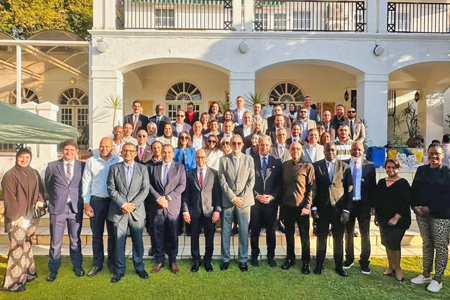
Led by Mr. Alaa Al-Wakil, Board Member of the Food Industries Export Council of Egypt, and featuring an influential delegation of 30 leading Egyptian food industry companies, the mission was a strategic initiative to showcase Egyptian agri-food capabilities to the South African market. The calibre of participants, which included Dr. Tariq Houbi, Chairman of the National Food Safety Authority, and Dr. Tamim Al-Dawi, Deputy Executive Director of the Council, highlighted Egypt’s intent to forge stronger commercial bridges with the South.
Ambassador Ahmed Sharif, Egypt’s Ambassador to South Africa, emphasised the dynamic, robust relations underpinning this drive for expanded trade. “Our ambition is exponential growth,” he stated. “Egypt’s food industry exports to South Africa already represent one-third of our total exports here. We see huge potential in expanding this footprint.”
The business matchmaking event in Johannesburg generated enthusiastic interest among South African importers and distributors, underlining the appeal of Egyptian food products, renowned for their price competitiveness, high quality, and stringent safety standards, ensured by Egypt’s independent food safety institutions.
Egypt's strategic geography cannot be overstated. Positioned at the crossroads of Africa, Asia, Europe, and the Middle East, and with control of the Suez Canal, Egypt is not just a producer, it is a logistics and transshipment powerhouse. The country’s ongoing economic reforms, infrastructure expansion, and 21% year-on-year growth in food exports (reaching US$6.1 billion in 2024) make it a highly attractive partner and investment destination for South African businesses.
Membership in BRICS, AfCFTA, COMESA, and the Arab League further enhances Egypt’s role as a continental connector, making it an ideal gateway for South African exporters aiming to tap into wider regional markets.
South Africa brings to the table an advanced and diversified economy, a mature financial system, and world-class infrastructure, traits that make it an attractive destination for Egyptian goods and investments. Its regulatory environment, stable banking system, and sophisticated retail sector present a secure and scalable platform for Egyptian exporters looking to enter southern African markets.
Direct flights between Johannesburg and Cairo, regular diplomatic dialogue, and rising tourism and cultural exchange reinforce the people-to-people ties essential to deepening bilateral relations.
From a continental perspective, this emerging partnership embodies the revival of the Cairo-to-Cape dream, a Pan-African vision that traces its roots back to the early ideals of unity and shared prosperity. This corridor is not just symbolic; it has the potential to become Africa’s economic spine, connecting value chains, integrating infrastructure, and linking consumers across vastly diverse markets.
The Egyptian Food Export Council’s delegation featured industry powerhouses such as SECO SALT, Pasta Regina, Vitrac Egypt, Daltex Corporation, Edita Food Industries, Elcaptain Co., Noodles Park, and others, companies with both the scale and ambition to meet South African market needs and contribute to a more resilient and interdependent African supply chain.
For Egypt and South Africa, the path forward is clear. What remains is intentional action: investment in logistics, harmonisation of trade regulations, and a shared commitment to breaking down the barriers that have historically fragmented intra-African trade.
With AfCFTA providing the policy framework, BRICS+ offering financial and geopolitical alignment, and the private sector demonstrating growing appetite, now is the time to unlock the vast potential between the continent’s two economic giants.
Trade is not merely about goods, it is about growth, dignity, and a shared African future.