


Awakening the Spirit: Yoga and the Dialogue of Civilisations in the Age of Overload
TDS
23 June 2025
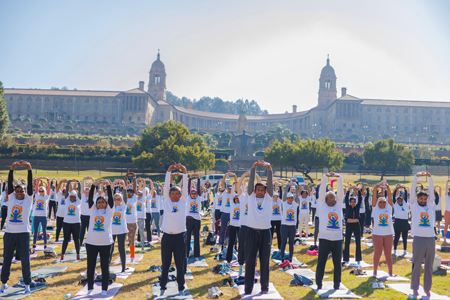
On the sprawling lawns of the Union Buildings in Pretoria, under the clear winter skies of the Highveld, the annual International Day of Yoga unfolded with grace and symbolism. Hosted by the High Commission of India, this year’s celebration echoed beyond the postures and breathing exercises, it resonated with a deeper message of balance, unity, and reconnection in a world increasingly pulled apart by digital dissonance.
International Yoga Day, marked every year on June 21st, synchronises with the Summer Solstice in the Northern Hemisphere and the Winter Solstice in the Southern Hemisphere, and a celestial moment revered in many ancient cultures for its spiritual potency. Its relevance to the inaugural United Nations International Day for Dialogue Among Civilisations, on June 10th reinforces the idea that understanding, peace, and introspection are more relevant than ever in our fast-paced, divided world.
Yoga, derived from the Sanskrit root “yuj”, means “to join” or “to unite.” It is an ancient Indian practice dating back thousands of years, originating not just as a physical discipline but as a profound spiritual philosophy. Designed to align the body, mind, and spirit, yoga was first codified by the sage Patanjali in the Yoga Sutras, laying down an eightfold path of self-mastery and enlightenment.
More than a form of exercise, yoga was, and remains, a holistic approach to life. From the bustling cities of ancient India to the quiet Himalayan ashrams, practitioners viewed yoga as a journey inward, a tool to overcome the noise of the material world and access inner stillness.
Today, that noise has grown louder. In an age defined by high-speed connectivity, social media saturation, and an overwhelming flood of information, society is showing signs of deep psychological fatigue. Mental health issues, digital addiction, and stress-related disorders have become widespread. We are constantly “connected” but increasingly disconnected - from ourselves, our communities, and the natural rhythms of life.
It is within this context that yoga has surged in popularity across the globe. No longer confined to studios or monasteries, yoga is now practiced in city parks, corporate boardrooms, schools, and even correctional facilities. The very act of pausing to breathe, to stretch, and to centre oneself offers a radical antidote to the breakneck speed of modern existence.
In South Africa, June is celebrated as Youth Month, commemorating the courage of the youth of 1976 while inspiring a new generation to pursue wellness, education, and transformation. The Indian High Commission in Pretoria and the Consul Generals in Johannesburg, Cape Town and Durban traversed the country to introduce and inspire South Africans with yoga. From Kirstenbosch Gardens to Maropeng, from the Drakensberg to Potchefstroom, the sessions truly transcended age, backgrounds and ability, reinforcing that yoga is for everyone.
The event at the Union Buildings was a vibrant celebration of this potential. Youth, elders, diplomats, and community members came together in unity, not just in stretching their limbs, but in stretching their understanding of one another. It became a living example of the dialogue among civilisations: an ancient Indian tradition flourishing on African soil, promoting peace, wellness, and mutual respect.
In essence, yoga is dialogue — a dialogue within oneself and with the world. It teaches us to listen: to our breath, to our thoughts, to the silent spaces between. In doing so, it fosters the very qualities the world so desperately needs — patience, empathy, awareness, and compassion.
As global tensions rise and societies become more fragmented, initiatives like the International Day of Yoga and the Day for Dialogue Among Civilisations remind us that our shared humanity transcends borders, ideologies, and technologies. They call us back to the essentials — to breathe, to move, to be present, and to engage deeply with one another.
In the words of Indian Prime Minister Narendra Modi, “Yoga is not just about exercise. It is a way to discover the sense of oneness with yourself, the world and nature.”
In a world yearning for calm, yoga may very well be the bridge — ancient in roots, modern in relevance, and eternal in its wisdom.