


Safety, a Questionnaire, and a White Paper on the RMB
By Kirtan Bhana – TDS
14 July 2025
“We are full of confidence in South Africa's future development and in the bright prospects of China–South Africa cooperation. At the same time, to promote healthier, more stable, and more sustainable development of our bilateral economic and trade relationship, we must also acknowledge the challenges we currently face,” said Ambassador WU Peng of the People’s Republic of China to South Africa.
Speaking at an event jointly hosted by the Bank of China (Johannesburg branch) and the Inclusive Society Institute (ISI), Ambassador Wu expressed deep concern regarding the surge in violent crime, particularly kidnappings, targeting Chinese nationals in South Africa. Since the beginning of the year, 12 such cases have been reported to the Chinese Embassy. In one instance, a woman was held hostage for 40 days while pleas for her release were ignored. “Some are even forced to abandon their businesses and return to China,” he added. “This situation not only gravely violates the personal safety and property rights of our citizens, but it also undermines the confidence of Chinese enterprises and personnel in South Africa.”
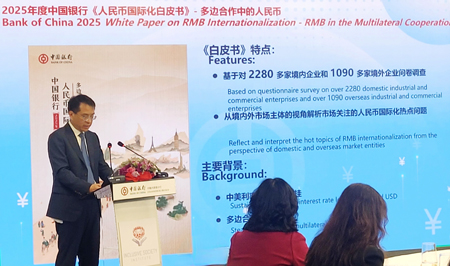
The event also saw Zhang Chaoyang, Chairperson of the South African Chinese Economic and Trade Association (SACETA) and CEO of the Bank of China in Johannesburg, welcome guests and present a white paper on the internationalisation of the renminbi (RMB), China's official currency. He outlined how the volatility and unpredictability of the current global financial system have exposed deep structural weaknesses in the international monetary framework. These uncertainties, he noted, have created an opening for the RMB to take on a more prominent role in cross-border trade and investment.
Last year, the RMB facilitated an impressive ¥1.3 quadrillion in cross-border clearing—reflecting a near 50% year-on-year increase. This signals growing global confidence in the currency as a viable alternative for international transactions and settlement, particularly among emerging economies seeking greater financial sovereignty and diversification from traditional reserve currencies.
To better understand investor sentiment, particularly among Chinese businesses operating in South Africa, the Inclusive Society Institute launched a comprehensive questionnaire. Presented by ISI CEO Darryl Swanepoel, the survey aims to assess the level of satisfaction with investment decisions made in South Africa, expectations versus actual outcomes, and how investor perceptions have evolved over time. The 38-question survey seeks to identify obstacles and systemic inefficiencies—such as the complexities of Broad-Based Black Economic Empowerment (B-BBEE) compliance, localisation policies, and the protracted and often frustrating work visa process. These factors continue to stifle the transfer of knowledge and critical skills, which are essential for innovation and employment creation.
China's rapid transition to high-quality development has, in many respects, caught other countries—South Africa included—unprepared for the magnitude and scale of the "China phenomenon." The survey results are expected to spark important dialogue around the practical reforms needed to unlock the full potential of this strategic partnership.
The renminbi’s growing international role, if managed pragmatically and equitably, holds great promise. Beyond its monetary function, it represents a stabilising force in an increasingly fragmented global order. It offers a pathway to modest prosperity, basic human dignity, and a buffer against the evils of crime, inequality, and conflict. In a world rife with volatility and unrest, the RMB stands as a symbol of constructive economic diplomacy and a potential shield against egregious criminality and senseless wars.