


'Cuba never took an ounce of gold from Africa’
by Kirtan Bhana - TDS
17 December 2025
On 1 January, Cuba marks its National Day, 67 years since the triumph of the Cuban Revolution in 1959. Few revolutions of the 20th century have so profoundly reshaped a nation’s destiny while simultaneously imprinting themselves on global struggles for justice, sovereignty and human dignity. Sixty-seven years on, Cuba’s story is of defiance, solidarity and an unbroken commitment to principles that continue to resonate deeply with South Africa and much of the Global South.
Cuba’s revolution was born in a world defined by colonial hierarchies, Cold War rivalries and stark inequalities. From the outset, it challenged the prevailing global order by asserting that sovereignty, social justice, and human development were not privileges reserved for wealthy or powerful nations. Despite relentless external pressure, most notably decades of economic blockade and attempts at regime change by the United States, Cuba chose a path centred on people rather than profit, on dignity rather than dependency.
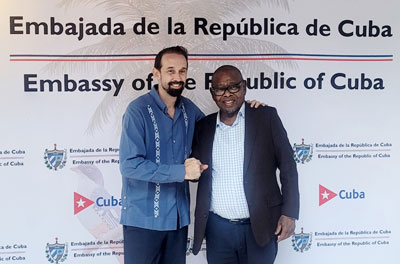
It is this choice that explains why Cuba’s revolution cannot be assessed solely through the lens of geopolitics or ideology. As Cuban Ambassador-designate to South Africa, Fakri Rodríguez Pinelo, stated in his address in Pretoria, the revolution “turned dreams into realities, challenges into victories,” placing the human being at centre stage. For a small country under siege, Cuba’s achievements remain extraordinary: universal, high-quality healthcare; one of the highest doctor-to-population ratios in the world; life expectancy nearing 80 years; infant mortality rates comparable to the richest nations; and free, universal education from kindergarten to university. These are not abstract statistics, they are lived outcomes of a political project rooted in social justice.
Yet Cuba’s revolution was never inward-looking. From its earliest days, it embraced an internationalist vocation that set it apart from many post-colonial states. Nowhere is this more evident than in Africa. As South African Minister of Science and Technology and SACP Chairperson Dr Bonginkosi “Blade” Nzimande so powerfully reminded guests at the 67th anniversary celebrations, “Cuba never took one ounce of gold from Africa.” Instead, it gave blood, expertise and unwavering solidarity.
Cuban soldiers fought alongside African liberation movements, most famously in Angola, where their decisive role against apartheid forces altered the balance of power in Southern Africa and hastened Namibia’s independence and South Africa’s own liberation. Cuban doctors, teachers, engineers and trainers followed not for profit, but out of principle. This legacy explains why Cuba occupies a unique moral position on the African continent: it is remembered not as an extractor, but as a partner in struggle.
The relationship between Cuba and South Africa is therefore not transactional; it is historical, ethical and deeply human. Forged in the crucible of anti-colonial and anti-apartheid struggles, it was cemented by the shared vision of Fidel Castro and Nelson Mandela, two leaders who understood freedom not as a national possession, but as a universal obligation. Mandela’s words still echo: “The Cuban people hold a special place in the hearts of the peoples of Africa.”
Ambassador Rodríguez Pinelo’s speech highlighted how this relationship continues to evolve in the present geopolitical moment. At a time when the world is again marked by unilateralism, sanctions, proxy conflicts and the marginalisation of smaller states, Cuba and South Africa find common cause in defending multilateralism, sovereignty and the right of nations to choose their own development paths. The regular high-level political dialogue, the Joint Consultative Mechanism, growing economic cooperation, and exchanges in science, health, culture and education all indicate a partnership that is alive, dynamic, and forward looking.
Minister Nzimande’s in-depth tribute was therefore historically and politically necessary. In an era where historical amnesia is actively cultivated, such tributes reaffirm uncomfortable truths: that liberation was not gifted by global powers, that solidarity can exist without exploitation, and that principled internationalism is not naïve, but transformative. As both a cabinet minister and leader of the SACP, Nzimande’s words also situated the Cuba–South Africa relationship within a broader ideological commitment to justice, freedom and solidarity values increasingly under strain in a world driven by narrow self-interest.
Cuba’s resilience today, as Ambassador Rodríguez Pinelo emphasised, is not accidental. It is the product of a people who have endured hardship without surrendering their core values. In the face of renewed economic pressures and global uncertainty, Cuba continues to assert that another way of organising society and international relations is possible.
At 67, the Cuban Revolution stands not as a relic of history, but as a living reminder that dignity can be defended, sovereignty can be preserved and solidarity can cross oceans without demanding tribute. For South Africa, honouring Cuba is not about nostalgia; it is about recognising a shared past, confronting a challenging present and reaffirming a common commitment to a more just and humane world.