


People at the Centre of China and Africa, 2026
Kirtan Bhana - TDS
20 January 2026
Pretoria | Addis Ababa | Africa–China
The phenomenal and unprecedented development of the People’s Republic of China has, at its core, a simple yet profound principle, the people. Guided by the collective mandate of the Communist Party of China (CPC), China’s modernization journey has consistently placed people’s wellbeing, aspirations, and collective consensus at the centre of governance and development.
As Africa advances its own integration and transformation agenda, the continent is increasingly recognising a parallel truth, that its greatest asset lies in its people, its youthful dynamism and the untapped value of its ancient civilizations.
It is against this philosophical and developmental convergence that the Year of China–Africa People-to-People Exchanges was formally launched, marking a new and deeper phase in China–Africa relations, one that foregrounds human connection as the foundation of sustainable partnership.
A Milestone Launch in Pretoria
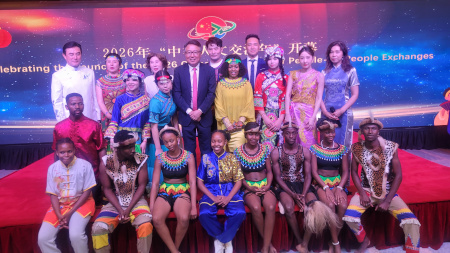
The Embassy of the People’s Republic of China in Pretoria hosted a launch celebration event to mark the commencement of the People-to-People Exchange Mechanism. The event reflected the close bonds and deep partnerships that have evolved over decades, while also acknowledging the momentum of Africa’s continental integration and China’s continued opening-up to the world.
Hospitality, trade and travel were highlighted as central pillars of the Year of Exchanges. These sectors are not merely economic activities; they are conduits of first contact, cultural understanding and trust-building between societies. As Africa’s connectivity improves and China continues to expand access to its vast market, people-to-people exchanges emerge as both a soft-power bridge and a tangible driver of shared prosperity.
Trade Facilitation and Shared Growth
Ambassador Wu Peng reaffirmed China’s commitment to expanding the tariff-free regime for African goods entering the Chinese market for countries maintaining diplomatic relations with the PRC. He noted that discussions with South Africa’s Department of Trade, Industry and Competition (DTIC) were at an advanced stage, with a comprehensive framework expected to be finalized shortly.
This initiative represents a practical expression of China’s support for Africa’s industrialisation, value addition and export diversification. By lowering barriers and encouraging African participation in global value chains, the tariff-free regime complements the people-to-people framework by ensuring that human exchange is matched by inclusive economic opportunity.
China’s New Year Diplomacy and Continental Engagement
Continuing a tradition spanning 36 years, China’s New Year diplomacy once again began in Africa. In January, Foreign Minister Wang Yi visited Tanzania, Lesotho and Ethiopia, highliting Africa’s centrality in China’s foreign policy.
On 8 January, Foreign Minister Wang Yi attended the continental launch of the People-to-People Exchanges at the African Union headquarters in Addis Ababa, coinciding with the Ninth China–AU Strategic Dialogue. There, he met with AU Chairperson Mahmoud Ali Youssouf, reaffirming China’s commitment to multilateral engagement with Africa as a unified and strategic partner.
The AU platform provided a fitting continental stage, reinforcing the alignment between China–Africa cooperation frameworks and Africa’s own Agenda 2063 vision of integration, people-driven development and cultural renaissance.
Hospitality, Tourism and First Encounters Between Peoples
In Pretoria, Victor Vele, Director-General of South Africa’s Department of Tourism, delivered incisive remarks on the catalytic role of hospitality, travel and tourism. He emphasized that these sectors create interconnected value chains that generate employment, stimulate local economies and often serve as the first encounter between peoples.
Artists, athletes, business leaders, students and ordinary families alike require a bouquet of services—transport, accommodation, cultural experiences and leisure activities. Importantly, such interactions frequently transcend leisure, opening pathways to business partnerships, investment opportunities and long-term trade relations. Tourism, in this sense, becomes both an economic driver and a platform for mutual discovery.
Inclusive Exchanges: Women, Youth, and the Most Vulnerable
A defining strength of the People-to-People Exchange Mechanism is its inclusive ethos. Delivering her message, Deputy Minister Mmapaseka Steve Letsike, from the South African Presidency responsible for Women, Youth and Persons with Disabilities, highlighted the importance of upliftment, acknowledgment and recognition of women’s capabilities and leadership.
She highlighted the necessity of robust youth engagement, noting that Africa’s demographic dividend and China’s innovation-driven development offer fertile ground for intergenerational learning, skills transfer and shared creativity. Equally significant was her emphasis on the inclusion of vulnerable groups, persons with disabilities, those living with health challenges, the elderly and the infirm whose participation adds moral depth and social value to people-to-people exchanges.
Deputy Minister Letsike reflected on the 70 years of China–Africa relations, describing them as a comprehensive partnership rooted in solidarity, mutual respect and enduring bonds between peoples rather than governments alone.
The People-Centred Mandate
President Xi Jinping’s leadership and the enduring mandate of the Communist Party of China have consistently emphasized a people-centred development philosophy. Since its inception, the CPC has prioritized collective consensus, health and wellbeing, education, inspiration and social cohesion recognising that development must encompass not only material progress, but also joy, dignity, and hope.
This holistic approach, balancing economic growth with cultural confidence and human fulfilment resonates deeply with Africa’s own rediscovery of its civilizational heritage. As the cradle of humankind, Africa is endowed with extraordinary diversity, indigenous knowledge systems and ancient civilizations whose wisdom remains relevant to contemporary development challenges.
A Shared Human Future
As Chinese and African people look toward 2026 and beyond, the People-to-People Exchange Mechanism stands as a cornerstone of a maturing partnership. It signals a shift from transactional cooperation to transformational engagement where diplomacy is lived through everyday interactions, shared experiences and collective aspirations.
In placing people at the centre, China and Africa reaffirm a shared belief: that sustainable development, genuine integration and a common future for humanity are built through trust, understanding and the enduring bonds between peoples.