


The ART of the Deal: Ecuador, America and the Shifting Geometry of Power
By Kirtan Bhana – TDS
17 March 2026
The enduring enigma of Donald Trump lies not merely in his personality or political contradictions, but in what his repeated electoral success reveals about the United States itself. Beneath the spectacle is a deeper structural shift, a recalibration of American power in a world no longer unipolar, where economic nationalism, strategic trade and geopolitical rivalry converge.
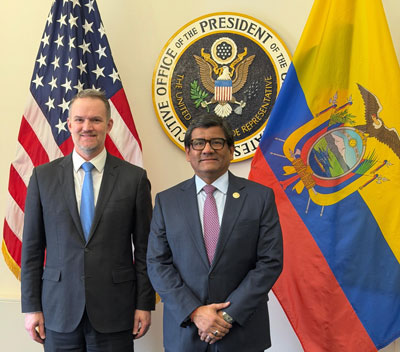
The signing of the Agreement on Reciprocal Trade (ART) between the United States and Ecuador on March 13, 2026, must be understood within this wider transformation. Far from a routine bilateral arrangement, the ART reflects a reassertion of American hemispheric influence, an updated expression of a long historical arc that has shaped relations across Latin America and the Caribbean.
A Familiar Pattern, Recast
From the Monroe Doctrine to Cold War interventions, the United States has long regarded Latin America as within its strategic orbit. Trade agreements have increasingly replaced overt political intervention as the preferred instrument of influence. In this context, the ART represents a 21st-century mechanism of alignment, less coercive in form, but no less consequential in substance.
Ecuador’s position is particularly telling. For decades, it has navigated between competing poles of influence: Washington, Beijing and regional blocs. The ART signals a deliberate pivot, one that seeks to rebalance Ecuador’s external economic relations toward the United States at a time of global uncertainty.
The Economics of Alignment
At face value, the agreement is commercially compelling. The United States is Ecuador’s second-largest destination for non-oil exports, accounting for 22% of total exports in 2025. With 53% of these exports, valued at $2.786 billion, gaining tariff-free access, key sectors such as bananas, cocoa, and flowers stand to benefit significantly.
Yet the deeper story lies in structural convergence. The ART goes beyond tariffs to reshape Ecuador’s regulatory, digital, and economic architecture:
• Acceptance of U.S. standards in pharmaceuticals, vehicles and medical devices
• Strengthened intellectual property enforcement
• Alignment with U.S. digital trade norms
• Labour and environmental commitments reflecting global governance frameworks
This is not merely trade liberalisation, it is economic harmonisation. Ecuador is being integrated into an American-led economic ecosystem, one that prioritises supply chain security, regulatory compatibility and geopolitical alignment.
The Regional Equation
For Latin America, the implications are profound. Countries such as Colombia and Peru have long benefited from preferential access to U.S. markets through agreements like CAFTA-DR and bilateral FTAs. Ecuador’s entry into this framework reduces its competitive disadvantage, but also intensifies regional competition.
More importantly, the ART may signal a broader reconfiguration of hemispheric trade blocs. As political cycles shift across the region, with left-leaning and right-leaning governments alternating in power, economic agreements such as this provide continuity amidst political volatility. They anchor countries into long-term strategic alignments that outlast electoral mandates.
Trump’s Trade Doctrine
Under Donald Trump, trade has become an instrument of national security. The ART reflects this doctrine clearly:
• It strengthens supply chain resilience
• Counters “non-market policies” (a veiled reference to competitors like China)
• Expands U.S. export markets while reducing trade deficits
This is not free trade in the classical sense. It is strategic trade, designed to consolidate influence while mitigating external dependencies.
The Shadow of Global Conflict
No analysis of current geopolitics is complete without reference to the ongoing crisis in the Middle East. Widely criticised in international legal circles, aspects of the conflict have been described as violations of international law, exposing fractures in the so-called “rules-based order.”
For Latin America, this has two implications:
1. Skepticism toward Western norms: Many countries in the region increasingly question the consistency of U.S. foreign policy, particularly when legal principles appear selectively applied.
2. Strategic hedging: Nations seek diversified partnerships - balancing relations with the U.S., China and other emerging powers.
In this light, Ecuador’s ART agreement represents a calculated choice rather than an inevitable alignment.
Judicial Pushback and Economic Sovereignty
Complicating the picture further is the growing role of U.S. domestic institutions. American courts have recently pushed back against certain tariff regimes, reflecting internal tensions between protectionism and legal constraints.
This judicial oversight introduces an element of unpredictability into U.S. trade policy. For partners like Ecuador, it highlights a critical reality: agreements with the United States are not shaped solely by the executive branch, but by a complex interplay of political, legal and economic forces.
Beyond the Deal
Ultimately, the ART is both an opportunity and a test.
For Ecuador, it offers:
• Enhanced market access
• Increased foreign investment potential
• A pathway toward a full Free Trade Agreement
For the United States, it represents:
• A reassertion of regional leadership
• A strategic counterweight to global competitors
• A consolidation of economic influence in its near abroad
But for Latin America as a whole, it raises enduring questions about sovereignty, dependency and the nature of development in a fragmented global order.
The Art Beneath the Agreement
The “art” in this deal is not merely transactional, it is geopolitical. It reflects a United States adapting to a multipolar world, leveraging trade as a tool of influence, and redefining its relationships in a region that has long been central to its strategic imagination.
As history has shown, agreements such as these are never just about economics. They are about power - how it is exercised, how it is resisted, and how it evolves.
In that sense, the ART between Ecuador and the United States is less a conclusion than a beginning: a signal of the new contests, and collaborations, that will define the Americas in the decades to come.