


Pakistan Emerges as a Mediator in the US–Israel–Iran Conflict
By Kirtan Bhana and Anisha Pemjee
6 April 2026
The launch of the Sino–South Africa Press Club in Pretoria on April 2 could not have been more timely. It opened with a decisive diplomatic note as China’s Ambassador to South Africa, Wu Peng, unveiled the China–Pakistan Five-Point Initiative for Peace. For the journalists, media practitioners and communicators in attendance, the moment served as both a briefing and a reckoning, set against the backdrop of a volatile conflict involving Israel, Iran and the United States that has simmered, flared and reshaped global tensions for decades. In this charged environment, the initiative introduced a policy framework and it signalled the emergence of alternative diplomatic leadership at a time when traditional mechanisms appear increasingly strained.
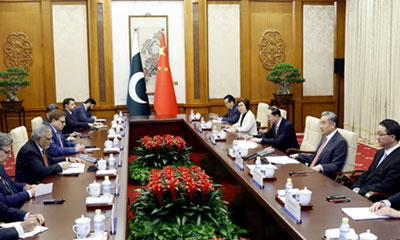
The joint “Five-Point Initiative” advanced by China’s Foreign Minister Wang Yi and Pakistan’s Deputy Prime Minister and Foreign Minister Ishaq Dar is, on the surface, a measured diplomatic intervention, one that seeks to re-anchor a spiralling crisis within the frameworks of international law, multilateralism and restraint. Yet beneath its carefully calibrated language lies a stark recognition: the Gulf and broader Middle East are once again at the edge of systemic destabilisation, driven less by inevitability than by political miscalculation, ideological rigidity and fractured alliances.
A Region on the Brink
The escalation involving Israel, Iran and the complicity of the United States reflects a deeper structural crisis in global governance. The Five-Point Initiative’s emphasis on an “immediate cessation of hostilities” and adherence to United Nations principles is an implicit indictment of a world order increasingly unable to restrain unilateral military adventurism.
The attack on Iran is unprovoked and illegal and exposes a dangerous precedent, the erosion of sovereignty norms that have underpinned international relations since the end of World War II. The normalisation of pre-emptive or ideologically justified strikes risks transforming the region into a perpetual theatre of conflict, where deterrence gives way to escalation.
Pakistan’s Unlikely Emergence
In this volatile context, Pakistan emerges as a power broker, uniquely positioned as an intermediary. Its geographic proximity to Iran, deep ties with Gulf monarchies, and longstanding - if complex - relationship with the United States grant it a rare multi-vector diplomatic reach. Coupled with its strategic alignment with China, particularly under the rubric of the Belt and Road Initiative, Pakistan occupies a liminal space between competing geopolitical blocs.
Yet this positioning is double-edged. Pakistan’s credibility as a mediator depends on its ability to transcend perceptions of alignment, especially given its historical security cooperation with Washington and economic reliance on Beijing. The Five-Point Initiative suggests an attempt to craft a new diplomatic identity, one rooted in facilitation rather than factionalism.
Beyond its external diplomatic significance, this moment presents Pakistan with a rare and strategic opportunity to recalibrate its internal trajectory. By stepping into the role of mediator, Pakistan is not only enhancing its global stature but also creating space to reinforce domestic stability across socio-economic and political dimensions. Credible international engagement can translate into renewed investor confidence, stronger regional trade linkages and the acceleration of infrastructure and development initiatives tied to broader frameworks. Politically, it offers Islamabad an avenue to project coherence and maturity on the world stage, potentially strengthening institutional legitimacy at home. If leveraged effectively, this diplomatic positioning could act as a catalyst, shifting Pakistan from reactive state navigating crises to a proactive actor driving development, fostering social cohesion and embedding itself more firmly within the architecture of global governance.
The Fracturing of the Arab Consensus
Equally significant is the shifting posture of Arab Gulf states. Once unified—at least rhetorically around the Palestinian cause and regional non-intervention, many have recalibrated their strategic priorities. The normalisation agreements with Israel, security cooperation frameworks, and economic diversification strategies reflect a pragmatic, if controversial, departure from ideological solidarity.
This current misalignment has profound consequences. By fragmenting the Arab position, it reduces the capacity for collective de-escalation and creates openings for external powers to shape outcomes. Moreover, it risks legitimising a security architecture that prioritises regime stability over regional justice, thereby deepening long-term grievances.
Israel’s Strategic Calculus and Its Consequences
For Israel, the current trajectory carries profound and potentially self-defeating consequences. Policies rooted in military pre-emption, territorial assertion, and an increasingly rigid interpretation of security risk entrenching a cycle of perpetual confrontation rather than resolving it. What is often framed as necessity begins to blur into strategic overreach, eroding international legitimacy and deepening regional isolation. The more hardline expressions of Zionist policy—particularly those that prioritise dominance over coexistence—reveal a critical flaw, the assumption that long-term security can be achieved through sustained coercion rather than mutual recognition.
Equally troubling is the emergence of reactionary narratives suggesting that Israel’s own existential insecurity justifies a broader destabilisation of the region, as though the fragility of one state negates the sovereignty of others. This notion is not only logically unsound, but dangerously escalatory. No durable regional order can be built on the premise that insecurity must be shared or multiplied. Stability, by contrast, requires a reorientation away from zero-sum doctrines and toward a framework where the security of one state is not predicated on the insecurity of another.
A Race to the Bottom?
The Five-Point Initiative’s call for dialogue, protection of civilian infrastructure and security of shipping lanes, particularly through the Strait of Hormuz, highlights the global stakes. Disruption in this corridor alone could trigger economic shocks far beyond the region, exposing the interconnected nature of modern conflict.
Yet the question remains: are these proposals sufficient to halt what increasingly appears to be a race to the bottom?
For diplomacy to succeed, it must be matched by political will. This requires:
• A recalibration of U.S. policy away from implicit endorsement of unilateral actions
• A reassertion of Arab collective agency beyond narrow national interests
• A willingness by Israel to reassess its strategic doctrine in favour of long-term coexistence
• And critically, an acceptance by all parties that security cannot be achieved through perpetual confrontation
Between Futility and Possibility
The China–Pakistan initiative is not a solution in itself, it is a framework, a starting point. Its significance lies less in its prescriptions than in its symbolism, a reminder that alternative diplomatic voices are emerging in a world no longer dominated by a single hegemonic narrative.
Whether this moment leads to de-escalation or deeper conflict will depend on choices made in the coming weeks. The danger is that entrenched positions and ideological certainties will override rational calculation, pushing the region toward irreversible fragmentation.
There remains a narrow path however, one where multilateralism is not merely invoked but practiced, where mediation replaces militarisation, and where the lessons of history are heeded rather than ignored.
The alternative is not just continued conflict. It is the normalisation of chaos.