

President of New Development Bank Dilma Rousseff: NDB launches new strategy development with clear long-term vision
Financing in national currencies to remain a strategic priority
TV BRICS
18 May 2026
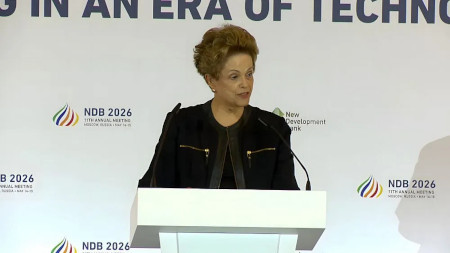
The New Development Bank (NDB) has begun work on a new strategy designed to maintain a clear policy direction over the next five years. This was stated by NDB President Dilma Rousseff at the opening ceremony of the 11th Annual Meeting of the Board of Governors, held in Moscow.
"The Bank will be strengthening its role as a platform for cooperation among its members, supporting initiatives in digital infrastructure, energy transition, advanced low-carbon energy technologies, intelligent hospitals, and all sorts of innovation, amplifying the comparative advantages of our member countries. […] NDB will continue to pursue gradual, balanced membership expansion and strengthen its role as a unified voice and platform for the Global South, amplifying members' priorities and mobilising collective solutions to share developing challenges" Dilma Rousseff President of the New Development Bank
According to the President, the NDB must adapt its financing strategy by actively combining traditional instruments with emerging digital solutions. Alongside market-based debt tools such as trade finance, guarantees, bond issuance in national currencies, swaps and co-financing mechanisms, the Bank is expected to explore tokenisation. Converting assets into digital form, she noted, opens new opportunities by accelerating settlements and creating additional financing channels. In the future, such infrastructure could become part of an updated global financial system, offering countries greater flexibility and alternatives.
“Tokenisation has geopolitical significance since it reduces dependence on traditional financial instruments. Moreover, tokenised financial infrastructure may eventually become part of a broader geopolitical competition over reserve currency systems, payment networks, and global liquidity architecture. Today, this movement is part of a new reality at an early stage of deployment,” she said.
Rousseff emphasised that infrastructure in all its forms – transport, digital and social – remains the foundation of development, technological capacity and innovation. She also highlighted the energy transition, noting that small modular nuclear reactors deserve particular attention as a potential source of stable low-carbon energy supply.
“Technological progress does not deepen inequalities but instead becomes a driver of inclusion, productivity and sovereignty in this sense,” she added.
Her view was supported by NDB Governor for South Africa and Finance Minister Enoch Godongwana, who stressed the importance of ensuring that development financing remains accessible, affordable, and aligned with the needs of all member states.
"The role of the Bank becomes even more critical. There's a need to scale up financing for a resilient infrastructure, support for green transition, and harness the opportunities presented by technological innovation. At the same time, we must ensure that development finance remains accessible, affordable, and aligned with the needs of all members. In this regard, strengthening local currency financing, embracing innovative finance instruments, and expanding membership in a manner that preserves the Bank's mandate are critical" Enoch Godongwana NDB Governor for South Africa, Minister of Finance of South Africa
Anuradha Thakur, Alternate Governor for India and Secretary at the Department of Economic Affairs at the Ministry of Finance, highlighted the importance of treating key growth factors as global public goods, in line with India’s BRICS Chairmanship agenda this year. She noted that, alongside new financing approaches, partnerships will play a decisive role in the Bank’s strategic evolution and invited participants to the upcoming BRICS finance meetings in India in August.

The importance of partnerships was also underlined by Chang Junhong, Temporary Alternate Governor for China and Assistant Minister of Finance.
"The NDB should uphold the BRICS spirit of openness, inclusiveness, and win-win cooperation and strive to become a strong and most reliable development partner for BRICS countries and the Global South on their path to modernisation. […] China also looks forward to greater strategic alignment between the NDP and other global initiatives such as the Belt and Road initiative and global development initiative, contributing to the realisation of the UN 2030 agenda for sustainable development and having more countries of the global south achieve modernisation in the coming decades" Chang Junhong Temporary Alternate Governor for China and Assistant Minister of Finance
She added that the development of a new overarching strategy is of significant importance, noting that the Bank should continue improving its business model, expand membership, and strengthen its role in global economic governance.
In turn, Russian Prime Minister Mikhail Mishustin, addressing the participants of the meeting via video message, emphasised that over the past years the Bank has become one of the pillars of the emerging financial architecture of the Global South. The statement is published on the website of the Government of Russia.
"The NDB has everything it needs to become an international ‘innovation bank’ – helping countries define development pathways, select the best tools, and create conditions for long-term investment. Russia consistently supports the formation of a fair and sustainable financial system in which Global South countries gain greater opportunities. The New Development Bank has a special role in this" Mikhail Mishustin Chairman of the Government of the Russian Federation