
Mashatile secures investment commitments during India visit
3 June 2026
Deputy President Paul Mashatile says South Africa has secured commitments from Indian business leaders to expand investments in key sectors of the economy following the successful conclusion of the first leg of his working visit to India.
Addressing members of the media on Tuesday upon the conclusion of the first leg of his Working Visit, Deputy President Mashatile described the visit as highly productive and said it had strengthened the long-standing strategic partnership between South Africa and India while opening new opportunities for trade, investment and economic cooperation.
The Deputy President is leading a delegation of Ministers and Deputy Ministers on a working visit aimed at deepening bilateral relations and positioning South Africa as a preferred investment destination.
“We have come to the capital of India to build on the long-standing friendship and partnership between our two countries. Currently, India ranks among the top 10 investing countries in South Africa.
“The purpose of this visit has been to strengthen our trade and investment relations. As such, we engaged business associates, current investors in South Africa and India, and those who want to invest in our country,” Deputy President Mashatile said.
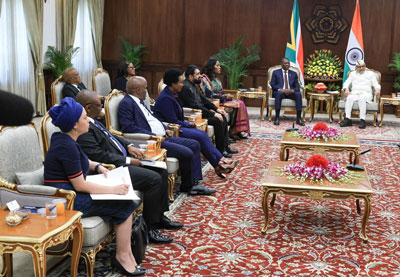
During the first leg of the visit, Deputy President Mashatile held high-level engagements with Indian leaders, including Vice President Chandrapuram Ponnusami Radhakrishnan and President Droupadi Murmu.
The discussions focused on strengthening cooperation in trade, investment, skills development, infrastructure and multilateral cooperation.
According to Deputy President Mashatile, the engagements reaffirmed the historic relationship between the two countries and highlighted opportunities for greater collaboration in trade diversification, investment promotion and skills development.

“Our meetings reaffirmed our historic common bond of cooperation and friendship between South Africa and India and the deep cooperation in the areas of trade diversification, investment promotion, skills development, and multilateral cooperation in such areas as BRICS, IBSA, the G20, and the United Nations,” the Deputy President said.
He said both countries were seeking to align their cooperation with Africa's Agenda 2063 and India's Viksit Bharat 2047 vision to advance inclusive growth and development across the Global South.
A key component of the visit was engagement with Indian business leaders and investors.
Deputy President Mashatile delivered a keynote address at the Global Trade and Technology Council of India (GTTCI) Business Round Table and met with representatives of the National Association of Software and Services Companies (NASSCOM), one of India's leading technology industry organisations.
“There was consensus on South Africa and India transitioning from dialogue to action, aiming to transform historic solidarity into a future-oriented partnership centered on innovation, industrialization, and shared prosperity,” he said.
The South African delegation also met with major Indian companies operating in sectors including energy, water, infrastructure, agriculture and information and communications technology.
These included Mahindra Group, Jindal Power, IGT Solution, Thermax and UFlex.
“Our discussions focused on expanding investment footprints in South Africa in sectors such as renewable energy, automotive manufacturing, mining, and infrastructure,” he said.
The parties also explored opportunities to strengthen cooperation in agricultural exports and agro-processing, mineral beneficiation and vaccine manufacturing.

Outcomes
Among the major outcomes of the visit was a commitment by Indian industry leaders to increase investments in South Africa, particularly in clean energy, pharmaceuticals, ICT and automotive components.
Deputy President Mashatile also welcomed progress on agricultural trade following India's notification of in-transit cold treatment for South African citrus exports.
The development is expected to create new opportunities for South African citrus producers seeking greater access to the Indian market.
The Deputy President said the visit had further strengthened cooperation between the two countries on reforming global institutions and advancing the interests of developing nations through multilateral platforms.
He noted that South Africa and India had also agreed to deepen people-to-people relations, recognising the strong cultural and historical ties between the two countries.
“This visit has laid a solid basis for greater cooperation and development of a better future for all. It has positioned South Africa as India's gateway into Africa under the African Continental Free Trade Area, while reinforcing our role as a reliable partner in advancing the development agenda of the Global South,” he said.
Second leg
The second leg of Deputy President Mashatile's visit will take him to Hyderabad, where he is expected to engage leaders in the pharmaceutical and information technology sectors.
The discussions will focus on expanding partnerships that support innovation, youth employment and economic growth.
“I committed myself to growing investment in South Africa and to building mutually beneficial relationships with India, rooted in shared prosperity. Our business in South Africa and India will be facilitated," the Deputy President said.
The Deputy President expressed optimism about the future of bilateral relations and indicated that further engagements would follow.
“As the second Deputy President of South Africa to visit India, I want to affirm that though this trip is my first visit, it is the beginning of many to come. I look forward to returning to India in the near future to further strengthen our relations, deepen our economic partnership, and advance sustainable development,” he said.
Deputy President Mashatile concluded by thanking the Government and people of India for their hospitality during the visit.
Deputy President calls for deeper SA-India cooperation
Deputy President Paul Mashatile has urged Indian business leaders and investors to work with South Africa to build industries that create jobs, advance technology and expand skills to meet the changing needs of the economy.
Addressing the South Africa-India Technology, Trade and Investment Roundtable, he underscored the importance of deeper cooperation in turning global challenges such as unilateralism, climate change and resource depletion into opportunities.
“Our collective task is therefore to transform these shared challenges into opportunities, to turn climate action into renewal, technology into empowerment, and global governance into a voice for all.
“This is the call of our time to face the limits of our planet with courage, to harness the power of innovation with wisdom, and to defend the dignity of nations with unity,” the Deputy President said on Saturday.
He said India’s globally competitive Micro, Small and Medium Enterprises (MSME) ecosystem and South Africa’s industrial and entrepreneurial base offer strong complementarities.
To leverage the strengths of both countries, Mashatile proposed the establishment of a South Africa-India Small, Medium and Micro Enterprise (SMME) Industrial Linkage Programme focused on supply-chain integration, co-production and joint market access.
"This partnership will prioritise sectors where our strengths are complementary, including agro-processing, mining beneficiation, renewable energy components, pharmaceuticals and digital services, and will move beyond trade facilitation towards true industrial cooperation.
“Critically, this collaboration must be digital by design. India’s experience in technology-enabled MSMEs, including AI and automation, offers valuable lessons as South Africa strengthens the competitiveness of its small business sector,” he said.
Mashatile also called for a shift from technology transfer to technology co-creation.
"Artificial intelligence will shape competitiveness across mining, logistics, retail and public administration. South Africa and India must be active architects of this transformation while deepening cooperation on AI ethics, governance and public trust," Mashatile said.
He urged businesses to invest in data centres, cloud infrastructure and fibre connectivity to strengthen Africa’s digital economy and enable scale under the African Continental Free Trade Area.
"India already has a strong investment footprint in South Africa. We now seek to deepen this through beneficiation-led and manufacturing-focused investment, particularly in critical minerals such as platinum group metals, manganese and vanadium, as well as pharmaceuticals and renewable energy technologies," the Deputy President said.
Mashatile said South Africa could learn from India’s technical training and industrial skills to expand capacity in software engineering, artificial intelligence, advanced manufacturing and green technologies.
"We will therefore pursue a South Africa-India Skills and Innovation Exchange, anchored in university partnerships, youth technology programmes and vocational training aligned with industry demand.
"At the same time, we see strong potential to connect our innovation hubs, from Cape Town and Johannesburg to Bengaluru and Hyderabad, creating an Africa-Asia Innovation Bridge that supports start-ups, co-investment and global scaling," he said.
The Deputy President said India-affiliated Global Capability Centres in South Africa present a significant opportunity by leveraging the country’s skilled talent base and continental reach.
"To focus our collective effort, we propose three flagship outcomes from this collaboration: first, the launch of the South Africa-India SMME Industrial Linkage Programme within the next year.
"Second, the establishment of at least two joint technology or pharmaceutical manufacturing projects serving African markets. Third, the rollout of a South Africa-India Youth Technology Skills Programme targeting AI, digital services and advanced manufacturing," Mashatile said.
He said these initiatives would provide tangible platforms for partnership, investment and job creation.
SAnews.gov.za