|
|
|
The fall of a legend: Joseph Shabalala of the Ladysmith Black Mambazo passes
|
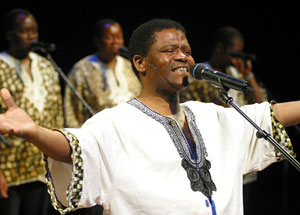 'By Stella Sigcau 'By Stella Sigcau
On 11 February 2020 South Africans woke up to the sad news of the passing of a musical legend Joseph Shabalala, this when South Africa was celebrating 30 years since the release of the late former President Nelson Mandela from prison.
Mandela’s release was a historic moment in the history of South Africa which marked, according to President Ramaphosa speaking at the 30th anniversary of the release of Mandela from Victor Verster prison, “the end of apartheid”. The legend Shabalala fell on this historic day. Shabalala had shared a special friendship and bond with the late President Mandela. When President Mandela received the Nobel Peace Prize in 1993, he was accompanied to Oslo by the group Ladysmith Black Mambazo, founded and led by Shabalala. President Mandela referred to the group as South Africa’s cultural ambassadors to the world. The group also performed at his presidential inauguration in 1994. 11 February will thus forever be important to South Africans as it is synonymous with the release of President Mandela and now the passing of Joseph Shabalala.

|
The palm oil paradox: What Asia can learn from Gabon
|
 A view of palm fruit in Sampoinet, Aceh Jaya, Indonesia, EPA-EFE/HOTLI SIMANJUNTAK A view of palm fruit in Sampoinet, Aceh Jaya, Indonesia, EPA-EFE/HOTLI SIMANJUNTAK
By Luveshni Odayar
Palm oil is universally viewed as one of the most destructive monocultures globally, contributing to massive deforestation and wherever it is grown, exacerbating the climate crisis. But the biodiversity-rich African nation of Gabon is developing an innovative approach to offsetting its destructive environmental effects.
Accounting for roughly one-third of the world’s annual vegetable oil production, palm oil — cultivated in the Asian, African and Latin American tropics — constitutes the most widely consumed, traded and high-yielding vegetable oil commodity in the world. The controversial cash crop, native to West Africa, is cheap to produce, generates five to eight times more oil per hectare than other oil crops such as soybean, sunflower and rapeseed, and is ubiquitous, found in everything from processed foods, cosmetics, biofuels and candles, to soaps and detergents.
To put its pervasiveness into perspective — about 50% of products stocked in supermarkets contain palm oil. In response to its multifarious uses and growing market demand, the global extent of palm cultivation has increased exponentially, with 75% of production traded internationally. The global palm oil industry, valued at $65.73-billion in 2015, has been projected to reach a staggering $92.84-billion by 2021.
Such predictions alone are enough to strike despondency, or catalyse anti-dystopian demonstrations, among those more environmentally inclined. The unrelenting rise in the demand for palm oil drives ongoing deforestation at a devastating scale, resulting in the widespread loss of biodiversity and natural habitats — threatening extinction of countless species of flora and fauna that cannot exist within palm monocultures, and a reduction in ecosystem services — for example, the rapid degradation of the dwindling carbon sinks provided by tropical rainforests results in the emission of trapped carbon into the atmosphere, exacerbating the current climate crisis calamity.

|
President Cyril Ramaphosa assumes AU chairship
|
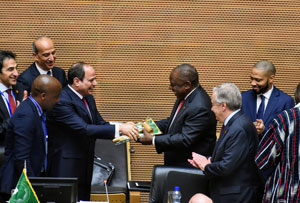 “Let us build the Africa we want. Let the guns be silenced. Let our swords be beaten to ploughshares, and our spears turned into pruning hooks. It is the actions we take from this day onwards that will determine our continent’s destiny,” said President Cyril Ramaphosa. “Let us build the Africa we want. Let the guns be silenced. Let our swords be beaten to ploughshares, and our spears turned into pruning hooks. It is the actions we take from this day onwards that will determine our continent’s destiny,” said President Cyril Ramaphosa.
Photo: President Abdel Fattah el-Sisi of the Arab Republic of Egypt hands over the chairship of the AU to President Ramaphosa of South Africa (Katlholo Maifadi/DIRCO)
With these words, the President highlighted South Africa’s focus for the African Union (AU) chairship, which he assumed during the first day of the 33rd Ordinary Session of the Assembly of Heads of State and Government in Addis Ababa, Ethiopia.
Read more
|
AfDB committed to Zimbabwe realising its full potential
|
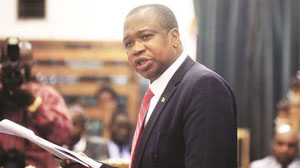 The African Development Bank (AfDB) pledged support for Zimbabwe when a team of its executive directors paid a courtesy call on President Mnangagwa at his Munhumutapa Offices. Finance and Economic Development Minister, Professor Mthuli Ncube, said the AfDB was happy with Zimbabwe’s economic reforms. Photo: Professor Mthuli Ncube, Minister of Finance and Economic Development of Zimbabwe “The AfDB continues to support us in various social production projects. As you know, they supported us when we requested resources around Cyclone Idai. In fact, they visited Chimanimani and just returned this afternoon. “We also requested support in clearing our arrears and when they give us support, we will eventually clear those arrears and eventually that will open up lines of credit. “In terms of opening lines of credit for the private sector, they are open for business. “And it is up to our private sector, working with us as Government to access private sector funding on a purely commercial basis. So that is open for us,” he said. AfDB head of delegation Mr Mbuyamu Matungulu, said the bank was committed to assisting Zimbabwe realise its full potential. “We discussed what we think is a very good relationship between AfDB and Zimbabwe.
|
|
|
|
|
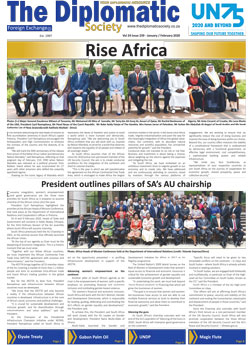
JANUARY/FEBRUARY 2020 Print Edition
|
|
|
|
|
|
|
|