


Freedom to Enterprise: South Africa at 32 — Progress, Paradox and the Path Forward
Kirtan Bhana - TDS
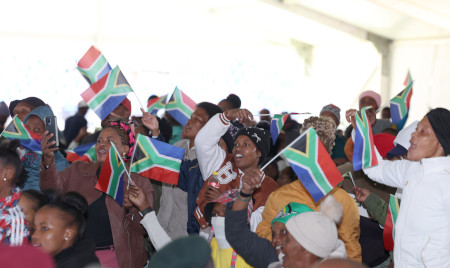
2026 Freedom Day Celebrations at the Dr Rantlai Molemela Stadium in Bloemfontein, Free State Province (photo GCIS)
27 April 2026
As South Africa marks 32 years of democracy this Freedom Day, the nation stands at a crossroads shaped by extraordinary progress and persistent contradiction. The story of these three decades is neither one of failure nor triumph alone, it is a complex narrative of resilience, reform and unfinished business. The end of apartheid ushered in one of the most admired constitutional democracies in the world. Political freedom was secured through sacrifice, negotiation and vision. Since 1994, millions have gained access to housing, education, healthcare and other basic services. A new Black middle class has emerged. Women have advanced into leadership across government, business and civil society. South Africans, once excluded from the global economy, now participate in international markets, diplomacy and innovation.
Yet political freedom has not fully translated into economic justice.
South Africa remains one of the most unequal societies globally. The structural legacy of apartheid, spatial inequality, concentrated wealth and unequal access to opportunity continues to define lived reality. Policies like Black Economic Empowerment (BEE) and Affirmative Action were designed to correct these imbalances. They have succeeded in creating a class of empowered professionals and business leaders, but they have also revealed limitations including the concentration of benefits, perceptions of elite capture and insufficient broad-based impact.
At the same time, unemployment especially among the youth remains alarmingly high. This cannot simply be explained by a “skills gap.” South Africa produces graduates, postgraduates and skilled professionals who struggle to find meaningful employment. The deeper issue lies in an economy that has not expanded inclusively or dynamically enough to absorb its own talent.
A widening gap between executive wealth and average earnings further entrenches inequality. Even those earning relatively stable incomes find themselves unable to build generational wealth. The burden of extended family support often referred to as “Black Tax” compounds this challenge, reflecting both cultural resilience and systemic failure.
Social tensions, including periodic outbreaks of anti-immigrant sentiment, reveal deeper frustrations. Ironically, while South African corporations expand successfully across the continent, contributing to growth in neighbouring economies, migrants within South Africa are often perceived as competitors rather than collaborators. This contradiction highlights a need for a more coherent economic and social vision, one that aligns domestic inclusion with continental leadership.
The global context is shifting rapidly. The world is moving away from unipolar dominance toward a more fragmented, multipolar order. Emerging economies are asserting greater influence, and new alliances are reshaping trade, finance and development models. In this environment, South Africa holds a strategic position.
Through regional and international platforms, the country has an opportunity to drive a new development agenda, one that prioritizes equity, sustainability and shared prosperity. But leadership abroad must be matched by coherence at home.
The greatest obstacle to South Africa’s transformation today is not a lack of policy, but a deficit of execution and political will. Too often, governance is consumed by factionalism, patronage and short-term power struggles rather than long-term nation-building. Bureaucratic inefficiencies, many inherited from colonial administrative systems, continue to stifle innovation, delay investment and frustrate entrepreneurs.
To move forward, South Africa must embrace a new economic paradigm, one that truly frees enterprise.
This means:
• Broadening ownership and participation beyond elite structures, enabling small businesses, cooperatives and informal enterprises to thrive.
• Streamlining bureaucracy to make it easier to start, operate and grow businesses.
• Investing in productive sectors such as manufacturing, agriculture, digital technology and green energy.
• Reimagining education and training to align with future industries while supporting entrepreneurship, not just employment.
• Encouraging fair but dynamic markets, where competition drives innovation but does not entrench inequality.
• Building social solidarity, where economic growth is linked to shared benefit rather than concentrated accumulation.
South Africa must also rethink its social contract. Redistribution alone cannot sustain prosperity; it must be coupled with production, innovation and inclusion. Economic justice must not come at the expense of growth, it must be the engine of it.
Freedom, after all, is not static. It is a living condition that must be deepened, defended and expanded.
At 32, South Africa has proven that political liberation is possible. The next chapter demands economic liberation rooted in dignity, driven by enterprise and sustained by unity.
The promise of Freedom Day will only be fulfilled when opportunity is not the privilege of a few, but the inheritance of all.