


Russia Day - Celebrating a Nation of History, Culture and Enduring Friendship
By Kirtan Bhana and Anisha Pemjee
15 June 2026
Russia Day, celebrated annually on June 12, is an occasion for reflection on the rich historical journey of a nation whose contributions to literature, philosophy, science, technology and global affairs have shaped the modern world.
The holiday commemorates the signing of the Declaration of State Sovereignty of the Russian Soviet Federative Socialist Republic (RSFSR) on June 12, 1990, a pivotal moment that laid the foundation for the modern Russian state. Two years later, in 1992, the RSFSR was officially renamed the Russian Federation, marking the beginning of a new chapter in the country's long and distinguished history. In 2002 the holiday formally became known as Russia Day.

Russia's story is one of remarkable achievement and resilience. It is the homeland of literary giants such as Leo Tolstoy, Fyodor Dostoevsky and Alexander Pushkin, whose works continue to influence global thought and culture. It is a nation that has produced pioneering scientists, engineers and innovators whose discoveries have expanded humanity's understanding of the world and beyond. From the achievements of the Soviet space programme to contemporary advances in science and technology, Russia remains an important contributor to human progress.
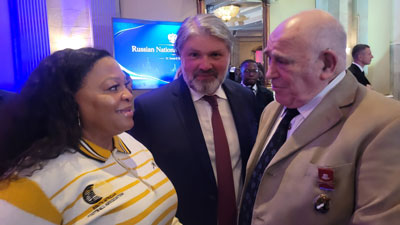
This spirit of achievement and national renewal was celebrated far from Moscow, in Pretoria, where the Embassy of the Russian Federation hosted a reception to commemorate Russia Day. Guests enjoyed traditional Russian hospitality, cuisine and, naturally, Russian vodka, alongside South African wines in a symbolic celebration of the friendship between the peoples of Russia and South Africa.

Russian Ambassador to South Africa, Roman Ambarov, together with South African Deputy Minister in the Presidency for Women, Youth and Persons with Disabilities, Mmapaseka Steve Letsike, reaffirmed the Comprehensive Strategic Partnership between Moscow and Pretoria. Their remarks emphasized ties rooted in mutual respect, shared aspirations and a long history of cooperation.
During the struggle against apartheid, the Soviet Union provided political, educational and material support to many liberation movements across Southern Africa, including the African National Congress. That solidarity remains an important chapter in the collective memory of both nations and continues to inform contemporary engagement.
Today, cooperation has expanded into trade, education, culture, science, multilateral diplomacy and development. South Africa and Russia work closely through platforms such as BRICS, where they advocate for a more inclusive and representative international order that reflects the growing importance of the Global South. Preparations are also underway for the Third Russia-Africa Summit, scheduled to take place in Moscow in October 2026, further strengthening a partnership that continues to evolve.
The occasion also provided an opportunity to reflect on broader African aspirations. Addressing guests, African National Congress First Deputy Secretary-General, Nomvula Mokonyane, invoked the vision of generations of African leaders who understood the importance of continental unity and collective advancement. Her remarks resonated particularly strongly as South Africa marks the 50th anniversary of the historic June 16, 1976 Soweto Youth Uprising.
The reflections highlighted a principle increasingly relevant in contemporary global affairs: that collective ownership, collective responsibility and collective leadership can unlock shared prosperity. In an era characterised by shifting centres of economic and political influence, the ideals of Pan-African cooperation and South-South solidarity are finding renewed relevance. These principles align closely with the growing engagement between Africa and Russia, founded on dialogue, mutual respect and the pursuit of common development goals.
Among the distinguished guests were ANC veterans Ronnie Kasrils and Amina Frense. Kasrils' acclaimed work, The Unlikely Secret Agent, recounting the remarkable story of Eleanor Kasrils, has been adapted into an award-winning stage production currently showing at the South African State Theatre, adding another dimension to South Africa's ongoing reflection on its liberation history.
The African Union Choir from Soweto performed the national anthems of both Russia and South Africa, symbolising the friendship between the two nations. Their repertoire also included the beloved Russian folk song "Oy, Moroz, Moroz" ("Oh Frost, Frost"), whose familiar melody bridged languages, cultures and continents.

As Russia Day is celebrated across the Russian Federation and by Russian communities around the world, it remains both a commemoration of national sovereignty and a celebration of a civilization that has made profound contributions to humanity. For South Africans, the occasion also serves as a reminder of a friendship forged through history and sustained through cooperation, mutual respect and a shared belief in a more equitable and multipolar world.
In a rapidly changing international landscape, Russia Day is an affirmation of its continuing role in shaping the future, alongside partners across Africa and the broader Global South.