

The World on the Move
Filling the Vacuum: From Regulation to Responsibility
by Kirtan Bhana and Anisha Pemjee – TDS
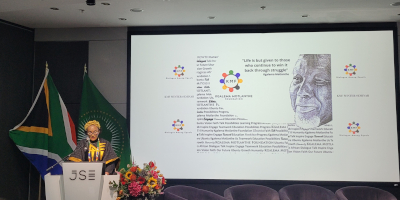
28 July 2026
"Political vacuums never remain empty. They are always filled."
— Gugu Motlanthe, Executive Trustee, Kgalema Motlanthe Foundation
There are conferences that report on the world as it is, and there are those rare gatherings that challenge us to imagine the world as it could become. The Kgalema Motlanthe Foundation's Winter Seminar belongs firmly in the latter category.
Convening leaders from government, diplomacy, business, academia and civil society, the Foundation once again demonstrated that its greatest contribution is not simply convening dialogue but elevating national discourse. At a time when public debate is increasingly polarised, the Foundation has created a trusted space where complex questions can be examined with intellectual honesty and historical perspective. It is a contribution worthy of recognition and one that South Africa, and indeed Africa, needs now more than ever.
The seminar's central theme was migration. Yet beneath every discussion lay a more profound question. Migration is not merely about the movement of people; it is about the movement of hope. People seldom leave behind family, culture and homeland simply because another destination appears attractive. They move because opportunity has become unevenly distributed, because aspiration has outgrown possibility, and because somewhere a vacuum has emerged between what life promises and what society delivers.
The timing of the seminar carried its own symbolism. Held just days after former President Kgalema Motlanthe celebrated his seventy-seventh birthday on 19 July, following Nelson Mandela International Day on 18 July, it served as a reminder that leadership is not measured solely by holding office. It is equally defined by the willingness to continue asking difficult questions that strengthen democratic institutions and inspire future generations.
Perhaps the most powerful metaphor of the seminar was unintended.
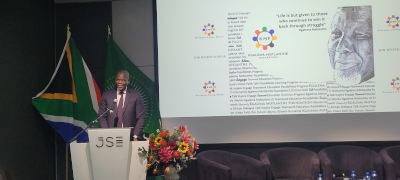
Inside the Johannesburg Stock Exchange, the engine room of African capital markets,participants reflected on inequality, exclusion and migration in one of the world's most unequal societies. The contrast was striking. It illustrated that prosperity cannot be measured only by market performance or national income. The true measure of development lies in whether opportunity reaches those standing furthest from its centre.
Throughout the seminar one word quietly emerged as the defining idea.
The vacuum.
Nature abhors a vacuum.
Politics abhors a vacuum.
Economies abhor a vacuum.
Societies abhor a vacuum.
When leadership hesitates, uncertainty fills the space.
When institutions weaken, distrust replaces confidence.
When opportunity diminishes, frustration seeks an outlet.
When hope disappears, people move.
Migration, therefore, is not the vacuum.
It is one of its consequences.
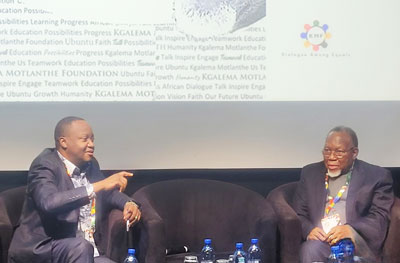
Former President Kgalema Motlanthe reminded delegates that South Africa's economy was built through generations of migrant labour drawn from across Southern Africa. Long before regional integration became formal policy, African workers, entrepreneurs and traders had already woven together the economic fabric of the subcontinent. History therefore cautions against simplistic narratives. South Africa has never existed apart from Africa. It has prospered because of Africa, just as Africa has benefited from South Africa's industrial and commercial development.
MTN Group Chief Executive Officer Ralph Mupita reinforced this reality by observing that Africa's future will be shaped less by the borders that separate nations than by the opportunities that connect them. Investment follows certainty. Enterprise follows stability. Prosperity follows confidence.
His remarks invite an important shift in thinking.
Perhaps the defining question is no longer how governments regulate migration.
Perhaps it is how governments create opportunity.
That distinction changes the entire conversation.
Yet another vacuum emerged during the seminar, one seldom discussed in public policy circles.
It is the vacuum between innovation and bureaucracy.
The Kgalema Motlanthe Foundation itself provides a revealing example. Despite its recognised contribution to education, dialogue, peacebuilding and social cohesion, its leadership acknowledged the continuing challenge of securing sustainable funding for initiatives that demonstrably serve the public interest. This is not simply the experience of one Foundation. It reflects a broader dilemma confronting many organisations working to strengthen society.
The paradox deserves attention.
Those committed to transparency, accountability and public benefit often navigate increasingly complex administrative processes before they can access support. Meanwhile, those intent on exploiting systems frequently devote their energies to circumventing them.
This is not an argument against accountability.
Far from it.
Transparent governance remains essential.
Public resources must always be protected.
But there is an equally important question.
At what point does bureaucracy cease to protect innovation and begin to suppress it?
Every additional layer of unnecessary administration carries an invisible cost. It consumes time that could have produced solutions. It redirects energy from innovation towards compliance. It encourages institutions to measure success by procedural completion rather than societal impact.
Complexity, however well intended, can become its own form of exclusion.
The challenge for twenty-first century governance is therefore not to create fewer rules, but to create better rules—rules that safeguard integrity while encouraging initiative, enterprise and civic participation.
This points towards a larger philosophical question.
Every successful society is built upon two complementary architectures.
The first is the architecture of regulation.
The second is the architecture of trust.
Regulation defines the minimum standards of behaviour.
Trust inspires people to exceed them.
Regulation asks, "What must citizens do?"
Trust asks, "What kind of citizens do we aspire to become?"
No nation has ever regulated itself into greatness.
History consistently demonstrates that the most resilient societies are those where responsibility increasingly becomes internal rather than externally imposed. Laws remain essential, but they function as guardrails rather than the primary engine of social order.
Good governance should therefore aspire to something higher than compliance.
It should cultivate commitment.
It should encourage citizens to act responsibly not simply because penalties exist, but because dignity, belonging and self-respect become intrinsic values.
When people believe they belong, they protect what they have helped to build.
When they are respected, they are more likely to respect others.
When opportunity is shared, accountability becomes a matter of character rather than coercion.
Corruption, fraud and criminality will never disappear entirely. Every society will contain individuals who reject shared norms. Yet these should remain exceptions rather than defining characteristics. The objective of enlightened public policy is not to design systems around the assumption that everyone is dishonest. It is to create conditions in which honesty becomes easier, participation becomes more rewarding and integrity becomes culturally expected.
This is where Africa's future may ultimately be decided.
The continent possesses extraordinary natural resources, the world's youngest population, expanding digital connectivity and ambitious frameworks such as the African Continental Free Trade Area and Agenda 2063. What remains is to bridge the distance between vision and implementation.
That bridge will not be built solely through legislation.
It will be built through trusted institutions.
Through policy certainty.
Through simplified bureaucracy.
Through investment in people.
Through education that nurtures responsible citizenship.
Through public administration that rewards innovation instead of exhausting it.
Through leadership that measures success not by the volume of regulations enacted, but by the number of lives transformed.
The Kgalema Motlanthe Foundation has therefore done more than organise another seminar.
It has invited South Africa—and Africa—to ask a more courageous question.
How do we build societies where people flourish because they choose responsibility rather than merely comply with regulation?
Perhaps that is the next frontier of governance.
Not the endless expansion of bureaucracy, but the deliberate cultivation of trust.
Not governing through suspicion, but leading through confidence.
Not building systems that assume failure, but institutions that inspire excellence.
The world is indeed on the move.
The challenge before Africa is to ensure that opportunity moves with it.
For when societies invest in dignity, belonging, innovation and trust, migration increasingly becomes a matter of choice rather than necessity. Bureaucracy gives way to enterprise. Regulation is complemented by responsibility. Citizens become stakeholders rather than subjects.
In the end, the most enduring legacy of good governance is not the number of laws it creates.
It is the number of people it empowers to live with purpose, contribute with integrity and believe that their future is worth building where they already call home.