


Cuba, Russia and Africa Confront the Double Standards of the International Order
By Anisha Pemjee and Kirtan Bhana - TDS
13 November 2026
Few countries illustrate the profoundly contradictory international order that speaks so confidently about democracy, human rights, freedom and the rule of law, yet appears remarkably inconsistent when these principles collide with the strategic interests of the world's most powerful states, more vividly than Cuba.
For more than six decades, this Caribbean island of 10 million has endured an extraordinary degree of economic, diplomatic and political pressure from the United States. Its geographical proximity to the American mainland, approximately 90 kilometres from Florida, has done little to soften Washington's determination to influence the political and economic direction of the Cuban state.
The question that consequently arises is of international principle stemming from the historical solidarity forged in the struggles against colonialism, to the contemporary confrontation over sovereignty, economic coercion and the right of nations to determine their own destinies.
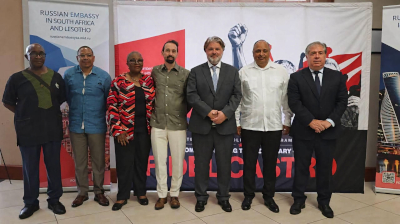
This question provided an important backdrop to the commemoration of the 100th anniversary of Fidel Castro's birth, which fell on 13 August 2026. The event on 10 November at the University of South Africa (UNISA) in Pretoria, South Africa was meaningful because it brought historical solidarity into conversation with contemporary geopolitical realities. It was entitled ‘Genesis of Cuban-Russian Friendship: Its Impact on Independence Movements in Africa.’
‘The Cuban Parliament designated 2026 the Year of the Centenary of Commander-in-Chief Fidel Castro Ruz. His legacy is consequently being commemorated internationally while Cuba's continues to experience economic difficulties due to renewed increasing hostilities by Washington. The event on 10 November 2026 was organised jointly by the Russian and Cuban diplomatic missions in Pretoria and the University of South Africa.
It also provides a compelling context for understanding the remarks made by Russian Foreign Ministry spokesperson Maria Zakharova at the Russia–Africa Media Forum in Moscow in October 2026.
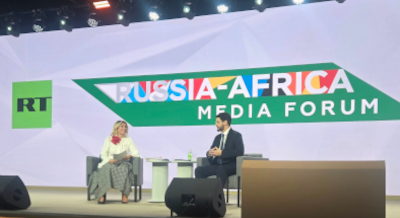
Her comments about the American embargo against Cuba formed part of a wider argument about the use of economic pressure, political intimidation and information control to influence the choices of sovereign countries.
Zakharova condemned the continuing American blockade and the intensification of punitive measures against Cuba, questioning the legitimacy of using economic coercion against an independent nation.
She also praised African countries for resisting external pressure and defended the right of African states to develop independent diplomatic relationships, determine their own priorities and exercise control over their information environments.
Her intervention was particularly significant because the forum brought together African media representatives and Russian officials at a time when the nature of international information flows, media independence and geopolitical influence was itself a subject of considerable contention as narrative warfare.
Zakharova's argument was essentially that the same international hierarchy that seeks to determine which countries may participate freely in economic and political relationships, also seeks to determine whose voices receive international recognition.
Her position was that Russia and African countries should resist attempts by third parties to dictate their diplomatic and informational choices.
Russia's position should certainly be examined critically, just as the foreign policies of Western powers should be. But the underlying question raised by Zakharova cannot be dismissed because it comes from Moscow.
If sovereignty is a universal principle, it cannot be reserved for countries whose political systems or international relationships happen to be acceptable to Washington, London, Paris or Brussels. Nor should it be selectively invoked by Russia when convenient. The credibility of the international system depends on applying the same standards to everyone.
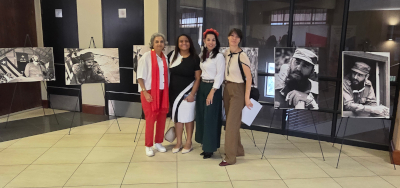
Cuba’s extraordinary international footprint
Under Fidel Castro's leadership, Cuba became an influential participant in the international anti-colonial movement, extending political, military and humanitarian assistance to liberation struggles across the developing world.
Cuba supported liberation movements and governments confronting colonial domination and apartheid, including in Angola and Namibia. Cuban internationalist assistance during the Angolan conflict, particularly the Battle of Cuito Cuanavale in 1987–1988, became an important turning point in the history of Southern Africa's liberation.
A history that will live on forever
In his opening remarks, Russian Ambassador Roman Ambarov and the participating diplomatic representatives brought attention to the historical relationship between Russia, Cuba and African liberation movements.
The discussion included Professor Sifiso Ndlovu of the Thabo Mbeki African School of Public and International Affairs, Cde Snuki Zikalala, President of the ANC Veterans League, Ambassador Roman Ambarov of the Russian Federation and Ambassador Fakri Pinelo of the Republic of Cuba.
The contributions highlighted the extraordinary historical circumstances that brought these countries together and the role of international solidarity in the struggle against colonial domination.
The event also unpacked the contemporary implications of the tightening American sanctions regime against Cuba and the immediate relief and humanitarian assistance that was needed.
The American contradiction on democracy, human rights and economic coercion
Perhaps the most striking feature of contemporary American policy towards Cuba is the contradiction between its stated commitment to human rights and the consequences of its economic restrictions.
The official justification the US government maintains is that its sanctions are intended to promote democracy, accountability and human rights in Cuba.
However, the practical consequences of comprehensive economic restrictions extend beyond government officials and political institutions. They affect ordinary citizens, businesses, healthcare provision, energy security, transportation, food supplies and the capacity of an already struggling economy to recover.
In January 2026, the US administration declared a national emergency relating to Cuba and intensified pressure on the island. On 1 May 2026, Executive Order 14404 expanded the sanctions framework, including provisions allowing measures against foreign individuals and entities operating in specified sectors of the Cuban economy or providing support to the Cuban government.
These measures have consequences for international commercial relationships and create additional risks for foreign companies and financial institutions engaging with Cuba.
If the objective is to improve the lives and freedoms of ordinary Cubans, how does intensifying restrictions on their country's economic capacity advance that objective?
And if the American administration considers economic coercion a legitimate instrument of foreign policy, on what consistent legal or moral principle does it condemn comparable forms of pressure when employed by other powerful states?
This issue of double standards is difficult to ignore. International law is not supposed to operate according to the principle that the powerful may impose their will while the less powerful must accept the consequences.
The United Nations Charter establishes sovereign equality among states and prohibits the threat or use of force against their territorial integrity or political independence. Although sanctions and other economic measures raise complex questions of international law, their legitimacy, proportionality and humanitarian consequences deserve serious scrutiny.
Obama's opening and Trump's reversal exposes the instability of US policy
The American approach to Cuba also reveals another contradiction of the apparent inability of successive administrations to maintain a coherent and sustainable strategy.
The Obama administration recognised that more than half a century of isolation had failed to produce the political transformation Washington sought.
The restoration of diplomatic relations in 2015, the reopening of embassies and the relaxation of certain travel and commercial restrictions represented an important departure from the confrontational policies of previous decades.
It was an acknowledgement, however limited, that engagement could achieve more than perpetual hostility.
The process was neither complete nor irreversible. The embargo remained substantially in place, and many restrictions required congressional action to remove. Nevertheless, the diplomatic opening created the possibility of a different relationship between the two countries.
Subsequent administrations reversed or substantially restricted important elements of that engagement.
The current US administration's renewed escalation in 2026 demonstrates just how dramatically American policy can swing from diplomatic engagement to economic confrontation. It raises a fundamental question about the credibility of American diplomatic commitments.
The international system cannot function effectively if the foreign policy of a powerful state becomes an instrument of domestic political cycles, electoral calculations and the ideological preferences of successive administrations.
There is also a troubling irony in Washington's insistence that Cuba must embrace political pluralism while the United States itself struggles to maintain consistency in its approach to international diplomacy.
Guantánamo Bay: The uncomfortable question of American accountability
The question of American accountability also inevitably brings the discussion to Guantánamo Bay.
The United States has maintained its naval installation at Guantánamo Bay under arrangements originating in the early twentieth century. Cuba has long contested the legitimacy of the arrangement and regards the continued American presence as an infringement of its sovereignty.
The detention facility established there became internationally notorious for allegations of torture, cruel treatment, indefinite detention without trial and violations of fundamental legal protections.
The irony is difficult to overlook as the United States frequently positions itself as an international defender of human rights and the rule of law. Yet Guantánamo became a powerful symbol of the consequences when national security arguments are used to circumvent established legal protections.
This does not mean that every American institution or citizen should be equated with the abuses committed there. It means that the credibility of a state claiming moral leadership must be measured against its own conduct.
The rule of law cannot be a standard imposed on adversaries while exceptions are created for oneself.
If Washington expects Cuba, Russia, African governments and other states to respect international legal principles, it must be equally prepared to subject its own actions to those principles.
Russia, Cuba and Africa, a new geopolitical alignment?
The historical relationship between Russia, Cuba and Africa is increasingly relevant to contemporary geopolitical debates.
The Soviet Union played a significant role in supporting African liberation movements, while Cuba provided direct military and humanitarian assistance in several African struggles. These relationships helped establish political connections that survived the end of the Cold War.
Today, Russia is seeking to strengthen its diplomatic, economic, security and media relationships across Africa. Cuba continues to draw upon its historical connections with African countries, while advocating for an end to the American embargo.
The obvious convergence of interests are in defending the principle that African and other developing countries should be able to determine their international relationships independently.
African sovereignty must mean precisely that: the freedom to choose partnerships without external intimidation, regardless of which major power is seeking influence.
Africa should not exchange one form of dependency for another. The objective of liberation was never to replace one external authority with another.
The true legacy of the liberation movements is the freedom to make independent choices.