
A Handbook for an Organisation in Transformation, the UN at 81
By Kirtan Bhana and Anisha Pemjee
22 September 2026
As world leaders gather in New York for the 81st session of the United Nations General Assembly, a significant publication launched in Pretoria offers a way of understanding the enormous institution at the centre of contemporary multilateral diplomacy.
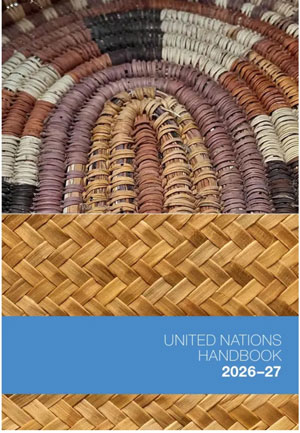
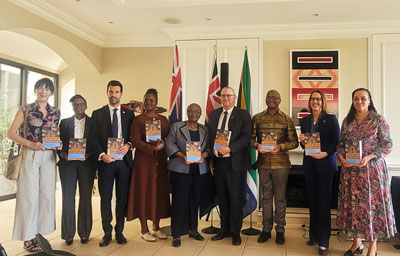
The 63rd edition of the United Nations Handbook, jointly produced by New Zealand and Australia, was launched at the New Zealand High Commission in Pretoria on 16 September 2026 by New Zealand High Commissioner Philip Hewitt and Australian High Commissioner Tegan Brink, with South Africa's Deputy Director-General for Global Governance and Continental Agenda, Ambassador Xoliswa Mabhongo, as Guest of Honour.
The launch took place just days before the opening of the General Debate of the 81st General Assembly, where Heads of State and Government and other senior representatives are gathering from 22 to 26 September and again on 28 September. The theme of this year's session is “Restoring trust, managing transformation: A United Nations that delivers for all.”
The Handbook and the theme of the 81st General Assembly may initially appear to belong to different worlds. One is a practical guide to the machinery of international governance; the other is a call to address some of the deepest challenges facing the multilateral system.
The Handbook is about understanding how the United Nations works. The 81st General Assembly is confronting the question of how that organisation must work in a world that has changed profoundly since the Charter was signed in 1945.
A handbook for navigating global governance
For more than six decades, the United Nations Handbook has served diplomats, officials, academics and practitioners attempting to navigate the complex institutional landscape of the United Nations.
First published by New Zealand in 1961, it has evolved with the organisation itself. Since 2025, Australia and New Zealand have jointly produced the publication.
High Commissioner Hewitt explained the practical value of the Handbook that brings together information on mandates, membership, reporting lines, elections and decision-making structures, providing in one place the information that diplomats need to understand the machinery of the UN.
A diplomat arriving at a multilateral posting is entering an intricate world of committees, agencies, procedures, negotiations, reporting mechanisms and institutional relationships. Knowing the political position of one's government is only part of the task. Knowing how the system works is equally important.
High Commissioner Hewitt made the point particularly strongly when he noted that for smaller missions with limited resources, the Handbook is much more than a reference book. It is a practical tool helping member states acquire the knowledge necessary to participate effectively in multilateral diplomacy.
As Hewitt observed, every member state, regardless of size or resources, should have the opportunity to contribute meaningfully to global decision-making. The Handbook therefore becomes part of the infrastructure of informed diplomacy.
From a handbook to a way of understanding the UN
The United Nations has become an extraordinary institutional ecosystem. The General Assembly, Security Council, Economic and Social Council, Secretariat, programmes, funds, specialised agencies, committees and other bodies collectively form a system that can be daunting even to experienced practitioners.
That complexity is often described as bureaucracy. But bureaucracy, in its neutral sense, is also the machinery through which large institutions organise responsibilities, preserve institutional memory and implement decisions. The Handbook helps make the machinery navigable.
Australian High Commissioner Tegan Brink provided a compelling illustration of this in her remarks.
Recalling her earlier service as Australia's Deputy Representative to the United Nations in New York, she described an occasion involving a change of government in a particular country and she was required to provide advice on the Credentials Committee. Australia was not a member of the committee, but she needed to understand how it operated.
Her solution was simple: “I reached for the Handbook.”
International diplomacy frequently depends upon understanding procedures before positions can be advanced.
The UN at 81 is an institution meeting a transformed world
The UN was established in a world emerging from a devastating global war. Its fundamental principles of sovereign equality, peaceful settlement of disputes, international cooperation and collective security remain central to international relations. But the environment in which those principles must operate has changed dramatically.
There are new centres of economic and political influence. Global production and trade patterns have shifted. Africa and the wider Global South are rightfully demanding greater representation in global decision-making. Technology has transformed communication, information and economic activity. Climate change has become a defining global challenge. Migration has become a central feature of the contemporary world. Artificial intelligence is beginning to alter how societies work, learn, communicate and govern. And geopolitical competition has become increasingly complex.
The 81st General Assembly's own programme recognises this changing environment. Its six priorities include peace and security, sustainable development, climate resilience, rights and protection for refugees and migrants, technological transformation and renewed multilateralism and UN reform.
The organisation is therefore being asked to navigate a world that is moving faster than many of the institutions created to govern it.
Technology has changed more than communication
Perhaps one of the least appreciated transformations is the speed of human communication. Information that once took days, weeks or even months to travel between continents now moves almost instantaneously. A diplomatic statement, a conflict, a natural disaster, an election result or a political controversy can become a global event within minutes. The smartphone has effectively placed the world's information networks in the hands of billions of people. Artificial intelligence is accelerating that transformation again.
The 81st General Assembly has explicitly identified digital governance, AI, science, technology and innovation as one of its six pillars. The President of the General Assembly has argued that the question is no longer whether these technologies will be used, but whether they will be governed wisely and fairly.
The African dimension
High Commissioner Hewitt noted that African countries are among the leading voices in the United Nations on peacebuilding and conflict resolution, sustainable development, climate resilience and institutional reform.
High Commissioner Brink recalled the organisation's role in supporting liberation movements, isolating colonial and apartheid regimes and supporting the journey towards self-determination. She highlighted Australia's contribution, including the deployment of approximately 600 Australian peacekeepers to Namibia under the United Nations Transition Assistance Group and Australia's support for UN resolutions against apartheid.
The international system created after the Second World War does not perfectly correspond with the political, demographic and economic realities of the 21st century.
High Commissioner Brink stated that Australia supports pragmatic reform and increased African representation on the UN Security Council, arguing that global institutions need to better reflect contemporary realities.
Ambassador Mabhongo reinforced the South African perspective. He acknowledged the shortcomings of the multilateral system but emphasised that there is “no substitute for the United Nations” as a forum where nations can engage one another as sovereign equals on matters of collective global importance.
The Handbook and the future of multilateralism
The launch of the Handbook provided a moment to reflect on the relationship between knowledge, governance and diplomacy at a time when the international system is under considerable pressure.
The UN is not a perfect institution. Nor could an organisation reflecting the interests, histories, cultures and political systems of 193 member states ever be entirely simple.
As Ambassador Mabhongo observed, negotiations can be difficult and progress incremental. Yet the existence of a universal forum remains essential.