


Remembering the Road We Have Travelled, Embracing the Broad Road Ahead: A New Chapter in China-Botswana Relations
By Zhao Yinan, China Media Group (CMG), Johannesburg
20 October 2026
When Chinese President Xi Jinping met Botswana's President Duma Gideon Boko at the Great Hall of the People in Beijing on October 13, he offered a reflection that captured both the history and the future of relations between the two countries.
The two sides, Xi said, should remember the road they have travelled together, supporting one another along the way, and move forward along the broad road of China-Botswana relations in the new era.
For me, as a journalist based in Southern Africa who has followed China's engagement with the region, these words carried particular significance.
In the weeks surrounding President Boko's state visit to China, I had the opportunity to participate in a series of interviews and reports, including conversations with Botswana's Minister for State President, Defence and Security, Moeti Caesar Mohwasa, and Minister of International Relations, Dr Phenyo Butale, as well as coverage of the historic visit itself.
What emerged from these conversations was a consistent message: Botswana sees its relationship with China not simply as a diplomatic partnership, but increasingly as an opportunity to shape its own economic future.
A Friendship Rooted in History
The relationship between China and Botswana has a history that predates the establishment of diplomatic ties in 1975.
In 1971, Botswana voted in favour of restoring the lawful seat of the People's Republic of China in the United Nations. More than five decades later, that decision remains an important symbol of the mutual respect and principled support underpinning bilateral relations.
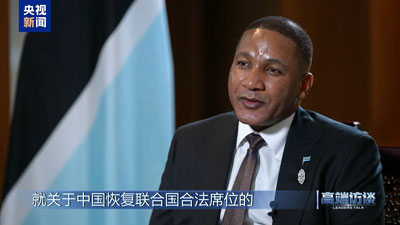
Botswana's President Duma Gideon Boko reflects on the historical friendship between China and Botswana during an exclusive interview with CMG's Leaders Talk programme
During his exclusive interview with CMG's Leaders Talk programme, President Boko reflected on this shared history, emphasizing that relations between the two countries were founded on principles that should continue to guide their future cooperation.
Those principles were reaffirmed during his state visit from October 12 to 17, when the two countries announced the elevation of bilateral relations to a Comprehensive Strategic Cooperative Partnership.
This was more than a diplomatic milestone, iIt represented a commitment to translate longstanding political trust into practical cooperation across trade, investment, industrial development, technology, healthcare and people-to-people exchanges.
The visit also came at a symbolic moment. Botswana celebrates 60 years of independence in 2026, while China marks the 105th anniversary of the founding of the Communist Party of China.
For both countries, the occasion offered an opportunity to reflect on their respective development journeys and consider how their experiences could complement one another.
China's Development: An Inspiration, Not a Blueprint
One of the strongest impressions I gained from my interviews with Botswana's senior officials was their interest in China's development experience.
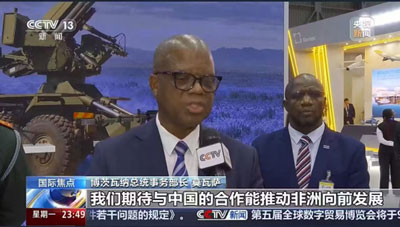
Botswana's Minister for State President, Defence and Security, Moeti Caesar Mohwasa, speaks to China Media Group (CMG) about strengthening China-Botswana cooperation during a defence exhibition
Before President Boko's visit, Minister Mohwasa spoke passionately about the importance of national unity, commitment and the sacrifices required to build a nation. He described the dedication of the Chinese people as an inspiration to other countries. His reflections went beyond China's economic achievements. He was particularly interested in how China had developed a system suited to its own national circumstances rather than simply copying models from elsewhere.
In his words, China's experience demonstrates that countries can develop their own solutions based on their particular conditions.
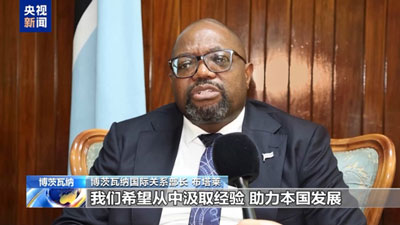
Botswana's Minister of International Relations, Dr. Phenyo Butale, speaks during an exclusive interview with China Media Group (CMG) about learning from China's development experience to support Botswana's economic transformation
A similar perspective emerged from my interview with International Relations Minister Dr Phenyo Butale.
He described President Boko's visit as an opportunity to reimagine and reinvigorate the relationship between Botswana and China, particularly following Botswana's historic change of government in 2024.
The minister emphasized that Botswana wished to learn from China's development journey while identifying practical areas of cooperation that could support its own economic transformation.
This was also a central theme of President Boko's visit.
In Fujian Province, his first stop in China, Boko examined the province's transformation and learned about China's experience in poverty alleviation. He also visited the Communist Party of China Museum in Beijing.
In his interview with CMG, Boko highlighted the importance of industrialization, confidence in domestic capabilities and the determination to seek solutions from within.
What struck me was that Botswana's leaders were not speaking about simply replicating the Chinese model. Rather, they were exploring how lessons from China's modernization could be adapted to Botswana's own realities.
This distinction is important. Development partnerships become more meaningful when they respect the different circumstances, priorities and aspirations of each country.
From Diamonds to a More Diversified Economy
Botswana's economic transformation was perhaps the most practical and urgent issue raised throughout the interviews and the presidential visit.
For decades, diamonds have been central to the country's development, providing the revenue needed to build roads, schools, hospitals and other essential infrastructure.
Yet heavy reliance on a single commodity has also created vulnerabilities.
As President Boko acknowledged during his exclusive interview, the challenges facing the global diamond industry have made economic diversification a necessity rather than an option.
Minister Butale was equally clear about the government's ambitions.
"We are in a hurry to industrialize. We are in a hurry to create jobs," he told me.
He explained that Botswana wanted to move away from an import-dependent consumer economy towards one capable of manufacturing products, developing industries and creating employment.
Chinese investment, industrial expertise and technology could play an important role in that transition.
Butale emphasized that Botswana was seeking not only investment, but also local production, skills development and greater participation in downstream industries.
In mining, for example, the objective is to ensure that more value is added within Botswana rather than allowing the economic benefits of mineral resources to be concentrated elsewhere.
These priorities were reflected in the joint statement issued on October 13.
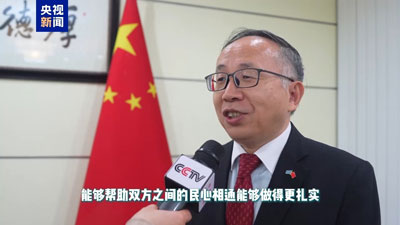
The two governments agreed to deepen cooperation in mining, energy, infrastructure, agriculture, manufacturing, logistics and emerging digital technologies.
They also expressed support for sustainable mineral development, green technologies and greater local value addition.
The challenge now is to turn these commitments into tangible projects that create jobs, strengthen industrial capacity and improve people's lives.
Opening New Doors Through Trade
Another important theme was the growing opportunity for Botswana to access the Chinese market.
China's decision to extend zero-tariff treatment to African countries with which it maintains diplomatic relations featured prominently in both the ministerial interviews and the presidential discussions.
For Botswana, a country seeking to diversify its exports, access to such a large consumer market presents significant opportunities.
Minister Butale welcomed the policy and highlighted the potential for Botswana to expand exports beyond traditional mineral products.
He pointed to progress on beef exports and efforts to create additional opportunities for citrus and other agricultural products.
Minister Mohwasa similarly stressed that Botswana needed to promote itself more actively to Chinese consumers, businesses and tourists.
With China's vast population and economic scale, he saw considerable potential for the two countries to deepen commercial ties.
The October 13 joint statement specifically identified beef, citrus and other agricultural products as areas where the two sides would work to improve market access and address relevant technical requirements.
President Boko also welcomed the zero-tariff initiative during his CMG interview, describing it as an important opportunity for developing economies facing uncertainty in international markets.
For Botswana, however, market access is only one part of the equation.
The longer-term opportunity lies in developing the productive capacity needed to supply that market competitively and sustainably.
Cooperation Built on Mutual Respect
Throughout my conversations with Botswana's leaders, one phrase appeared repeatedly: mutual respect.
Minister Mohwasa noted that one of the qualities Botswana valued in its engagement with China was a partnership that did not impose overly prescriptive conditions.
He emphasized the importance of cooperation in which partners engage with one another on the basis of respect, while sharing technology, knowledge and development experience.
Minister Butale similarly described China-Botswana relations as being founded on mutual respect and mutual benefit.
President Boko reinforced this message during his visit, expressing appreciation for China's support and emphasizing the importance of cooperation that respects national sovereignty and each country's right to choose its own development path.
The joint statement gave these principles a broader international dimension.
Both sides reaffirmed their commitment to multilateralism, the central role of the United Nations, and greater representation for developing countries in global governance.
They also expressed support for cooperation under the Global Development Initiative, the Global Security Initiative, the Global Civilization Initiative and the Global Governance Initiative.
From the perspective of Southern Africa, these discussions are especially relevant at a time when developing countries face growing economic uncertainty, technological competition and geopolitical tensions.
For countries such as Botswana, the ability to pursue development partnerships while preserving national priorities and policy independence is of considerable importance.
Beyond Economics: Connecting People and Cultures
Yet the story of China-Botswana relations is not confined to high-level diplomacy or economic agreements.
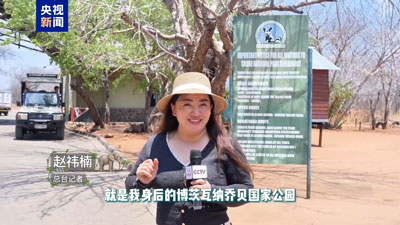
During my reporting in Botswana, I was also reminded of the country's extraordinary natural beauty and the warmth of its people.

China Media Group (CMG) journalist Zhao Yinan reports from Chobe National Park in Botswana, highlighting the country's rich wildlife and tourism potential
From the wildlife of Chobe National Park to the remarkable landscapes of the Okavango Delta, Botswana offers experiences that can form a powerful connection between people from very different parts of the world.
Minister Butale was particularly enthusiastic when inviting Chinese tourists to visit his country.
He spoke warmly about the Okavango Delta, describing each visit as an experience that felt entirely new, no matter how many times he had been there.
Tourism, education, cultural exchanges and media cooperation can all help bring the two societies closer together.
The joint statement also recognized the importance of expanding cooperation in education, healthcare, youth exchanges and cultural understanding.
It welcomed the continued contribution of Confucius Institutes and reaffirmed cooperation in medical services, including the longstanding presence of Chinese medical teams in Botswana.
These exchanges may attract fewer headlines than presidential meetings or major investment agreements, but they are essential to building relationships that endure across generations.
Turning a Historic Visit into Lasting Results
President Boko's October visit marked an important turning point in relations between China and Botswana.
The elevation of bilateral ties, the signing of cooperation documents and the new commitments to economic transformation provide a stronger framework for future engagement.
But the real measure of this partnership will be found beyond diplomatic ceremonies and official statements.
It will be seen in factories that open, jobs that are created, skills that are transferred, agricultural products that reach new markets, and communities that benefit from improved infrastructure and public services.
As Minister Butale emphasized during our conversation, the ultimate objective of cooperation should be to make a meaningful difference in the lives of the people of Botswana and China.
That observation stayed with me.
Having followed the discussions before, during and after the presidential visit, I believe the most significant development is not merely the elevation of diplomatic relations, but the growing convergence between Botswana's development ambitions and China's willingness to share its experience and expand practical cooperation.
There is a Setswana proverb discussed by President Boko during his CMG interview: "Sedibana pele ga se ikanngwe"— the waterhole ahead cannot be relied upon.
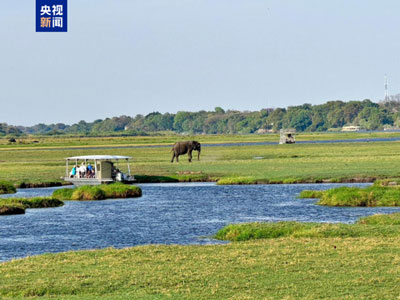
An elephant roams the floodplains of the Chobe River in Botswana, where wildlife and scenic river landscapes make the area one of the country's major tourist attractions
The president explained that while nations must have a vision for the future, they must also act decisively in the present to make that vision a reality.
It is a fitting reflection on the next chapter of China-Botswana relations.
The two countries have a shared history of friendship and mutual support. They now have an opportunity to turn that foundation into more concrete achievements.
As President Xi Jinping said, the two sides should remember the road they have travelled together and move forward along the broad road ahead.
For China and Botswana, the road behind them provides the foundation. The road ahead will be defined by what they build together.
Zhao Yinan is CMG Africa Bureau Correspondent in Johannesburg. She covers political, economic and diplomatic developments across Southern Africa, with a particular focus on China-Africa relations.