Filters

EU affirms strategic partnership with SA

President Cyril Ramaphosa hosts a working dinner for President Costa and President Von der Leyen and their delegation (photo: GCIS)
 

15 March 2025

Amidst the changing global landscape, European Council President António Costa has emphasised the importance of the strategic partnership between South Africa and European Union (EU). Addressing the opening of the 8th South Africa-European Union (SA-EU) Summit, Costa said the EU and South Africa are not just partners but are strategic allies, bound by shared values of democracy, human rights, rule of law and multilateralism.

“The world has changed profoundly in these past seven years. Pandemics, conflicts here in Africa, in the Middle East, and in Europe. Multilateral commitments are being tested, and the rules-based international order faces growing challenges. 

“Protectionism, economic coercion, and other threats undermine stability, while new technologies disrupt the political system and global power dynamics. In this world of uncertainty, our partnership matters more than ever.

“Let us use this summit to deepen our cooperation, reinforce our commitments, and chart a course for an even stronger partnership. A partnership that not only benefits our nations but contributes to global stability and prosperity – for our citizens, for our nations, and for our shared future,” Costa said on Thursday.

President Cyril Ramaphosa co-chaired the summit with Costa, and the President of the European Commission, Dr. Ursula von der Leyen, at Tuynhuys, in Cape Town.

Costa said the European Union does not see the future through the lens of division between blocks, between the North and South. 

“Instead, we see an interconnected world, where our fates are linked, and where joint action is not an option but a necessity. Our partnership delivers real benefits to our citizens, our economies, and the world.

“We are united in our commitment to peace, security, and sustainable development. We stand together to help uphold the United Nations Charter, advance the sustainable development goals, and drive towards global action on climate change, poverty reduction, and economic reform. 

“We appreciate South Africa’s leadership, both regionally and globally. You can count on the European Union’s full support as you take on the G20 Presidency and as we prepare together for the next European Union-African Union summit, later this year,” Costa said.  

With this year being the 25th anniversary of EU-African Union cooperation, Costa said this is a milestone that underscores the strength of engagement, and the vast potential ahead. 

“Despite many complex challenges, this is not a time for despair. It is a time for opportunity. An opportunity to build, to strengthen, and to expand our bilateral and multilateral cooperation. To shape a world that is fairer, more sustainable, and more secure,” he said.

In his address, President Ramaphosa said South Africa intends to hold further constructive discussions on a new investment package by the EU, to South Africa.

READ | President Ramaphosa engages EU on new investment package

“Through this we aim to consolidate cooperation in areas such as science and technology, education and skills development, climate action, peace and security, health and critical minerals,” the President said. 

SAnews.gov.za

A Jordanian Iftar: A Celebration of Faith, Culture, and Diplomacy

Dr Wasfi Ayyad, Ambassador of the Kingdom of Jordan (centre) with guests 
 

by Kirtan Bhana - TDS

15 March 2025

In the spirit of Ramadan, Dr. Wasfi Ayyad, Ambassador of the Hashemite Kingdom of Jordan to South Africa, hosted Iftar at his official residence in Pretoria. The event brought together diplomats, community members, and friends of Jordan to share in the time-honored tradition of breaking fast during the Islamic holy month.

Among the dignitaries who observed Iftar and joined the Salah prayers led by Dr. Abdel Wahab, Ambassador of Libya to South Africa, were former Minister of Foreign Affairs and Chair of the Board of Trustees of the Nelson Mandela Foundation, Dr. Naledi Pandor, as well as the Dean of the Arab Diplomatic Group, Mahash Saeed Alhameli, Ambassador of the United Arab Emirates (UAE) to South Africa.

Ramadan, guided by the lunar calendar, begins with the sighting of the crescent moon in the ninth month of the Islamic calendar. It is a sacred time marked by fasting from dawn to sunset, beginning with a pre-dawn meal (sahur) and concluding with Iftar at sunset. The fast is broken with dates and water, a cherished tradition in the Middle East, followed by a meal shared in unity and gratitude.

More than abstaining from food and drink, Ramadan is a period of introspection, spiritual reflection, and discipline. It is one of the Five Pillars of Islam, alongside faith, prayer, charity, and pilgrimage. Reading or reciting the Quran is a significant daily practice that strengthens faith and deepens one's connection to Allah. Empathy through almsgiving serves as a reminder of the interconnectedness of humanity and the importance of generosity. In Jordan, as well as across the Arab and Islamic world, Ramadan is a time of heightened worship and cherished family gatherings, embodying values of tolerance, mercy, and selflessness.

Dr Wasfi Ayyad, Ambassador of the Hashemite Kingdom of Jordan with Dr Naledi Pandor, Chair of the Board of Trustees of the Nelson Mandela Foundation
 

The Iftar at the residence of the Jordanian Ambassador was a rich culinary experience featuring iconic Jordanian dishes. The highlight of the evening was Mansaf, Jordan’s national dish, a fragrant combination of rice, tender lamb, and a distinctive fermented yogurt sauce, served as a symbol of hospitality and unity. Guests also enjoyed soups, falafel and hummus along with other delicacies from the region. The evening concluded on a sweet note with an array of Jordanian desserts, including Knafeh, a cheese pastry drizzled with syrup and garnished with pistachios and Qatayef, a traditional Middle Eastern stuffed pancake.

The gathering brought together diplomats from Arab embassies in Pretoria, Jordanian families and businesspeople residing in South Africa, and friends of Jordan, reinforcing the bonds of friendship between nations. The event highlighted the role of Iftar not only as a religious observance but also as a powerful diplomatic tradition that fosters cultural exchange and unity.

As the evening came to a close, guests left with a deeper appreciation of Jordanian hospitality and the unifying spirit of Ramadan. In a world where cultural understanding is key to international relations, such gatherings serve as a reminder of the shared values that transcend borders - faith, generosity, and the spirit of community.


Honouring Russian volunteers in Utrecht

Ambassador Roman Ambarov laid a wreath at the Leo Pokrowsky Monument and the Wall of Memory in Utrecht. He is pictured with officials and community members (photo supplied) 
 

14 March 2025

On 14 March 2025, Ambassador-designate of the Russian Federation to South Africa Mr. Roman Ambarov participated in annual commemorative events in Utrecht, KwaZulu-Natal, to honour the memory of Russian volunteers who took part in the Second Anglo-Boer War.

Rector of St. Sergius Orthodox Church in Midrand, Daniil Lugovoy served a lity for those who fell during the conflict, followed by a wreath-laying ceremony at the Leo Pokrowsky Monument and the Wall of Memory, which bears the names of 90 Russian volunteers. 

Leo Pokrowsky was one of over 200 Russian volunteers who arrived in South Africa to assist the Boers in their struggle against British colonial oppression. He was placed in command of one of the Boer guerilla units and earned a reputation as a courageous officer, for which he was promoted to the rank of captain.

In his address, Ambassador Ambarov emphasized the importance of preserving the historical memory, ensuring that those who sacrificed their lives in support of the Boers' fight for independence against British imperialism are never forgotten.

“We are immensely grateful to the parish of the Dutch Reformed Church in Utrecht for providing care service for the monument of Captain Leo Pokrowski, who died heroically in the struggle for freedom of the Boer Republics during the Second Anglo-Boer War, and for preserving the memory of Cpt. Pokrowski and other Russian volunteers,” the Ambassador said.

As part of the event, the Russian Embassy in South Africa donated several artifacts to the Old Parsonage Museum, including a copy of a declassified archival document, translated into Afrikaans. This document contains the resolution of Russian Emperor Alexander III in response to a letter from Empress Maria Fedorovna, offering aid to Boer women and children through the Red Cross.

Embassy of Russia in South Africa

The South African Royal Princesses elect their Leadership

TDS/SARPN

Princess Nonkululeko Mahlangu from amaNdzundza Kingdom was elected as the Chairperson


13 March 2025

On 8 March 2025, International Women's Day, South African Princesses from various parts of South Africa gathered in Midrand, in Gauteng Province, South Africa to officially launch the South African Royal Princesses Network - SARPN as well as elect new leadership. The Network whose role includes nation building, social cohesion, fight against GBV and contribution to rural development and gender empowerment was founded by Princess Stella Sigcau II from the Mpondo Kingdom in the Eastern Cape in 2019.

SARPN is the first organisation in South Africa that harnesses the important and influential status of the Princesses of the South African royalty . Princess Sigcau has since been appointed as the honorary President of the Network. Her role will be honorary whilst the Network will be led and governed by the elected leadership which will form the Executive Council of Princesses.

Princess Nonkululeko Mahlangu from amaNdzundza Kingdom was elected as the Chairperson and Princess Boiketlo Matsepo from the Taung Chieftaincy was elected as Deputy Chairperson. Princess Nomfundo Zibi of the Hlubi Kingdom was appointed as the Vice Deputy President whilst Princess Nandile Ndamase of the Mpondo Kingdom was elected as Secretary General. Elected as treasurer was Princess Tsholofelo Ramakoka from the Ramakoka Chieftaincy. Elected as additional members of the Council were Princess Sinovuyo Dumalisile from the Xhosa Kingdom and Princess Suzan Mathibe from Mathibe Chieftaincy.

The vision of the South African Royal Princesses Network is to create a unified and empowered community of progressive and developmental focused Princesses from diverse backgrounds across South Africa, driving positive change and development in their respective communities.

It's Mission is to provide a platform for Princesses to connect, share knowledge, and collaborate on initiatives that promote community upliftment, youth development, rural growth, and women's empowerment.

The South African Royal Princesses Network - SARPN

The objectives of the Network are:

  1. To Establish a strong network.
    2. Create a platform for Princesses to connect, share experiences, and support one another.
    3. Empowerment through knowledge sharing
    4. Contribute in the fight and uprooting of GBV, femicide, child abuse, human trafficking, child trafficking as well as create awareness through
    facilitation of workshops, Seminars, webinars and awareness campaigns.
    5. Training sessions, and discussions on topics such as leadership, community development, and entrepreneurship.
    6. Engage on community development initiatives.
    7. Collaborate on projects that address social, economic, and environmental challenges in communities across South Africa.
    8. Engage on youth development and mentorship.
    9. Establish mentorship programs, career guidance, and skills development initiatives for young women and girls.
    10. Identify and support initiatives that promote rural development, such as agriculture, education, tourism, biodiversity and infrastructure development.
    11. Advocate for women's rights, gender equality, and social justice, promoting a culture of inclusivity and respect.
    12. Create initiatives in collaboration with government, municipalities, business sector, NPOs and other relevant stakeholders that promote South Africa's diverse and rich heritage as a people, and diverse multilingual nation fostering unity that enables tradition and modernity to coexist
    13. Explore the possibility of establishing a formal association, defining its role, and establishing a governance structure.
    14. Identify, initiate, and support projects that align with the network's objectives, providing resources, expertise, and funding where possible.
    15. Initiate cultural events.
    16. Establish a communication platform for members to share information, updates, and events, promoting collaboration and support each other's initiatives.
    17. Promote and preserve the cultural heritage of Princesses from diverse backgrounds, celebrating their traditions, customs, and histories.
    18. Promote unity in a diversity of cultures.
    19. Create Networks with other Traditional and Royal Institutions and Princess Networks or Associations in the broader African Continent and the world as well Institutions like UN, IMO.
Princess Boiketlo Matsepo from the Taung Chieftaincy was elected as Deputy Chairperson. Princess Nomfundo Zibi of the Hlubi Kingdom was appointed as the Vice Deputy President whilst Princess Barata Pitso from Pitso Chieftaincy was elected as Secretary General deputised by Princess Nandile Ndamase Mabitsela from the Mpondo Kingdom. Elected as treasurer was Princess Tsholofelo Ramakoka from the Ramakoka Chieftaincy. Elected as additional members of the Council were Princess Sinovuyo Dumalisile from the Xhosa Kingdom and Princess Suzan Mathibe from Mathibe Chieftaincy.
 

The National Leadership will be launching branches through out the year in various provinces and the main celebration of the Launch of the Network will take place at Nkosi Ntsikayezwe Sigcau Multipurpose Centre in Matshona Village, Ntabankulu in September in the form of GBV, Child Trafficking, Human Trafficking and Child abuse Awareness Seminar.

China-Africa cooperation energizes joint pursuit of modernization

by Xinhua writer Zhang Jian

This photo taken on Jan. 10, 2024 shows vehicles transferring containers at a wharf of the expansion project of the Abidjan Port in Abidjan, Cote d'Ivoire. (Xinhua/Han Xu)


11 March 2025

At the bustling Port of Abidjan in Cote d'Ivoire, cargo ships glide in and out as towering cranes hum with ceaseless activity. Once a bottleneck for trade, the port now stands as a symbol of transformation thanks to its recent expansion fueled by Chinese investment.

This gateway to West Africa highlights Beijing's deepening economic engagement with the continent, a dynamic partnership that is reshaping Africa's trade and logistics landscape.

Through the Belt and Road Initiative (BRI), Africa's infrastructure has taken on a new look, allowing the continent to connect ever closer with the arteries of global commerce.

At the heart of the BRI are five pillars: policy coordination, infrastructure connectivity, unimpeded trade, financial integration and people-to-people exchanges. These principles align with Africa's own modernization aspirations. The vision has of late been reaffirmed at China's annual "two sessions," where Foreign Minister Wang Yi reiterated Beijing's commitment to supporting Africa's self-reliance and economic empowerment.

"China and Africa are always good friends, good partners, and good brothers with a shared future," Wang stressed at a press conference. "There will be no global modernization without African modernization, and Africa's stability and development are vital to the future of humanity."

China has backed its words with action. Since 2000, Chinese financing and expertise have driven a remarkable infrastructure boom across Africa: more than 10,000 km of railway, 100,000 km of roads and 100 ports, in addition to bridges, power plants and industrial zones.

This photo taken on Feb. 26, 2023 shows an upgraded road in Kigali, Rwanda. The road upgrading project in Rwanda contracted to China Road and Bridge Corporation (CRBC) has helped ease traffic flow and advance seamless trade along the Kigali-Bugesera district, eastern Rwanda.(CRBC/Handout via Xinhua)
 

The Beijing Summit of the Forum on China-Africa Cooperation last September reaffirmed both sides' commitment to modernization, offering African nations new pathways to economic transformation.

This partnership is rooted in a long history of diplomatic and economic collaboration. From China's tradition of making Africa the first overseas visit of its foreign minister each year to its advocacy for the African Union's inclusion in the G20, Beijing has consistently treated Africa as an equal stakeholder in global affairs. Initiatives such as the Global Development Initiative, the Global Security Initiative and the Global Civilization Initiative have further reinforced this engagement.

As cooperation deepens, it is rewriting traditional development paradigms. When China launched Algeria's first satellite, it empowered the country's remote education network. Chinese photovoltaic technology is helping Africa construct a green energy corridor. These projects signal a shift from the traditional North-South development model to one that emphasizes South-South knowledge exchange.

Aerial photo taken on Dec. 13, 2019 shows the 50 MW solar power farm in Garissa, Kenya. The plant is one of the largest photovoltaic electricity stations in Africa. (Xinhua/Xie Han)


The partnership is mutually enriching. China's increasing demand for agricultural imports has spurred Kenyan flower growers to adopt advanced cultivation techniques, while African ecological wisdom has influenced China's rural revitalization efforts. This two-way exchange highlights the dynamism of China-Africa cooperation and its potential to redefine modernization across the Global South.

Western critics have accused Beijing of debt-trap diplomacy and neocolonial motives, but numerous African policymakers beg to differ. As one local media outlet put it, "We do not have to choose between the West and China. We use the tools China offers to craft Africa's own solutions."

Standing at Abidjan's newly constructed container terminal, one can see Chinese-built cranes hoist Africa-grown cocoa beans onto ships bound for global markets. This is not a scene of dependence but of mutual progress, a story of two partners advancing together in a shared pursuit of prosperity.

This photo taken on Dec. 1, 2024 shows a train of the Lagos Rail Mass Transit (LRMT) Blue Line in Lagos, Nigeria. Spaning 13 km and covering five stations, this line kicked off its commercial operation in September 2023, and has been reckoned a symbolic project of the Belt and Road Initiative.  (Xinhua/Wang Guansen)

Xi stresses role of education in supporting sci-tech, talent development

Chinese President Xi Jinping, also general secretary of the Communist Party of China Central Committee and chairman of the Central Military Commission, visits national political advisors from the China Democratic League, the China Association for Promoting Democracy, and the sector of education, who are attending the third session of the 14th National Committee of the Chinese People's Political Consultative Conference (CPPCC), in Beijing, capital of China, March 6, 2025. Xi attended their joint group meeting, and heard their comments and suggestions. (Xinhua/Xie Huanchi)
 

BEIJING, 8 March 2025 (Xinhua) -- Chinese President Xi Jinping on Thursday stressed strengthening the role of education in supporting scientific and technological advancement as well as talent development.

Xi, also general secretary of the Communist Party of China (CPC) Central Committee and chairman of the Central Military Commission, called for a deep understanding of the needs of Chinese modernization for education, science and technology, and talent.

The goal is to cultivate a steady stream of talent, unlock their full potential, and ensure their abilities are fully utilized, Xi said while attending a joint group meeting during the third session of the 14th National Committee of the Chinese People's Political Consultative Conference (CPPCC), the top political advisory body.

The meeting was attended by national political advisors from the China Democratic League, the China Association for Promoting Democracy, and the education sector.

Xi stressed the importance of maintaining a correct orientation in running schools in the process of building China into a leading country in education, science and technology, and talent.

He called for nurturing a new generation of capable young people with the moral grounding, intellectual ability, physical vigor, aesthetic sensibility, and work skills needed to join and carry on the socialist cause.

He emphasized the need to equip students with the Thought on Socialism with Chinese Characteristics for a New Era.

To develop a high-quality educational system that meets the people's expectations, the key lies in deepening comprehensive reform of education, said Xi.

It is important to refine the school management system, grant schools greater autonomy in decision-making, and continuously advance law-based school administration, he added.

To achieve a sound interaction between independent sci-tech innovation and self-reliant talent training, education must further play its fundamental and leading role in supporting such cause, Xi noted.

He stressed the need to refine the mechanism for aligning talent cultivation with the needs of economic and social development to enhance the quality and efficiency of self-reliant talent training.
Noting that boosting education, sci-tech and talent development is a shared responsibility of the entire Party and society, Xi urged the CPPCC to fully leverage its role as a specialized consultative body.

Wang Huning, chairman of the CPPCC National Committee, and Cai Qi, director of the General Office of the CPC Central Committee, joined Xi in the discussion with political advisors. Wang and Cai are also members of the Standing Committee of the Political Bureau of the CPC Central Committee. 


Chinese President Xi Jinping, also general secretary of the Communist Party of China (CPC) Central Committee and chairman of the Central Military Commission, visits national political advisors from the China Democratic League, the China Association for Promoting Democracy, and the sector of education, who are attending the third session of the 14th National Committee of the Chinese People's Political Consultative Conference (CPPCC), in Beijing, capital of China, March 6, 2025. Xi attended their joint group meeting, and heard their comments and suggestions. Wang Huning, chairman of the CPPCC National Committee, and Cai Qi, director of the General Office of the CPC Central Committee, joined Xi in the discussion with political advisors. Wang and Cai are also members of the Standing Committee of the Political Bureau of the CPC Central Committee. (Xinhua/Wang Ye)

The Dominican Republic welcomes a record 11 million tourists
 
Ambassador Erika Alvarez Rodriguez and Deputy Minister Njabulo Nzuza raising a toast (photo: TDS)
 

by Kirtan Bhana

7 March 2025

Peace and stability are the essential ingredients for progress and prosperity. Overcoming the horror of colonialism’s divide and conquer, slavery, conflict and revolution has forged the island nation of the Dominican Republic into the exotic success it is today.  On the occasion of the celebration of the 181st anniversary of the Dominican Republic Ambassador Erika Alvarez Rodriguez acknowledged the visionary leadership of Juan Pablo Duarte and his fellow patriots, who courageously declared independence and laid the foundation for a free and democratic nation.

“The Dominican Republic has made remarkable strides in economic growth. For the second consecutive year our economy has expanded by 5%, positioning us as a leader in Latin America and the Caribbean. Key sectors such as tourism, manufacturing, agriculture, and service continue to drive this progress. Our free trade zones have positioned us as a hub for manufacturing and export, while agriculture, particularly the production of cacao, coffee, and tropical fruits continues to play a vital role in our economic landscape,” said Ambassador Rodriguez.

She also pointed out that the Dominican Republic is world-renowned for its cigars and rum, which guests had an opportunity to enjoy, and are symbols of the country’s rich heritage which contributes significantly to its economy and cultural identity.

Tourist visits to the idyllic Caribbean Island reached a record 11,2million, this due to policy and infrastructure development. The visits have also generated a great deal of interest in the potential opportunities for commercial and economic enterprise.

“Our beautiful beaches, vibrant culture, and world-class hospitality remain at the heart of our appeal. These sectors not only fuel our national growth but also create numerous opportunities for collaboration in trade, investment, and sustainable development initiatives with our global partners, including South Africa. Since assuming my position as Ambassador to South Africa, strengthening ties between our nations has been a key priority. I am pleased to witness increasing interest and support in trade, educational, cultural, and women’s empowerment activities that we have developed as an essential factor in both nations mutual awareness,” said Rodriguez.

South African Deputy Minister of Home Affairs Njabulo Nzuza  said that the Dominican Republic remains an attractive trading partner for South Africa in the Caribbean due to the country’s open and advanced economy and looked forward to increasing interactions at all levels.

The profound legacy of the African heritage and shared history of struggle for freedom, equality, and self-determination is reflected in the art, music, dance, food and identity of the Dominican people. Although distant geographically, Africa and the Dominican Republic are connected by spirit, and in this digital age of ICT can be considered neighbours.

This colourful, vibrant, festive national day celebration is a clear sign of deepening relations between the continent and a region which is part of the 6th region of the African Union and the African Diaspora. The potential and opportunities for cooperation and collaboration and building prosperity abound.

China's diplomacy provides much-needed stability to a turbulent world: FM

7 March 2025

China's diplomacy brought much-needed stability to a changing and turbulent world in 2024, Chinese Foreign Minister Wang Yi said Friday.

Xinhua

China fully confident in achieving 2025 GDP growth target: official
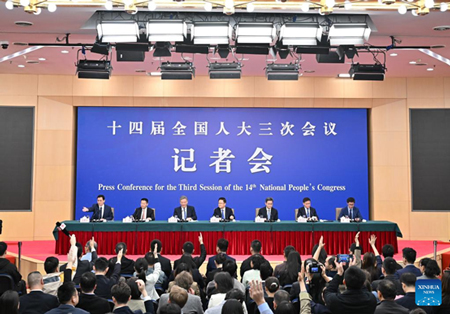
 
Zheng Shanjie, head of the National Development and Reform Commission, Lan Fo'an, minister of finance, Wang Wentao, minister of commerce, Pan Gongsheng, governor of the People's Bank of China, and Wu Qing, chairman of the China Securities Regulatory Commission, attend a press conference on economy for the third session of the 14th National People's Congress (NPC) in Beijing, capital of China, March 6, 2025. (Xinhua/Xu Bingjie)


BEIJING, 7 March 2025 (Xinhua) -- China is fully confident in achieving the economic growth target of around 5 percent this year as there is solid foundation, support and guarantee, Zheng Shanjie, head of the National Development and Reform Commission, told a press conference on Thursday.

Describing last year's economic performance as satisfactory, Zheng said that the Chinese economy has shown strong resilience and vitality, laying a solid foundation for this year's development.

In 2025, China will step up efforts to boost consumer spending, Zheng said. The country will allocate 300 billion yuan (about 41.8 billion U.S. dollars) to support the consumer goods trade-in program this year, up from 150 billion yuan in 2024, with the scope of the program to be expanded.

According to Zheng, a special action plan aimed at boosting consumption has recently been formulated by multiple departments and will be made public soon.

Effective investment will also be expanded this year, he said, noting that the country will support investment by private enterprises in emerging industries and industries of the future.

China last year recommended over 8,000 projects to private investors to encourage their investment, he said, noting that the country will introduce a number of major projects that will be attractive to private capital in sectors including railways, nuclear power, water conservancy, major scientific and technological infrastructure this year. 
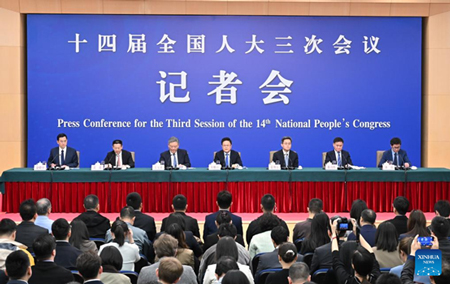
 
Zheng Shanjie, head of the National Development and Reform Commission, Lan Fo'an, minister of finance, Wang Wentao, minister of commerce, Pan Gongsheng, governor of the People's Bank of China, and Wu Qing, chairman of the China Securities Regulatory Commission, attend a press conference on economy for the third session of the 14th National People's Congress (NPC) in Beijing, capital of China, March 6, 2025. (Xinhua/Xu Bingjie)
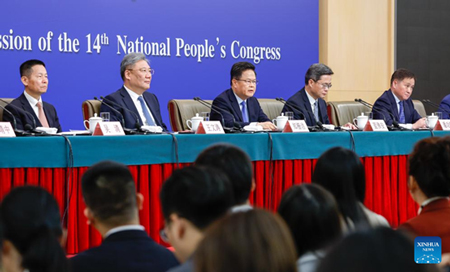

 
Zheng Shanjie, head of the National Development and Reform Commission, Lan Fo'an, minister of finance, Wang Wentao, minister of commerce, Pan Gongsheng, governor of the People's Bank of China, and Wu Qing, chairman of the China Securities Regulatory Commission, attend a press conference on economy for the third session of the 14th National People's Congress (NPC) in Beijing, capital of China, March 6, 2025. (Xinhua/Zhang Yuwei)
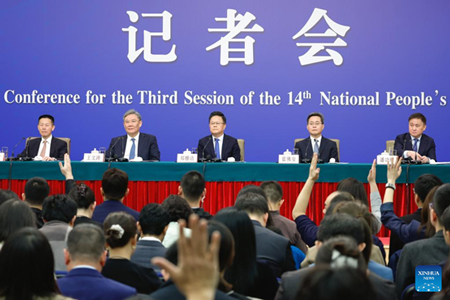
Zheng Shanjie, head of the National Development and Reform Commission, Lan Fo'an, minister of finance, Wang Wentao, minister of commerce, Pan Gongsheng, governor of the People's Bank of China, and Wu Qing, chairman of the China Securities Regulatory Commission, attend a press conference on economy for the third session of the 14th National People's Congress (NPC) in Beijing, capital of China, March 6, 2025. (Xinhua/Zhang Yuwei)
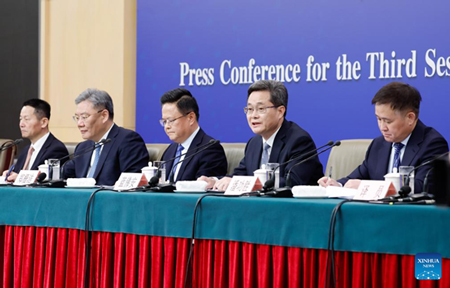

 
Zheng Shanjie, head of the National Development and Reform Commission, Lan Fo'an, minister of finance, Wang Wentao, minister of commerce, Pan Gongsheng, governor of the People's Bank of China, and Wu Qing, chairman of the China Securities Regulatory Commission, attend a press conference on economy for the third session of the 14th National People's Congress (NPC) in Beijing, capital of China, March 6, 2025. (Xinhua/Zhang Yuwei)
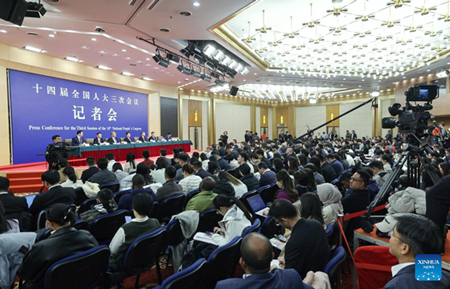

 
Zheng Shanjie, head of the National Development and Reform Commission, Lan Fo'an, minister of finance, Wang Wentao, minister of commerce, Pan Gongsheng, governor of the People's Bank of China, and Wu Qing, chairman of the China Securities Regulatory Commission, attend a press conference on economy for the third session of the 14th National People's Congress (NPC) in Beijing, capital of China, March 6, 2025. (Xinhua/Zhang Yuwei)
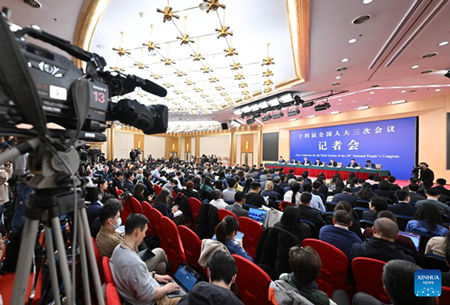

 
Zheng Shanjie, head of the National Development and Reform Commission, Lan Fo'an, minister of finance, Wang Wentao, minister of commerce, Pan Gongsheng, governor of the People's Bank of China, and Wu Qing, chairman of the China Securities Regulatory Commission, attend a press conference on economy for the third session of the 14th National People's Congress (NPC) in Beijing, capital of China, March 6, 2025. (Xinhua/Xu Bingjie)


Domestic demand unlocks new growth opportunities: Official  

BEIJING, 7 March 2025 (Xinhua) -- Expanding China's domestic demand will create new opportunities for growth across multiple sectors, an official said in the latest episode of the China Economic Roundtable, an all-media talk show hosted by Xinhua News Agency.

Domestic demand is a "home market that will not move away," and its growth will increase the country's market capacity and bolster economic circulation, according to Huang Lianghao, an official of the Research Office of the State Council.

Huang made the remarks while discussing this year's government work report, which was submitted to the national legislature for deliberation on Wednesday. Domestic demand will be made the main engine and anchor of economic growth, according to the report.

"We should adopt a comprehensive approach and identify key areas to unleash all potential of domestic demand," the official said.

Increasing spending power is one of the key measures to boost consumption outlined in the report. According to Huang, this is the most fundamental task aiming to ensure that people have enough money to spend.

Huang also called for efforts to address the most pressing issues hindering consumption, as well as to improve the overall consumption experience and boost people's willingness to spend.


© 2011 - 2025 The Diplomatic Society | All Rights Reserved | Website Designed by The Website Hoster