


Women placed at centre of South Africa’s science and innovation agenda
TDS - 24 August 2026
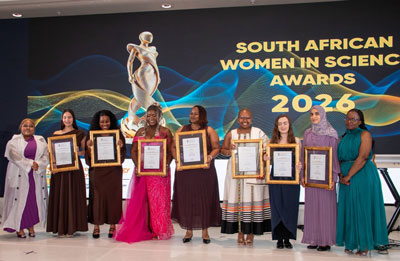
South Africa has reaffirmed the need to place women at the centre of its science, technology and innovation agenda, with the 23rd South African Women in Science Awards highlighting both the progress made and the barriers that still prevent women from reaching their full potential.
Opening the awards gala in Sandton, Science, Technology and Innovation Minister Blade Nzimande said South Africa could not achieve its national development goals while women and girls remained excluded from opportunities in science, technology and innovation.
The 2026 awards were held under the theme “Placing Women at the Centre of Science, Technology and Innovation”, reflecting the Department of Science, Technology and Innovation's broader objective of placing science, technology and innovation at the centre of government, education, industry and society.
Nzimande said the country had made important progress. Women now account for 52% of the academic workforce and 47.7% of the national research workforce, while women represented 62.6% of university enrolments in 2024.
Government has also introduced equity targets, including a requirement that at least 55% of postgraduate bursaries go to women and 80% to Black students. During the 2025/26 financial year, 6 246 postgraduate students received bursary support, including 708 Black women emerging researchers. Women also held 104 of the 198 operational South African Research Chairs as of April 2026.
However, Nzimande stressed that progress in participation has not yet translated into equal representation in research leadership and some of the country's most critical STEM disciplines.
Women remain underrepresented in areas such as engineering, computer science and artificial intelligence. Female-owned technology businesses also continue to face difficulties in accessing venture capital.
The Minister said government was therefore focusing on seed funding, incubation and venture capital for female-led technology enterprises. The objective, he said, was to ensure that women are not only researchers and scientists, but also entrepreneurs, intellectual property owners and leaders in global markets.
Women and the AI revolution
The challenge of ensuring women's meaningful participation in emerging technologies was also highlighted by Dr Wiebke Hutiri, Senior Research Scientist at Sony AI, who delivered the keynote address.
Hutiri said women should not be viewed simply as beneficiaries of new technologies. They should have a role throughout the research and innovation process, from identifying research questions and designing methodologies to analysing data, setting research priorities and influencing funding decisions.
She warned that South Africa could not afford to leave women out of the rapidly developing artificial intelligence economy.
Her message was particularly relevant as AI increasingly influences areas ranging from public services and energy to healthcare, education and business. Hutiri argued that women's experiences need to be reflected in the data used to develop AI systems and in the decisions about how these systems are evaluated and deployed.
She also emphasised the economic dimension, saying women must be able to participate in and benefit from the emerging AI economy rather than simply consume technologies developed by others.
A new name honours a scientific pioneer
One of the significant developments at this year's awards was the renaming of the DSTI fellowships in honour of the late Professor Keolebogile Shirley Motaung.
The fellowships will now be known as the DSTI-Professor Keolebogile Shirley Motaung Fellowships, recognising the contribution of a pioneering Black woman scientist whose work included stem cells, regenerative medicine and indigenous knowledge systems.
The decision gives a lasting institutional recognition to Motaung's contribution to South African science while linking her legacy to the development of the next generation of women researchers.
Seven emerging women researchers received the fellowships this year. Their research ranges from marine biodiversity and tax justice to honeybee health, infectious disease diagnostics, forestry, agricultural genetics and astronomy.
The recipients include Makwena Melita Sebone, whose research focuses on marine ecosystems; Associate Professor Jane Ndlovu, who is examining gender and the tax system; Nolwandle Nolen Khumalo, whose work looks at honeybee health; and Nondumiso Nkosi, who is developing diagnostic technology for hepatitis B.
Vhuhwavho Tshavhungwe is researching the competitiveness of South Africa's sawmilling industry, while Victoria Rankotsane Hlokoe is investigating chicken genetics with implications for smallholder farmers and food security. Annarien Headley is pursuing research into star formation across the Milky Way.
The breadth of these projects illustrates the contribution that women researchers are making across South Africa's scientific landscape, from addressing immediate social and economic challenges to advancing knowledge in highly specialised fields.
Recognising established and emerging researchers
The awards also recognised established researchers whose work is contributing to South Africa's development.
Professor Xanthe Hunt received recognition for her work in adolescent mental health, while Professor Tricia Naicker was recognised for her contribution to drug discovery and research addressing antimicrobial resistance.
Professor Tanusha Raniga was honoured for her work on gender justice, poverty alleviation and social welfare, particularly the economic challenges facing women in vulnerable households.
Together, the award recipients demonstrate the range of disciplines in which South African women are contributing to research, innovation and public policy.
The collective achievements of women recognised at the awards are also significant. Award recipients have produced 1 742 peer-reviewed papers and 112 book chapters and currently supervise 139 postgraduate students. Their contribution extends beyond academic publishing to mentoring, international scientific engagement, conference leadership and participation in professional and societal institutions.
Beyond recognition
The significance of the Women in Science Awards extends beyond celebrating individual achievements. The awards are intended to strengthen the pipeline of women entering science, technology and innovation and to provide visible role models for younger women and girls.
For South Africa, the challenge now is to turn increased participation into greater leadership, ownership and economic opportunity.
As the country looks towards the next decade of technological change, the message from this year's awards is clear: women cannot remain on the margins of the science and technology revolution.
The renaming of the fellowships in honour of Professor Keolebogile Shirley Motaung provides an important link between the achievements of women scientists of the past and the researchers who will shape South Africa's scientific future. The broader objective is to ensure that women are not only recognised for their contribution to science, but are positioned to influence its direction and benefit from the economic opportunities it creates.
THE 2026 SAWiSA FINALISTS ARE:
HUMANITIES AND SOCIAL SCIENCES
Distinguished Women Researchers
Prof. Tanusha Raniga – WINNER
Prof. Agnes Chigona – 1st Runner up
Prof. Nirmala Dorasamy – 2nd Runner up
Distinguished Young Women Researchers
Prof. Xanthe Hunt – WINNER
Prof. Faheema Mahomed-Asmail – 1st Runner up
Prof. Musawenkosi Saurombe – 2nd Runner up
NATURAL (LIFE AND PHYSICAL) AND ENGINEERING SCIENCES
Distinguished Woman Researchers
Prof. Marietjie Venter – WINNER
Prof. Sheena Kumari Pillai – 1st Runner up
Prof. Nelishia Pillay – 2nd Runner up
Distinguished Young Woman Researchers
Prof. Tricia Naicker – WINNER
Dr Yaseera Ismail – 1st Runner up
Prof. Muthumuni Managa – 2nd Runner up
PUBLIC ENGAGEMENT WITH SCIENCE
Distinguished Woman Researcher
Associate Prof. Lynn Hendricks – WINNER
Distinguished Young Woman Researcher
Dr Hafsa Essop – WINNER
INNOVATION FOR IMPACT: WOMEN LEADING CHANGE
Distinguished Woman Researcher
Prof. Tebogo Mothiba – WINNER
Distinguished Young Woman Researcher
Associate Prof. Sabrina Kumschick – WINNER
DSTI–PROF. KEOLEBOGILE SHIRLEY MOTAUNG FELLOWSHIPS
Doctoral Fellowships
Ms Makwena Sebone
Associate Prof. Jane Ndlovu
Ms Nolwandle Khumalo
Ms Nondumiso Nkosi
Ms Vhuhwavho Tshavhungwe
Ms Victoria Hlokoe
Ms Annarien Headley
Master's Fellowships
Ms Kayleigh Mathieson
Ms Mushayathoni Nwovhe
Ms Nasiphi Siguca
Ms Rebaone Mofokeng
Ms Yolanda Mngcongo
Ms Jos Jansen van Vuuren
Ms Ayesha Aswat