


Opening Doors - Widening the access for young people through international partnerships.
By Nazeer Osman and Zubaida Osman
23 October 2026
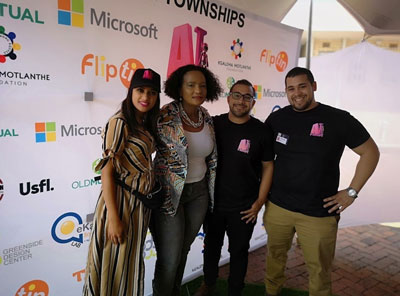
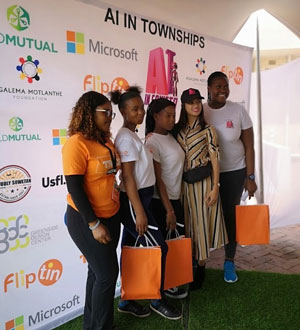
On 16 June this year, fifty years to the day after the learners of 1976 walked out of their classrooms over the terms on which they would be taught, a hundred learners from five Soweto high schools spent a day with a set of AI tools and a straightforward brief. Identify a challenge where you live, and brainstorm solutions that do something about it.
They identified issues in their own communities and researched them. They built pitch decks and websites, and then they stood up and presented what they had made to a hall of adults who had come to listen.
Dr Pali Lehohla, the former Statistician General of South Africa, spoke to them about data as something a community owns and uses rather than something taken from it, and asked them to think about the future they are both inheriting and creating. My brother, Yazeed Osman, co-founder of the non-profit Liberation Hub, told the young leaders on the day that Africa’s greatest resource has never been what lies beneath the ground, but the creativity and resilience of the people standing on it.
Education programmes like that take time to develop and evolve, and they come out of years of patient work by organisations that have learned, through practice, what opens the mind of a young person.
They also happen against a backdrop of historical uncertainty and ongoing transformation. Trade relations are being rewritten, old certainties about how countries deal with each other are giving way, and the news from many parts of the world varies in degrees of positive promise. None of that is a reason to look away from the potential of young people. All of our combined experience in civil society points to reasons as to why we should centre youth more, and it is for these reasons that the countries that will harness the future the best are the ones putting capability into the hands of the generation that will have to do the managing.
Two organisations, one direction
Liberation Hub and the Kgalema Motlanthe Foundation have been working alongside each other since 2019, in different configurations at different times, on the same broad purpose: putting real skills, real tools and real exposure within reach of young South Africans who would not otherwise encounter them.
At the Foundation’s programmes, learners from public schools work through robotics, which in practice means coding, electronics, physics and algorithms in a single afternoon. Others record multimedia podcasts on professional broadcast equipment, design and build their own video games, or learn to fly drones. Learners are taken on excursions and career days into environments they would not usually enter. Where a young person faces difficulties that a classroom struggles to address, social workers go to the school and to the community.
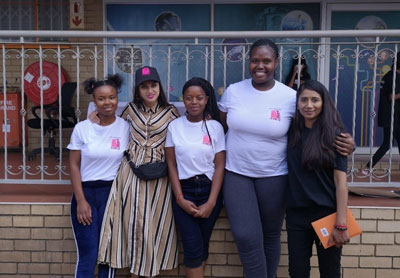
One of the Kgalema Motlanthe Foundation’s (KMF) first projects was AI Bootcamps for Girls. It grew and travelled across provinces in South Africa with an emphasis on reaching girls and young women within the digital divide. This has stayed as one of the focus points of the ever-expanding work that the KMF delivers to beneficiaries across the board.
Another growing pillar within the Foundation’s service offering is establishing sustainable greenhouse tunnels in schools to support agriculture teaching, to supplement feeding schemes and expose learners to hands-on training within the value chain of food security and fresh produce.
The KMF holistic approach to youth development through an education ecosystem combining technology, creativity, sustainability, wellbeing and ethical leadership has been noted by The United Nations Secretary-General’s report on industrial development in Africa.
That is a notable and significant milestone. The inclusion of the Kgalema Motlanthe Foundation’s digital skills centre in point 77 of the UN Secretary-General’s report for the 79th UN General Assembly acknowledges the global recognition of KMF Executive Trustee, Mrs. Gugu Motlanthe’s vision and on-the-ground work. By being framed as an exemplary initiative under the “Conclusions and Recommendations” for Africa’s industrialisation, this partnership with the Arab Bank for Economic Development in Africa (BADEA) serves as a blueprint for other UN member states looking to unlock youth potential through scalable digital infrastructure.
This is certainly a point of pride but more so a compass for Liberation Hub to navigate its strengths towards deepening partnerships. Among these strengths includes the design of programmes like the AI skills workshops in Soweto, and a network across technology, education and business that can be brought to bear on a specific cohort of learners.
That connection between the two organisations goes back further than the formal partnership. Zubaida Osman and Former First Lady of South Africa H.E. Mrs Gugu Motlanthe first worked together in 2019, with girls and young women in Mitchells Plain, Western Cape province of South Africa. The ongoing friendship and shared commitment that grew out of that work has shaped how the Liberation Hub understands and approaches work with young people since. Zubaida’s own account of the lessons learnt appears later in this essay.
Although work of this nature reaches many young people, the youth development programmes are also faced with the challenge where the need runs into the millions of youths. An honest position is to understand that programmes like these demonstrate what works, what can be upgraded, what innovations can be applied in the ambition to resolve the problem at wider, national scale, through intentionality and more partnerships. An upside of this working model is proving a method, holding it steady over a sustained period, and making it available to more who want to take it further.
An international connection worth noticing
Behind a significant part of the Kgalema Motlanthe Foundation’s work sits an organisation founded in Riyadh.
The Arab Gulf Programme for Development was established in 1980 on the initiative of the late Prince Talal bin Abdulaziz, with the backing of Gulf leadership. Over the four decades since, AGFUND has built partnerships with more than four hundred and fifty organisations worldwide, usually without much publicity attached. Its partnership with the Kgalema Motlanthe Foundation covers training, curriculum development, expert guidance and intergenerational dialogue, directed at young people, women and girls. Amongst these include a series of Winter Seminars for knowledge exchange and solutions, with the most recent taking place in July of 2026 around themes of the African continent and migration.
The relationship runs in both directions. In May 2024, the Foundation’s Executive Trustee, Mrs Gugu Motlanthe, travelled to Saudi Arabia to receive an Award for Development from the Arab Bank for Economic Development in Africa, in recognition of work carried out in South African communities.
A South African foundation delivering digital and agricultural skills to young people, supported from Riyadh, and its leadership honoured in the Kingdom for how well it does that work. It is a good story, and it is not always the sort of story that usually travels.
A view from Riyadh
Five years of living and working in Saudi Arabia help to make one thing plain to grasp: the appetite for these kinds of partnerships demonstrate the many connections that exist and the potential for further cooperation and collaboration between nations.
Saudi Arabia has an established national commitment to its young people. The Human Capability Development Program, launched in 2021 under Vision 2030, runs from early childhood through to adult retraining and rests on three commitments: an educational foundation for every citizen, preparation for the labour market at home and abroad, and continuing opportunities to learn across a working life. South Africa has made a comparable commitment through its own instruments, among them the National Development Plan, the National Youth Policy and the Presidential Youth Employment Intervention, and it devotes a larger share of its economy to education than any other OECD member or partner country.
Two countries, then, that have common goals about where their futures lie, and that already have a working example of what cooperation between them produces.
And although sovereign nations don’t always set the terms of the international system they operate in, it is a safe assumption that no nation can wait for a settled world before making inroads and following a vision for a world that their youth should grow up in.
What we, as civil society and concerned parents can do is build relationships directly with like-minded organisations and widen our own spheres of influence to act and contribute to meaningful impact. Partnerships in youth development are among the most durable of those relationships, because they are built on something both sides intend to keep doing regardless of what else changes.
The traffic between Africa and the Gulf is increasing across trade, technology and development. Youth development belongs inside that traffic, and there is a greater sphere of influence that more individuals and organisations can be a part of and inform.
What the AGFUND-KMF partnership demonstrates is that the distance between a Gulf institution and a South African classroom is far shorter than it looks. The obstacle is rarely willingness. It is more likely that too few people on either side exchange the knowledge and experience that is unique to them and valuable to many.
A note to the young women who might read this
By Zubaida Osman
In 2019 I spent my days going into communities in Mitchells Plain to persuade young women to give up three days of their lives to something called an artificial intelligence bootcamp. Most of them had never heard the phrase. A few thought I had the wrong house.
Getting them to say yes turned out to be the easy part.
What I remember is how they arrived. Quiet, watchful, sitting near the door. Several of them told me afterwards that they had spent the first morning waiting to be found out, waiting for somebody to notice they did not belong there and ask them to leave.
Nobody was going to ask them to leave. But they had no way of knowing that, because nothing in their experience had suggested a room like that one was built with them in mind.
So the work was not really about teaching artificial intelligence, though that happened too, through design thinking and teamwork and a great deal of arguing in groups. The work was making it a room they belonged in. Listening to them. Telling them, out loud and more than once, that they were capable. Making sure they left knowing about bursaries and further study, so that the three days opened onto something rather than closing behind them.
By the third day they were the ones talking over each other.
I have three children, and I think constantly about what will be available to them. That thinking does not stop at my own front door. Every young woman deserves to find out what she is capable of, whatever she has had access to until now.
If you are a young woman reading this and wondering whether these rooms are meant for you, the coding class, the robotics workshop, the bursary application you have opened and closed four times, they are. You will not feel ready. Almost nobody does. Go anyway.
Africa’s future will be built with these technologies. You should be among the people building it, not only among the people using it.
I cannot change every life. But one opportunity, one conversation, one person saying you are capable can change the direction of someone’s future. That is the kind of impact I hope to keep making.
What comes next
Liberation Hub intends to keep building with the Kgalema Motlanthe Foundation, and to keep the focus where it has been: on digital skills, on training that leads somewhere, on sustainability and food security, and on making sure girls, young women and youth are not the last to be reached.
The ambition is to widen the circle. There are foundations, companies and institutions in locations across South Africa and Saudi Arabia who recognise the value of this work and recognise in themselves the distinct benefits that their specific expertise and knowledge can bring to the table.
The kind of partnership worth pursuing is the kind that already exists here: sustained over years, tied to outcomes that can be measured, and tailormade enough that a young person can plan around it and see a future for themselves. Continuity is the thing that turns exposure into a pathway, and continuity makes the difference in serious partnerships.
It is the most natural thing a parent can want: that a child grows up free to be themselves, with the confidence to express who they are and the encouragement to find what they genuinely love. It is the whole of what this work is for. Some families can arrange it alone. Many cannot, and part of the difference is made by whether somebody puts the tools within reach and takes a young person seriously.
In a Soweto classroom on 16 June, one hundred young people got exactly that and there is no reason it should stop there.
Nazeer Osman is a customer experience and digital transformation leader who has spent the past five years working in Saudi Arabia. He is involved with Liberation Hub, a South African non-profit working on youth development, technology and entrepreneurship in partnership with the Kgalema Motlanthe Foundation. Liberation Hub was co-founded by his brother, Yazeed Osman.
Zubaida Osman is a South African entrepreneur and a marketing and events professional and works with Liberation Hub on its youth development programmes. She has worked on digital skills initiatives for young women since 2018.