


International Day of the Migrant (IDM) – Mobility, Memory and Solidarity
by Kirtan Bhana - TDS
21 December 2025
From the earliest nomadic communities to today’s hyper-connected societies, human mobility has been a defining feature of civilization. Long before borders, passports, or nation-states, nomadic humans moved in response to climate, food sources, conflict, curiosity and opportunity, migration is a constant human activity. These movements shaped human evolution itself spreading languages, technologies, belief systems, genetics and culture across continents over millennia.
Migration is therefore not an anomaly of modern times; it is the default condition of human history. The agricultural revolution encouraged settlement, empires formalised borders, and industrialisation accelerated urban migration but the instinct to move, adapt and explore never disappeared. What has changed is the scale, speed and complexity of migration in a globalised world.
Today, nomadic life is experiencing a renewed relevance. Connectivity, affordable travel, digital platforms, and global labour markets have transformed migration into a dynamic, multi-directional experience shaped not only by survival, but by love, education, career opportunity, entrepreneurship and cultural exchange. Migration now intersects with technology, identity and aspiration in ways unimaginable even a generation ago.
Purpose and Significance
International Migrants Day (IDM), observed annually on 18 December, was proclaimed by the United Nations General Assembly in 2000 marking 25 years of global recognition in 2025. The day reaffirms the need for safer, more inclusive and fairer migration, and acknowledges migrants as contributors to human development rather than burdens on host societies.
IDM highlights both the positive role migrants play as workers, innovators, cultural bridges and community builders and the challenges they face, including discrimination, precarious legal status, exploitation and displacement. In an interconnected world, migration governance is no longer optional; it is central to social cohesion, economic resilience and international cooperation.
Ecuador’s Commemoration in South Africa
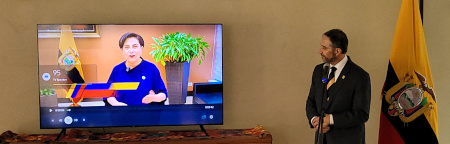
In Pretoria, Ecuador’s Ambassador to South Africa, H.E. Mauricio Montalvo, hosted a reception to mark International Migrants Day, honouring migrants and reaffirming Ecuador’s commitment to human mobility rooted in dignity and rights. Welcoming guests, Ambassador Montalvo emphasised the particular resonance of migration for Ecuadorians, many of whom live abroad. A video message from Ecuador’s Minister of Foreign Affairs and Human Mobility, Gabriela Sommerfeld, reinforced this position. She described migration as a vital component of human development, underscoring Ecuador’s commitment to migrant rights, cooperation among states, and the principles of the Global Compact for Safe, Orderly and Regular Migration. The Minister also highlighted improvements in consular services, recognising the state’s responsibility to protect and support its citizens wherever they reside.
Migration in Practice
The human dimension of migration was powerfully illustrated through the testimony of José D. Moran, who left Ecuador 14 years ago. His journey took him across Mozambique, Zambia, Tanzania, Ethiopia and South Africa, where he currently works as a regional manager for a major multinational brewing company.
Moran described migration not simply as relocation, but as transformation learning, adapting and representing his home country while becoming deeply connected to Africa. “We belong to Latin America,” he noted, “but we are citizens of the world.” His reflections challenged narrow notions of identity, emphasising Africa’s diversity and the need for the world to better understand the continent beyond stereotypes.
Building Bridges and Social Cohesion
Migration’s potential is realised most fully when it is accompanied by cooperation and social cohesion. Simphiwe Ngwenya, a South African destination development specialist, highlighted ongoing efforts to establish sister associations between countries, including new cooperation initiatives between Ecuador and South Africa. Such people-to-people frameworks transform migration from an individual experience into a shared developmental opportunity.
Similarly, Linda Ben, Co-founder and CEO of the Alkebulan Immigrants Impact Awards (AIIA), emphasised the importance of recognising immigrant and refugee contributions. AIIA’s advocacy for social cohesion reflects a growing recognition in South Africa that migrants are integral to innovation, entrepreneurship, cultural vitality and economic growth. Ambassador Montalvo presented awards to individuals and organisations that have strengthened cooperation and mutual understanding between Ecuador and South Africa affirming that migration, when supported, becomes a force for unity rather than division.
Migration, Crisis and Solidarity
Against this backdrop, the need for Latin American and Caribbean solidarity takes on renewed urgency. Ongoing humanitarian, economic and climate-related challenges in the Caribbean region continue to displace communities, reinforcing the reality that migration is often not a choice but a necessity. History reminds us that solidarity between regions, states and peoples has been most critical during moments of upheaval.
Migration shaped the Caribbean through centuries of forced and voluntary movement; today, it demands collective responsibility rather than securitised responses. The principles highlighted on International Migrants Day safety, dignity, fairness and cooperation are essential if mobility is to contribute to stability rather than suffering.