

History, Reform and the Rise of a New Eurasian Powerhouse, Kazakhstan
By Kirtan Bhana
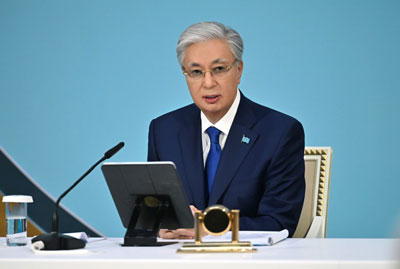
Kyzylorda, Kazakhstan – 22 January 2026
From the vast, mystical expanses of the Kazakh steppe—rich in energy, precious minerals and breath-taking natural topography, has emerged a nation consciously shaping its future while remaining deeply anchored in its ancient past. Kazakhstan’s profound civilisational heritage, nurtured by the rhythms of nomadic culture and the strategic arteries of the Great Silk Road, today underpins the rise of a modern, innovative and increasingly influential state.
At the fifth convening of the National Kurultai, held on 20 January on the sacred land of Kyzylorda, President Kassym-Jomart Tokayev delivered a comprehensive and forward-looking address that reflected both the depth of Kazakhstan’s history and the clarity of its national ambition. His speech reaffirmed that Kazakhstan’s consistent, timely and carefully sequenced transformation is yielding tangible results in governance, economic resilience, social mobility and international standing.
Kyzylorda is a Cradle of Memory and Momentum
President Tokayev’s choice of Kyzylorda as the venue was deeply symbolic. Each Kurultai gathering has traced Kazakhstan’s civilisational geography — from Ulytau and Turkestan to Atyrau and Kokshetau — culminating now on the banks of the Syr Darya, long revered as “Alash’s mother.”
The President evoked the ancient settlements of Chirik-Rabat, Zhankent, Syganak, Altynasar and Barshynkent, which testify to an early urban culture on Kazakh soil. Kyzylorda, once the capital of Kazakhstan a century ago, stands as their modern successor, a place where pivotal decisions shaping the nation’s future were once made, and are being made again.
Culturally, the region remains synonymous with storytelling, poetry and music. From the legacy of Korkyt Ata to the oral epic traditions of Zhiyenbay, Nurtugan and Nartai, Kyzylorda represents the living continuity of Kazakh identity. This spiritual and cultural grounding, President Tokayev suggested, is inseparable from Kazakhstan’s contemporary state-building project.
Kyzylorda as a Microcosm of National Growth
The President highlighted Kyzylorda’s recent socio-economic performance as emblematic of Kazakhstan’s broader transformation:
• Gross regional product growth of 6.5% in the past year
• Nearly two trillion tenge in investment attracted over three years
• 27 investment projects implemented in 2025 alone
• Commissioning of a new investor-funded thermal power plant, strengthening regional energy security
Infrastructure development has been equally robust. The region now enjoys universal access to quality drinking water, 80% gas coverage with ongoing expansion, modernised road networks, and upgraded aviation and rail facilities—including a new terminal at Korkyt Ata Airport and the reconstruction of historic railway stations.
Social investment has matched economic momentum. Over three years, dozens of new schools, hospitals, cultural and sports facilities have been built. Major healthcare projects, including a 300-bed multifunctional hospital, a 500-capacity polyclinic and a 200-bed perinatal centre, are underway, reinforcing the people-centred character of Kazakhstan’s development strategy.
Energy, Water and the Imperative of Environmental Diplomacy
Standing on historic land that once launched humanity’s first journey into space from Baikonur, President Tokayev turned to one of the most pressing challenges of our time: water security.
The fate of the Aral Sea, he emphasised, remains a matter of global concern. While Kazakhstan has successfully preserved and begun restoring the Northern (Small) Aral, the President acknowledged that water governance is inherently transboundary. The volume of Syr Darya waters reaching the sea depends on upstream policies, making water diplomacy a strategic necessity rather than a choice.
Tokayev outlined concrete steps:
• Raising the Kokaral Dam, increasing the Small Aral’s water volume
• Advancing regional water-sharing agreements across Central Asia
• Promoting the establishment of an International Water Organization within UN reform discussions
• Hosting an International Environmental Summit in Astana in April 2026
Water, he declared unequivocally, is a strategic national resource, inseparable from food security, energy planning and regional stability.
Constitutional Reform and a New Political Architecture
At the heart of President Tokayev’s address was a clear articulation of Kazakhstan’s next constitutional phase. Building on the landmark 2022 reforms, he outlined a transition away from the 1995 constitutional model toward a fundamentally new system grounded in checks and balances, institutional clarity and electoral legitimacy.
Key reforms include:
• Clear constitutional rules for presidential succession, ensuring leadership transitions occur exclusively through elections
• The proposed establishment of a Vice President, with constitutionally defined responsibilities to enhance governance coherence
• Strengthening parliamentary oversight over key institutions, including the Constitutional Court and Central Election Commission
• Reconfiguring legislative structures toward a more streamlined, professional and accountable parliamentary system
These reforms, many to be endorsed through a national referendum, aim to entrench long-term political stability while reinforcing the principle of law and order for all.
Diplomacy, Integration and Kazakhstan’s Global Role
President Tokayev situated Kazakhstan firmly within a rapidly shifting global environment marked by declining trust and rising militarisation. Against this backdrop, he reaffirmed a balanced, pragmatic and interest-driven foreign policy, positioning diplomacy as a tool of compromise rather than confrontation.
As chair of the Eurasian Economic Union (EAEU) in 2026, Kazakhstan will prioritise the removal of trade barriers, the defence of national economic interests, and the application of artificial intelligence to integration processes. Simultaneously, Kazakhstan is accelerating its ambition to become a pivotal East–West and North–South logistics hub, with major investments in highways, railways and cargo aviation.
Digitalisation, Culture and the Future of National Agency
Looking ahead, President Tokayev identified digitalisation and artificial intelligence as decisive forces shaping sovereignty and competitiveness. Kazakhstan’s strategy links technology with governance reform, infrastructure development and cultural preservation.
He advanced the vision of a National Digital Heritage, ensuring that Kazakhstan’s history, knowledge systems and artistic achievements are integrated into the global digital civilisation. Cultural and spiritual development, he stressed, is strategic. Without a strong cultural core, economic and political reforms cannot succeed.
Kazakhstan is positioning itself as a rapidly emerging economic and diplomatic powerhouse at the heart of Eurasia.