

NDB Flagship Governors Seminar highlights New Development Bank’s growing role in supporting sustainable development priorities
High-level discussions in Moscow highlight innovation financing, AI, energy systems and inclusive growth
TV BRICS/Photos: New Development Bank
18 May 2026
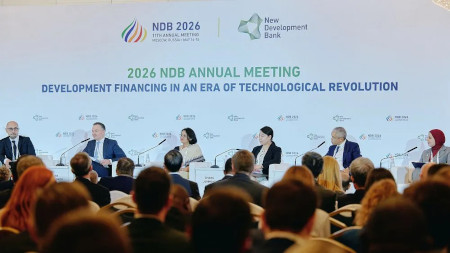
For the first time, the Annual Meeting of the Board of Governors of the New Development Bank (NDB) has been held in Moscow, marking a significant moment for the institution’s global agenda and engagement with its member countries.
The NDB Flagship Governors Seminar was held under the theme “Development Financing in an Era of Technological Revolution” and took place on 14 May 2026.
The seminar brought together senior government officials; finance ministers; central bank representatives, including NDB President Dilma Rousseff; as well as development experts and policy leaders to examine how technological transformation is reshaping development pathways across emerging economies. The focus was placed on how development finance can accelerate innovation, strengthen resilience and support inclusive growth, especially in the BRICS and Global South countries.
A central theme throughout the seminar was the role of the New Development Bank in supporting countries to adapt to this transformation through targeted financing, knowledge sharing and capacity building, particularly in areas such as artificial intelligence, digital infrastructure and energy systems.
Deputy Prime Minister of Russia Aleksey Overchuk stressed that technological change is directly linked to energy demand and economic competitiveness, particularly as artificial intelligence becomes more embedded in industrial and social systems.
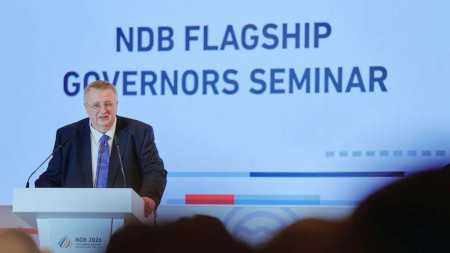
He emphasised that a stable and sustainable energy supply is becoming a critical foundation for digital development, noting that nuclear energy and other reliable sources will play an important role in supporting data-intensive technologies.
Overchuk highlighted the institutional strengths of BRICS cooperation, stating that the NDB is fortunate to have among its member countries that possess cutting-edge technologies and are able to make such solutions available to other members of the group.
"We have countries that are like-minded in the sense that we all value our independence and believe in mutual respect between nations. This is one of the greatest strengths of BRICS. No matter how large or small the economy of a member country may be, decisions are made on the basis of respect and consensus. That is extremely important, and it is one of the key advantages that BRICS offers to all its members" Aleksey Overchuk Deputy Prime Minister of Russia
Jeffrey Sachs, Director of the Center for Sustainable Development at Columbia University, reinforced the importance of the transition to greener agriculture and the development of new green energy systems in shaping global technological progress, arguing that innovation should be directed towards public benefit.
“BRICS is accelerating the energy transition and the green transformation; this will represent a major economic success from the perspective of the member countries. […] This is the direction in which the BRICS countries are leading. In 20 years’ time, it will be BRICS that provides the technologies the world needs,” he said.
Sachs added that artificial intelligence should prioritise improvements in healthcare, education, environmental sustainability and public services, stressing that technological progress must enhance quality of life rather than concentrate on narrow applications.
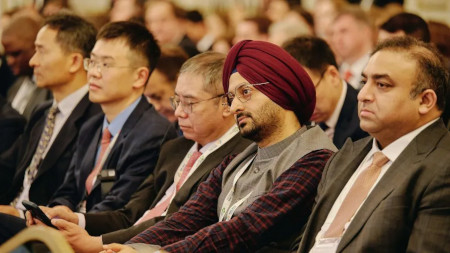
Anuradha Thakur, Alternate Governor for India and Secretary at the Department of Economic Affairs at the Indian Ministry of Finance, emphasised that NDB must continue to evolve to meet the demands of rapid technological change. She outlined three key priorities: expanding support for technology-enabling infrastructure, promoting country-led innovation pathways, and integrating digital tools into development finance operations.
According to Thakur, the New Development Bank plays a distinctive role in advancing South–South cooperation and supporting innovation-driven growth through long-term financing and flexible development instruments.
Further strengthening this perspective, Chang Junhong, Temporary Alternate Governor for China and Assistant Minister of Finance, described NDB as a key provider of global public goods in the digital era.
“Compared with many of its peers, I believe the NDB has a distinctive niche as a relatively new institution supporting its members in harnessing the opportunities created by technological innovation,” she said, adding that they can help bridge the digital divide and improve global digital governance.
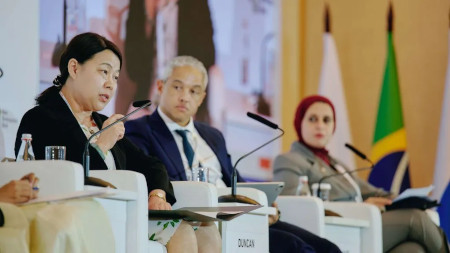
She highlighted that many developing countries remain at different stages of digital readiness and require support in infrastructure, institutional capacity and human capital development to fully benefit from technological transformation.
Chang stressed that the New Development Bank has a unique advantage due to its country-driven model and membership structure, which enables tailored solutions rather than uniform approaches.
She added that China stands ready to deepen cooperation with the New Development Bank to support innovation-led development and expand technological capacity across member economies.
Enoch Godongwana, Governor for South Africa and Minister of Finance of South Africa, outlined three priorities for the New Development Bank: expanding financing for advanced technologies, including artificial intelligence, quantum computing and biotechnology; developing flexible funding mechanisms for early-stage innovation; and strengthening the bank’s role as a knowledge-sharing hub across member countries.
He also noted the need to further strengthen the Global South's position on the world stage and the NDB's role in this process.
"We must therefore ensure that the Global South acts as an active innovator rather than a passive consumer. […] This also requires development finance to evolve beyond traditional infrastructure financing, and this is where the NDB will need to play an important role," he stated.
Samar Al Ahdal, Temporary Alternate Governor for Egypt and Deputy Minister of International Cooperation, emphasised that technology has become a defining factor in modern development, shaping productivity, food security, climate action, and governance systems.
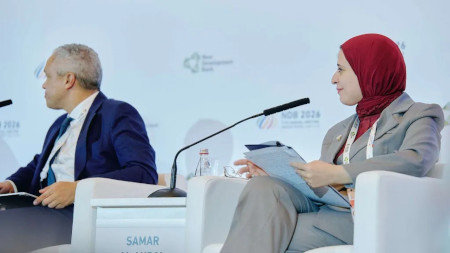
She noted that inclusive and sustainable technological transformation requires financing, governance frameworks, knowledge-sharing and international cooperation, highlighting the increasing NDB's impact.
“The New Development Bank continues to play an increasingly important role in supporting sustainable development priorities across its member countries, particularly through its strong focus on infrastructure, innovation, connectivity, and sustainable financing solutions tailored to the needs and realities of emerging economies,” she said.
She added that technology should be viewed as a historic opportunity to reshape development models in a more equitable and sustainable direction.
Throughout the seminar, participants agreed that development finance institutions must evolve to meet the demands of the technological era by supporting innovation ecosystems, strengthening infrastructure investment, and ensuring equitable access to digital tools and capabilities.
Earlier, Russian President Vladimir Putin met with President of the New Development Bank (NDB) Dilma Rousseff to discuss the bank’s current activities and future prospects.