


One Nation, 32 million Coaches: The World Cup Effect in Ghana
By FiiFi Netty
16 June 2026
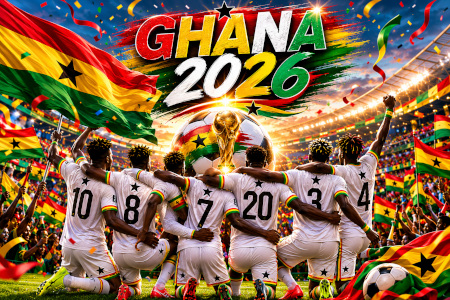
Ghana has once again qualified for the FIFA World Cup, joining the rest of the world for the historic 2026 tournament, which will be hosted by three countries — the United States of America, Mexico, and Canada. For the first time in the competition’s history, the World Cup will feature 48 teams instead of the traditional 32, following FIFA’s decision to expand the tournament.
Ghana is among the African nations that secured qualification for this historic event, alongside Morocco, Senegal, Egypt, Algeria, Tunisia, South Africa, Côte d’Ivoire, and Cabo Verde. Congo DR also earned a place in the intercontinental play-off tournament, which will determine the final qualification spots before the competition begins.
The FIFA World Cup remains one of the most prestigious sporting events in the world. Every footballer dreams of playing on that stage, while nations across the globe long to see their national teams compete among the best.
As Mr Bright Blewu, my former boss and fatherly friend, once said, “Football is the only game that will be played in Heaven.” Football is more than a sport in Ghana; it is a national passion that unites people from all walks of life.
Just weeks before the tournament, the Ghana Football Association parted ways with Black Stars coach Otto Addo, despite the fact that he successfully guided the team to qualification and had achieved that feat twice Critics argued that the team’s recent performances, particularly in friendly matches, were not convincing enough. His dismissal once again highlighted the intense pressure and expectations that come with managing Ghana’s national team.
As the tournament approaches, the excitement across the country continues to grow. People are replacing old television sets with newer ones in preparation for the matches. Ghana jerseys are selling rapidly, football debates are becoming louder, and streets, homes, and viewing centres are already filled with anticipation and celebration. The World Cup spirit has returned, and with it comes the unmistakable reality that in Ghana, during football season, the nation truly becomes one country with 32 million coaches.
In a chat with Nicholas Laryea, a football enthusiast, began by saying that before discussing the Black Stars, attention should first be given to local teams such as Accra Hearts of Oak. He explained that coach Cecil Jones Attuquayefio served as head coach of the club for many years and repeatedly led the team to the African Champions League before eventually winning the trophy.
According to him, former Black Stars coach Otto Addo should also have been given more time because building a strong team is a process, and he believed the coach was on the right path. Although he did not agree with some of Otto Addo’s decisions, he stressed that the coach needed time to rebuild the team and achieve the desired results instead of being sacked. As he put it, “Rome was not built in a day.
Mr Bright Blewu indicated that, In Ghana, whenever the senior national football team, the Black Stars, is in the world biggest tournament, the FIFA World Cup, it is a period of high national emotional drama and religious reflection. We offer prayers for the success of the team, regardless of our religious status, and collectively go through euphoria or trauma depending on match results. But one common benefit of that period is always that there is a great sense of national togetherness during the tournament, and acrimonious politics is significantly and temporarily suspended.
Mr Blewu added that in Ghana, everyone becomes a coach when the Black Stars are involved in a tournament. Young or old, rich or poor, almost every Ghanaian has an opinion on tactics, player selection, and team performance. Football conversations dominate homes, workplaces, markets, drinking spots, and public transport. The Black Stars are not just a football team; they are a symbol of national pride and identity. It is the only thing that brings Ghanaian together and unites us a country.
Joe Owusu Ansah, another football enthusiast, said he has little hope in the current Black Stars team because he has watched them play on several occasions and has not been impressed. According to him, he has followed the team for a long time, but their performances have not been convincing. However, he expressed hope that the new coach could bring some experience and possibly change the fortunes of the team.
Mr. Emmanuel Larbi AMOAH, Esq, a football enthusiast and team owner with over three decades of experience in football administration, said the sacking of the coach was unnecessary because, in his view, it would not have any significant impact on Ghana’s performance at the World Cup. According to him, changing the coach alone can not transform the fortunes of the Black Stars in some few weeks.
He explained that the real issue lies with the playing body — the caliber of players, the quality of football they play, the competitive leagues they feature in, and the level of contribution they make to their respective clubs. He noted that countries that usually excel at the World Cup are those whose players have spent many years playing together, often progressing through the national teams from the Under-17, Under-20, and Under-23 levels. Such teams, he said, usually have four, five, or six players who have built strong understanding and chemistry over time playing togehter while also competing at the highest levels in European leaques and other top leagues.
Mr. Larbi AMOAH also pointed to temperament and player development as major challenges facing the national team. He argued that many locally discovered talents do not enjoy the same long-term football development as to players who moved abroad at a younger age or were born and raised outside Ghana. According to him, some of these local players retire too early, even when they are at the peak of their careers, which affects continuity and maturity within the national team setup.
He stressed that Ghana must rethink its approach to football development. In his opinion, the country focuses too heavily on natural talent, whereas modern football now places greater emphasis on technical development, tactical understanding, and proper training. He added that players can be developed into excellent goalkeepers, strikers, midfielders, or defenders through proper coaching and investment in the technical aspects of the game.
He concluded that unless Ghana changes its football structure and development system, the national team may continue to struggle to achieve the expected results. For that reason, he said he is not expecting much from the Black Stars beyond the usual performances supporters have become accustomed to.
Henry Asante Twum, Communications Director of the Ghana Football Association(GFA), stated that in football, nothing is guaranteed, as no team in the world can assure supporters of success. According to him, history has shown that even the biggest teams with world-class players can fail to progress beyond the group stages of major tournaments. He cited the example of France, who entered the 2002 World Cup as defending champions but were eliminated in the group stage. He also pointed to Italy, one of the most successful nations in World Cup history, which failed to qualify for recent tournaments.
He explained that football is unpredictable and that even African powerhouses such as Nigeria are currently struggling to make an impact on the world stage. Speaking about Ghana’s new coach, Carlos Queiroz, he described him as highly experienced and well exposed, having participated in about five World Cups with different countries, including Portugal, South Africa, and Iran. He added that Carlos has also worked in the UAE and Qatar and was a finalist at the Africa Cup of Nations with Egypt. According to him, the coach has worked with top clubs such as Manchester United and Real Madrid , gaining experience in different football environments across the world.
However, he stressed that experience alone does not automatically guarantee results. Despite this, he expressed optimism about the atmosphere in the Black Stars camp, describing the chemistry between the foreign and local members of the technical team as very positive. He noted that the players have already undergone three intense training sessions and that the coach is working hard to build both the physical fitness and mental strength of the squad.
According to him, the training programme has involved gym work, field sessions, and swimming pool exercises, with some players expected to continue additional gym and recovery sessions later in the day. He emphasized that the coach is paying attention to both on-field and off-field preparation.
Henry Asante Twum further stated that the selection of the 28-man squad suggests the coach has a clear vision and something positive to offer the team. However, he noted that all the preparations will only be meaningful once the tournament officially begins, starting with Ghana’s opening match against Panama on June 17. He said the team must prove that they are capable of becoming a force in the competition.
He also welcomed the fact that many Ghanaians are not placing huge expectations on the Black Stars, despite their continued love and support for the team. In his view, that could become an advantage, as it may allow the team to surprise both opponents and critics.
He concluded by saying preparations are still ongoing and that the team will continue training, with many of the coach’s ideas expected to become clearer during the next friendly match against Wales. After that, the team will travel to the United States for another friendly before the tournament begins.
I wish to conclude by donning my national colours and give a shout out to our Black Stars with this prose:
Go-go-go, Black Stars go!
End
Fiifi Nettey Media Consultant