
Go, Africa, go! It's Our Time to Shine
By Fiifi Netty
22 June 2026
As excitement continues to build across Africa ahead of the 2026 FIFA World Cup, conversations in many homes, offices, markets, and cities have gradually shifted from politics and economic challenges to football.
Wherever you go, football dominates discussions. The anticipation is growing stronger by the day as the tournament draws closer, uniting millions of fans across the continent in hope and expectation. With participating countries announcing their final squads, the usual debates have begun. Armchair coaches and football enthusiasts are questioning some of the selections, arguing that certain players should have been included while others should have been left out.
In Ghana, for instance, many fans have criticised some of the coach's choices and continue to debate the reasons behind the inclusion of particular players.
However, this phenomenon is not unique to Ghana. Across Africa, football lovers are passionately discussing their national teams and analysing every squad announcement. Interestingly, the excitement is also evident in countries that have not qualified for the tournament. Social media platforms and international media outlets are filled with discussions, predictions, and expressions of support as fans eagerly await the start of the competition. One of the pay television networks has an advert that says " FIFA World Cup20206 Time as ooooo Everything Must wait NOW".
Shama Chol, a fellow journalist from Juba, South Sudan, said: "The moment millions of people around the world have been eagerly waiting for is finally here—a time of excitement, joy, and celebration. The FIFA World Cup is more than just a football tournament; it is a global festival that unites people of different cultures, backgrounds, and nations through the spirit of sport, friendship, and fair competition.
We are all set to witness some of the most memorable moments in football history and cheer on the teams and stars who will leave their mark on the world stage. Hearts will race with every goal, celebrations will erupt with every victory, and the thrill of competition will be felt in every match.
Let us get ready for days filled with passion, excitement, and unforgettable memories. Together, let us make the 2026 World Cup a remarkable football journey—one that brings people together and allows us to share in the world's love for the beautiful game. Welcome to the World Cup, and welcome to endless excitement!"
Omar Saher, a journalist friend with Almasry Alyoum newspaper in Egypt, indicated that the mood in Egypt is incredible as the country prepares to participate in the World Cup.
According to him, there is a great deal of excitement, pride, and hope among Egyptians. People are discussing the tournament everywhere—from cafés and workplaces to social media platforms.
Fans are eager to see how far the national team can progress, and many believe this could be a memorable moment for Egyptian football. While expectations remain relatively modest and most supporters are realistic about Egypt’s chances of making a deep run in the tournament, there is still a strong sense of optimism and ambition across the country.
Omar added that much of this confidence stems from the presence of internationally acclaimed players such as Mohamed Salah and Omar Marmoush, who compete at the highest levels of European football. Their experience and quality give fans hope that Egypt can be highly competitive and perhaps even spring a few surprises on the world stage.
Lassana Coulibaly, a journalist friend with journal le Guido from Mali, said the mood surrounding the 2026 World Cup is largely subdued among the Malian public. While football remains immensely popular in the country, the Eagles' failure to qualify for the tournament has left many fans disappointed.
According to Coulibaly, the approach of the 2026 World Cup is generating mixed feelings across Mali. The national team's campaign ended during the African qualifiers, with the Eagles finishing third in their group behind Ghana and Madagascar. This elimination was a significant setback for supporters who had hoped to see Mali reach the World Cup finals for the first time in its history.
He explained that the disappointment has been compounded by the country's ongoing security challenges and fuel shortages, which have shifted public attention to more pressing concerns. As a result, Malians are not showing the same level of enthusiasm for the World Cup as they did during the 2022 tournament in Qatar.
Coulibaly added that there is currently little excitement surrounding the upcoming World Cup. Instead, much of the country's sporting attention is focused on the African Taekwondo Nations Championship, which will be hosted in Mali for the first time. Even within sports media circles, discussions about the World Cup remain limited, with journalists dedicating far more attention to local and continental sporting events.
Yann Bossatsi, another journalists friend from Brazzaville, told me that In Congo-Brazzaville, the atmosphere surrounding the World Cup is relatively calm, as the country failed to qualify for this edition. Nevertheless, Congolese people are delighted by the qualification of their neighbors, the Democratic Republic of Congo (DRC), who are returning to the World Cup after a 52-year absence. They have already been promised massive support from across the river.
According to Kirtan Bhana, a fellow journalist from South Africa, there are moments in sport when history seems to pause, reflect on itself, and then stride confidently into the future. On 11 June 2026, when South Africa's Bafana Bafana step onto the iconic Estadio Azteca in Mexico City to face Mexico in the opening match of the FIFA World Cup, the world will witness one of those remarkable moments.
Sixteen years ago, South Africa and Mexico opened the 2010 FIFA World Cup—the first tournament ever hosted on African soil. The memory of Siphiwe Tshabalala's stunning opening goal remains one of the most celebrated moments in football history, accompanied by the unforgettable sound of vuvuzelas that announced Africa's arrival on the global football stage.
Today, fate has reunited these two nations, this time on North American soil, in what feels like a symbolic passing of the baton between hosts of football history.
For South Africans, the occasion stirs feelings of nostalgia, pride, and renewed optimism. Bafana Bafana's qualification for the 2026 FIFA World Cup reflects the steady growth of a nation that has undergone profound transformation over the past three decades.
South Africa occupies a unique place in global sporting history. It remains the only country to have hosted the FIFA World Cup, the Rugby World Cup, and the Cricket World Cup. It has also staged the Africa Cup of Nations on multiple occasions, consistently demonstrating the power of sport to unite people across cultures and backgrounds.
The 2026 FIFA World Cup marks another historic milestone for Africa. For the first time, ten African nations have qualified for football's biggest tournament, representing the continent's strongest-ever presence on the world stage. Africa arrives not as an outsider hoping to cause an upset, but as a genuine footballing force capable of competing with the very best.
Over the decades, African football has matured significantly. The flair and creativity of West Africa, the tactical discipline of North Africa, the resilience of Southern Africa, and the growing technical excellence found across the continent have transformed African teams into serious contenders. The dream that once seemed distant—the possibility of an African nation lifting football's most coveted trophy—no longer belongs solely to the realm of imagination.
Africa has produced world-class players, legendary clubs, and unforgettable World Cup moments. The next great chapter would be for an African nation to lift the FIFA World Cup itself. The 2026 tournament, jointly hosted by Mexico, the United States, and Canada, is the first World Cup to be shared by three countries. It comes at a time of considerable global uncertainty.
Historically, the FIFA World Cup has been one of the few events capable of transcending political, cultural, and social divisions. For one month, football reminds humanity of its shared passions, hopes, and aspirations.
Bafana Bafana enter the tournament as underdogs. The rankings may not place them among the favourites, and many experts will focus on traditional football powers. Yet every World Cup begins with possibility, and that remains the enduring magic of the beautiful game.
As South Africa returns to the opening stage of the FIFA World Cup against Mexico, the echoes of 2010 will travel with them. So too will the hopes and dreams of a nation determined to make its mark on football's grandest stage.
Another colleague from Egypt, Mahmoud Hashem, says the FIFA World Cup is regarded almost like a national festival in the country. According to him, preparations begin at least a month before the tournament, with thousands of football fans gathering daily in cafés from morning until dawn, proudly wearing the Egyptian national team jersey as well as the kits of their favourite teams.
Families, including children, often join these gatherings, while others organize watch parties in homes to enjoy the matches together. With Egypt participating in the tournament, authorities also set up giant screens in public spaces to enable large crowds to watch the games. Football clubs and stadiums similarly provide viewing opportunities for supporters.
Hashem noted that whenever Egypt, or any Arab or African team, secures a victory, celebrations erupt across the country. Fireworks light up the skies, while motorists sound their horns in jubilation, creating a vibrant and festive atmosphere that reflects the nation's deep passion for football.
The 2026 FIFA World Cup is particularly historic. It will be hosted jointly by three countries and will feature an expanded format with 48 teams, making it the largest World Cup ever staged. This expansion offers more opportunities for nations from Africa and other regions to compete on football's biggest stage.
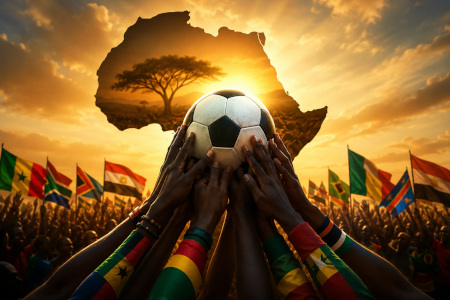
As the countdown continues, one thing is clear: Africa is ready. The passion, energy, and enthusiasm being displayed across the continent demonstrate the love Africans have for the beautiful game. The dream is alive, and millions of Africans will be cheering their representatives on as they seek to make history.
Go, Africa, go! It's our time and win.