

Durban conference positions Special Economic Zones as catalysts for South Africa's industrial revival
TDS - 20 July 2026
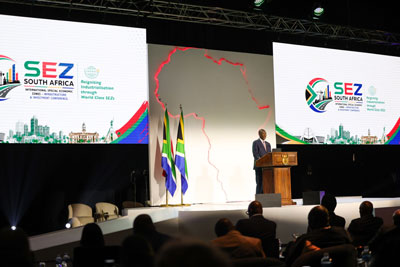
South Africa has renewed its commitment to using Special Economic Zones (SEZs) as engines of industrialisation, investment and job creation, with government leaders, investors and development partners gathering in Durban for the Second International Special Economic Zones Infrastructure and Investment Conference under the theme, "Reigniting Industrialisation through World-Class SEZs."
Hosted by the Department of Trade, Industry and Competition (the dtic), the two-day conference highlighted both the progress achieved since the inaugural conference in 2019 and the work that still lies ahead if South Africa is to tackle one of its greatest challenges – persistently high unemployment.
Delivering the keynote address, Deputy President Paul Mashatile framed the conference as more than an investment gathering, describing it as part of a long-term national project to reshape South Africa's economy.
"It is a privilege to attend the Second International Special Economic Zones Conference in Durban, a city that represents the transformative potential of Special Economic Zones in promoting investment and inclusive economic growth," he said.
Mashatile stressed that government's new Spatial Industrial Development Strategy seeks to build "a more productive, competitive and inclusive economy," centred on sustainable employment, enterprise development and restoring dignity through meaningful economic participation.
South Africa currently has 13 designated SEZs across eight provinces, with government viewing them as strategic platforms to attract manufacturing investment, increase exports and integrate local businesses into regional and global value chains.
Rather than competing solely on low production costs, Mashatile argued that South Africa must distinguish itself through reliability, infrastructure and inclusivity.
"We have 5,400 SEZs globally competing for the same capital. We cannot compete simply by being the cheapest. We compete by being the most strategic, the most reliable, and the most inclusive."
He emphasised that future success would be measured not by ambitious plans but by tangible outcomes.
"Your performance will be measured every five years. Not on glossy brochures, but on actual jobs and exports."
Opening the exhibition component of the conference, Minister of Trade, Industry and Competition Parks Tau showcased the significant gains already achieved through the SEZ programme.
He announced that the country's SEZs now host 224 companies, which have collectively invested R31.7 billion, representing an increase of R17.2 billion over the past eight years. These investments have created 28,821 direct jobs, while government has invested approximately R12 billion in bulk and top-structure infrastructure to support the programme.
Tau encouraged delegates to move beyond policy discussions and engage directly with investment opportunities showcased at the exhibition.
Among the programme's flagship successes, he highlighted:
- the Tshwane Automotive Special Economic Zone, where Ford's expansion has unlocked R16 billion in private investment alongside R5.9 billion from other investors, creating 3,333 direct jobs
- the Richards Bay Industrial Development Zone, which now has a pipeline of 24 potential investments valued at R247 billion; and
- the R14.5 billion Nyanza Light Metals titanium dioxide project, expected to generate more than 800 direct jobs once fully operational.
Tau also outlined several reforms aimed at strengthening the programme, including the designation of two additional SEZs at Fetakgomo Tubatse and Vaal, a revised implementation model informed by an independent World Bank review, stronger non-financial incentives, increased private sector participation and formal mechanisms to intervene where zones underperform.
While both leaders celebrated the investment achievements of existing SEZs, they were equally clear that industrial development must benefit surrounding communities.
Mashatile urged investors to see South Africa as a long-term partner rather than merely a production location.
"South Africa is open for business, but we are not open for extraction. We want you to benefit here, to train here, and to partner with our SMMEs here."
He also stressed that local communities must become active participants in industrial development.
"These zones are yours. Hold us accountable... The artisan in Musina must see the SEZ as a market, and most importantly, a door to global markets."
The Deputy President argued that every new SEZ should be strategically located around existing infrastructure corridors, natural resource advantages, industrial parks and district development priorities while ensuring that communities living nearby share in the benefits of economic growth.
Despite encouraging investment figures, the conference repeatedly acknowledged that South Africa's unemployment crisis remains the country's greatest economic challenge.
The approximately 29,000 direct jobs created through existing SEZs represent important progress, but they remain modest relative to the millions of South Africans seeking work. This reality means that future success will depend not only on attracting additional investors but also on expanding manufacturing capacity, strengthening supplier networks, improving logistics, ensuring reliable energy and creating stronger links between SEZs, technical colleges and local small businesses.
Government also intends to leverage opportunities created by the African Continental Free Trade Area (AfCFTA) to position South African manufacturers within regional value chains and expand exports into fast-growing African markets. Conference discussions focused on improving export readiness, mobilising infrastructure finance, strengthening public-private partnerships and increasing the participation of small, medium and micro enterprises within SEZ value chains.
Mashatile concluded by calling on government, investors and communities to work together to ensure SEZs become genuine instruments of economic transformation rather than isolated industrial enclaves.
"As we leave Durban, let us renew our collective commitment to ensure that our Special Economic Zones become engines of investment, innovation and opportunity, not islands of prosperity, but catalysts for inclusive growth that will uplift every province and every community across our country."
The conference demonstrated growing confidence in South Africa's industrial strategy, but it also highlighted that the ultimate measure of success will be whether Special Economic Zones can generate sustained manufacturing growth, attract significantly greater levels of investment and create the scale of employment required to meaningfully reduce unemployment and improve livelihoods.