


Ghana Eyes Deeper Cooperation with Russia
Fiifi Nettey, West Africa Correspondent for The Diplomatic Society
16 November 2026
The Russian Federation emerged as the principal successor state to the Soviet Union (USSR) following its dissolution in December 1991.
As the largest and most influential of the 15 Soviet republics, Russia inherited much of the former Union’s international diplomatic standing, military capabilities, institutional structures and global responsibilities, allowing it to retain a significant role in international affairs.
The Soviet Union established strong diplomatic and strategic relations with Ghana and several other African countries, particularly during the Cold War (1947–1991). Its engagement with the continent was driven by political solidarity, support for anti-colonial and liberation movements, military cooperation, educational exchanges, industrial development and mutually beneficial economic partnerships.
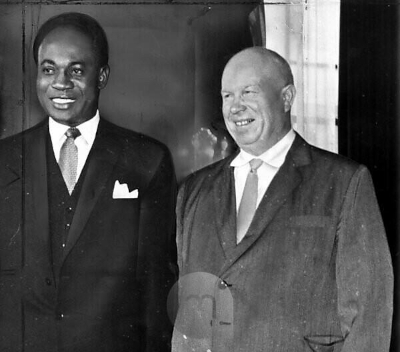
Ghana was among the early African countries to establish diplomatic relations with the Soviet Union in 1958, just two years after gaining independence. Under the leadership of President Dr. Kwame Nkrumah, Ghana strengthened its ties with Moscow as part of a broader foreign policy agenda centred on non-alignment, anti-colonial solidarity, Pan-Africanism and industrial development.
The Soviet Union also played a significant role in advancing education and human capital development in Ghana by offering scholarships and academic opportunities for Ghanaian students to study at Soviet universities and technical institutions. Many other African students also benefited from specialised training in medicine, engineering, science, agriculture and other technical fields.
Beyond education, Ghana and the Soviet Union strengthened their military and technical cooperation. This partnership provided opportunities for Ghanaian military personnel to receive training in Soviet institutions, while Soviet military equipment, technical assistance and expertise contributed to Ghana's broader defence and security relationships.
The Soviet Union also contributed to Ghana's efforts to diversify its international partnerships and develop industrial and technical capacity during President Nkrumah's administration. One example was the Tema Fishing Harbour project, for which the Soviet Union provided technical assistance and support. The project was part of President Nkrumah's ambition to expand Ghana's fishing industry, improve food production and reduce dependence on cocoa exports.
Experts from the Soviet Union also undertook preliminary studies for the proposed Bui hydroelectric project. In 1961, Ghana and the Soviet Union signed an agreement on peaceful nuclear cooperation, supporting plans for a research reactor and isotope laboratory at the University of Ghana, Legon.
Over the decades, Ghana and several other African countries have maintained their longstanding diplomatic and strategic relations with the Soviet Union, now the Russian Federation. These historical ties have continued to provide a foundation for cooperation across various sectors.
Russia, in turn, has remained an important development partner to several African countries through strategic partnerships. These engagements have contributed to strengthening national institutions, developing human capital, facilitating the transfer of technical knowledge and expertise, and creating opportunities for economic growth and sustainable development across the continent.
Russia is still widely recognised as a global superpower and a major economic force and it regards Africa as a longstanding ally and an important strategic partner. It is strengthening its engagement with the continent as part of broader efforts to diversify its export markets, deepen trade and investment relations, and expand its economic footprint across Africa.
With its vast agricultural potential and capacity to emerge as one of the world’s leading food-producing continent, Africa stands to benefit significantly from such collaboration. Increased investment, technology transfer and technical expertise could help strengthen food security, boost agricultural productivity, modernise farming practices and accelerate sustainable development across the continent.
For the third time, Russia hosted the Russia–Africa Economic and Humanitarian Forum from October 28 to 29, 2026, at the historic Gostiny Dvor Exhibition Centre in Moscow. In attendance were leaders from 48 African countries, with 22 represented by their presidents, demonstrating strong continental participation and growing interest in strengthening economic, political and humanitarian relations with Russia.
Since the first meeting in Sochi in 2019, Russian-African cooperation has stood the test of time and acquired a strategic character. Today, Russia is identifying the key areas of interaction which will strengthen sovereignty, reinforce the positions of Africa and Russia on the international stage, contribute to the effective implementation of national and regional development strategies to make the lives the peoples better, more harmonious and more prosperous with vast opportunities.
The opening plenary session, held on October 28, 2026, was chaired by Russian President Vladimir Putin, with African Union Chairperson and Burundi’s President, Évariste Ndayishimiye, alongside Professor Irina Abramova, Director of the Institute for African Studies at the Russian Academy of Sciences, serving as moderators.
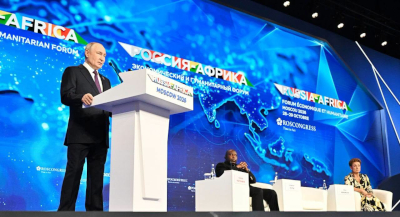
Africa is increasingly asserting itself as one of the key players in the global economy and politics," President Putin said. President Putin indicated that the emergence of a multipolar world is, of course, no easy task; it faces resistance from countries accustomed to thinking in terms of their colonial past and to enriching themselves.
He argued that African countries should have a stronger voice in international decision-making, including within the IMF and World Bank.
"BRICS is becoming a key centre of the new world order. Over the past five years, its member states have produced more than 40% of global GDP, while the G7 accounted for less than 30%," President Putin added.
Technological sovereignty is becoming the foundation of the modern economy and public administration. Russia is ready to share expertise with African partners in digital platforms, artificial intelligence, cybersecurity and data storage, President Putin revealed.
"The colonial legacy and neo-colonial practices remain serious obstacles to Africa’s development. This include illegitimate sanctions, tariff wars, economic dictate, debt dependence, and interference in internal affairs," Putin said
The Chairperson of the African Union and President of Burundi, Évariste Ndayishimiye, said there had been positive outcomes from previous Russia-Africa engagements, particularly the 2019 Sochi meeting and the 2023 St. Petersburg Summit.
Highlighting several measures aimed at strengthening cooperation, Ndayishimiye described Africa, with an estimated population of 1.5 billion people, as a vast market with enormous potential.
He stressed, however, that Africa's aspirations go beyond market opportunities, noting the need to transform and strengthen regional value chains, improve access to transport corridors, and make further progress in healthcare and cultural cooperation.
"We adhere to the principle of African solutions to African problems. Africa supports a balanced and mutually beneficial partnership," Ndayishimiye added.
On the sidelines of the Russia–Africa Summit, Russian President Vladimir Putin held bilateral one-on-one meetings with 22 African leaders and with leaders of key regional organisations across the African continent. The meeting was attended by Sergei Lebedev, Secretary-General of the Commonwealth of Independent States (CIS), and Bakytzhan Sagintayev, Chairman of the Board of the Eurasian Economic Commission.
Representatives of several major African institutions and regional bodies also participated, including the African Union (AU), the African Continental Free Trade Area (AfCFTA), the Arab Maghreb Union, the Common Market for Eastern and Southern Africa (COMESA), the East African Community (EAC), the Economic Community of West African States (ECOWAS), the Economic Community of Central African States (ECCAS), the Southern African Development Community (SADC), the Intergovernmental Authority on Development (IGAD), and the African Export-Import Bank (Afreximbank).
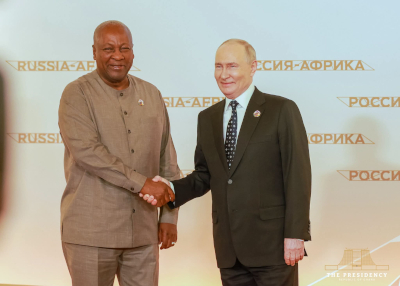
President Dramani Mahama of Ghana said, “we believe that the time has come for us to move from just political cooperation to economic cooperation. And the environment is right for us to have mutual investments between Russia and Ghana.” He said this in a one-on-one bilateral meeting with President Putin following the conclusion of the Summit.
President Mahama told President Putin that Ghana is today the eighth largest economy in Africa with a GDP of about $120 billion, a stable economic environment and a growth rate of about six percent per annum. President Mahama added that the summit would serve as the bridge for cooperation and expressed confidence that it would promote and strengthen relations to a strategic level.
He also informed President Putin that Ghana will hold the Permanent Joint Commission for Cooperation meeting next year, in 2027, expressing hope that it will provide a proper framework for cooperation going forward.
President Mahama commended Russia’s solidarity with Africa during the period of decolonization, recalling that Russia stood by Africa in the fight against apartheid. When the COVID-19 pandemic struck, the first vaccines received in Africa were the Sputnik V vaccines from Russia.
“It just shows that Russia is always in solidarity with Africa and we appreciate that,” President Mahama added
On Ghana-Russia relations, President Mahama said Ghana was the first sub-Saharan African country to break from colonialism, and that as early as 1958 Russia recognized Ghana and established diplomatic relations.
He recalled that in 1961, Ghana’s first President, Dr Kwame Nkrumah, visited Russia and met with Nikita Khrushchev, a historic visit by the first African leader, and said relations had since grown from strength to strength.
President Putin, for his part, said he was glad to meet with President Mahama, recalling the long-standing diplomatic relations between Ghana and Russia dating back to 1958.
President Putin said Russia will particularly focus on improving relations through support for Ghana’s education and military development, including skill training for Ghanaian students and capacity building for the civil service.
“For this I am glad to meet you Mr President ,” he said.
There were several commitments between the two countries during the the summit, including an agreement to work toward a 2,000-megawatt nuclear power plant to guarantee energy security and anchor industrialization, a revival of Dr Kwame Nkrumah’s vision, which was truncated by the 1966 coup.
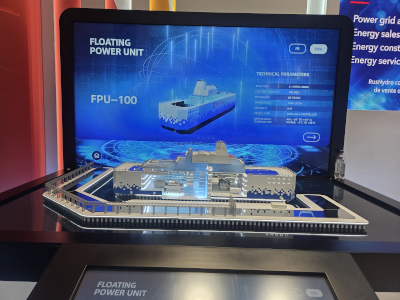
Other commitments included a new defence pact to acquire strategic military assets for the Ghana Armed Forces; enhanced agricultural cooperation to boost grain production and fertilizer supply; increased scholarships for Ghanaian students; and a declaration by President Putin that Ghanaians are no longer allowed to participate in the war in Ukraine, whether through irregular recruitment or voluntary interest.
The two countries also agreed to revive the Permanent Joint Commission for Cooperation, with Moscow ready to host in the next few weeks
In a conversation with a fellow Ghanaian journalist Kwame Appiah, he expressed the view that strengthening Africa’s partnership with Russia is an important pathway towards accelerating development across the continent. He noted that Russia has been a longstanding ally and development partner of Africa, adding that the time has come for African countries to deepen these ties to drive faster progress across various sectors. He also expressed hope that more forums of this nature would be organised to provide platforms for meaningful discussions on Africa’s welfare, economic growth and sustainable development through investments.
Patrick Annan a Ghanaian businessman expressed his delight at seeing President John Dramani Mahama in Russia to participate in the summit and hold bilateral discussions with Russian President Vladimir Putin. He noted that Ghana and Russia have maintained longstanding relations since Ghana gained independence, stressing the importance of preserving and strengthening these historic ties. He added that Ghana must seize the opportunity to deepen its cooperation with Russia.
The strengthening of these relations and exploring strategic partnerships can improve the living conditions and aspirations of its people, in particular the youth which makes up over 60% of Africa’s population.