26 March 2026 Issue 347 - A New Revolution Has Begun
|
|
|
|---|
|
| A New Revolution Has Begun |
|
|
|---|
Wreaths were laid at the Wall of Names at Freedom Park in commemoration of the Battle of Cuito Cuanavale (photo: TDS) |
|
|---|
By Kirtan Bhana
The late twentieth century witnessed a decisive turning point in global history at the Battle of Cuito Cuanavale. Fought on Angolan soil between 1987 and 1988, this confrontation was a regional military engagement that led to geopolitical rupture. The victory of revolutionary forces, supported by Cuban internationalists and aligned liberation movements, dealt a strategic blow to apartheid South Africa’s military ambitions and hastened the independence of Namibia. More profoundly, it accelerated the internal and external pressures that would eventually dismantle apartheid in South Africa. This historic moment unfolded in parallel with the disintegration of the Cold War order, symbolised by the Fall of the Berlin Wall and the collapse of the Soviet Union. Together, these events reshaped global power structures, ushering in a unipolar world that promised liberal democracy, free markets and global integration. Yet, as history has shown, that promise was unevenly fulfilled. Nearly four decades later, the annual commemoration at Freedom Park is an act of remembrance and becoming a site of reflection and redefinition. What emerges from these commemorations is a growing recognition that the post-Cold War order, much like the colonial systems before it, has reached a point of exhaustion. The world now stands on the threshold of another transformation, a new revolution, not of trenches and tanks, but of technology, information and consciousness.
|
|
|---|
|
| Hong Kong - Gauteng emerging new safe havens in a fragmented global economy |
|
|
|---|
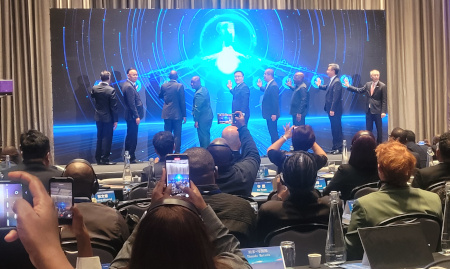
Unveiling of the Shenzen International Business e-Station South Africa Service Centre - TDS Photo
|
|
|---|
By Kirtan Bhana In an era defined by geopolitical volatility, supply chain disruptions and shifting centres of economic gravity, a new narrative of strategic opportunity is emerging. The growing cooperation between Hong Kong and Gauteng (Place of Gold) signals the rise of two interconnected regional hubs that are positioning themselves as “safe havens” for investment, innovation and stability across Asia and Africa. The Shenzhen–Hong Kong–Johannesburg Economic Trade Cooperation Conference, held in Johannesburg on 20 March, brought together influential policymakers, institutional leaders and business stakeholders whose insights collectively framed a new phase of Afro-Asian cooperation. At the heart of this partnership lies a powerful alignment of capabilities and a convergence of strategic hubs. Shenzhen, widely regarded as China’s innovation engine, and Hong Kong, a globally trusted financial and legal gateway, form the eastern pivot of this cooperation. On the African side, Johannesburg—located in Gauteng, South Africa’s economic powerhouse, serves as the continent’s primary financial and commercial gateway. Together, these regions form a dynamic corridor linking the Guangdong–Hong Kong–Macao Greater Bay Area (GBA) with Africa’s most industrialised province. |
|
|---|
|
| BRICS payment system: what experts say about possible mechanisms, functionality and timelines for its creation |
|
|
|---|
BRICS is steadily moving towards the creation of an independent payment system and, potentially, even a new unit for mutual settlements. What might the new financial infrastructure of the group look like, and what is it most likely to be based on? Expert forecasts are presented in the TV BRICS report. BRICS single currency: pros and cons Back in December 2025, responding to a question from Indian journalists about the prospects of creating a single BRICS currency or alternative payment mechanisms using national currencies, President of Russia Vladimir Putin noted that such matters should not be rushed in order to “avoid making serious mistakes”. In the case of BRICS, this task indeed requires carefully considered decisions. The member states are spread across different continents, and both standards of living and inflation levels vary significantly. To create a single unit of account or a mechanism for payments in national currencies, all these factors would need to be brought to a common denominator.
|
|
|---|
| The ART of the Deal: Ecuador, America and the Shifting Geometry of Power |
|
|
|---|
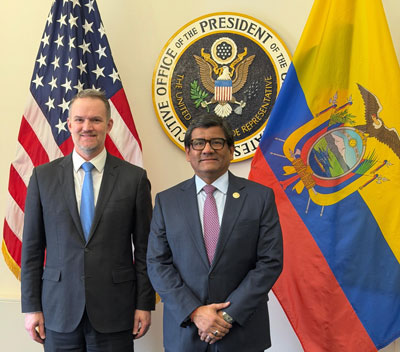
United States Trade Representative Jamieson Greer and Ecuadorian Minister of Production, Foreign Trade and Investment Luis Alberto Jaramillo (photo: X)
|
|
|---|
The enduring enigma of Donald Trump lies not merely in his personality or political contradictions, but in what his repeated electoral success reveals about the United States itself. Beneath the spectacle is a deeper structural shift, a recalibration of American power in a world no longer unipolar, where economic nationalism, strategic trade and geopolitical rivalry converge. The signing of the Agreement on Reciprocal Trade (ART) between the United States and Ecuador on March 13, 2026, must be understood within this wider transformation. Far from a routine bilateral arrangement, the ART reflects a reassertion of American hemispheric influence, an updated expression of a long historical arc that has shaped relations across Latin America and the Caribbean. From the Monroe Doctrine to Cold War interventions, the United States has long regarded Latin America as within its strategic orbit. Trade agreements have increasingly replaced overt political intervention as the preferred instrument of influence. In this context, the ART represents a 21st-century mechanism of alignment, less coercive in form, but no less consequential in substance.
|
|
|---|
| SADC Council of Ministers calls for accelerated regional integration |
|
|
|---|
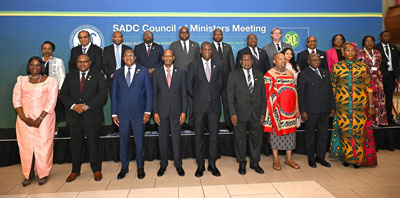
The Southern African Development Community (SADC) Council of Ministers has called for the accelerated implementation of policies and programmes to advance regional integration and development. The call was made at the conclusion of the two-day Council of Ministers meeting held in Pretoria from 12 to13 March 2026 under the theme “Advancing Industrialisation, Agricultural Transformation, and Energy Transition for a Resilient SADC”. The meeting was opened and chaired by Minister of International Relations and Cooperation (DIRCO) Ronald Lamola, in his capacity as the Chairperson of the SADC Council of Ministers. South Africa is currently leading the regional bloc following its election as the interim Chairperson of SADC during a virtual Extraordinary Summit of Heads of State and Government held on 7 November 2025. Minister Lamola called for enhanced regional cooperation to make a tangible difference in the lives of the SADC citizens through improved livelihoods, jobs, food security, energy access and resilience. He also stressed that SADC citizens are looking forward to seeing regional integration producing meaningful economic opportunities and improving their prospects for a better future.
|
|
|---|
| Growing relations in the health sector between South Africa and the Hellenic Republic |
|
|
|---|
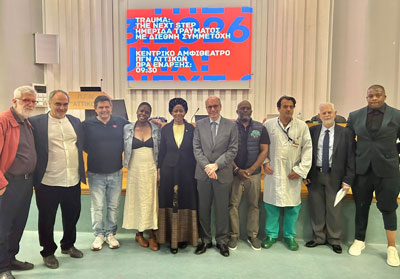
Distinguished Trauma Surgeons travelled from South Africa to Athens, during the month of March 2026, to lead medical training sessions and participate in a conference that was held at the Attikon University General Hospital.
Addressing the Trauma Conference on 08 March 2026, the Ambassador of South Africa to Greece, Dr Lindiwe Msengana-Ndlela, recognised the role of the Deputy Minister of Health, Dr Marios Themistocleous and acknowledged the Ministry of Health for this collaboration. She applauded the Conference Co-Presidents (Prof Koulouvaris and Prof Vassiliu) and health practitioners for taking practical steps to strengthen public health systems and promote excellence in trauma surgery in academic hospitals of both countries. Also participating in the conference were the President of the Hellenic Surgical Society, Prof Manos Pikoulis and the President of the Scientific Committee, Prof Michalis Chrisophos. |
|
|---|
|
|