


The Bridges Are There, They Just Need to Be Crossed
By Kirtan Bhana – TDS
20 August 2026
Jamaica celebrated 64 years of independence on 6 August 2026. For a nation whose history is inseparable from Africa, the Caribbean and the wider African diaspora, the anniversary offered a moment to reflect on where the relationship between Africa and the Caribbean has come from and, more importantly, where it is heading.
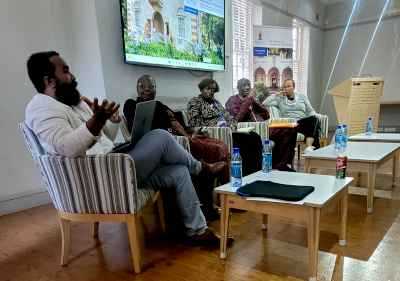
That conversation gained particular relevance in Pretoria on 17 August, when the Centre for the Advancement of Scholarship (CAS) at the University of Pretoria and the High Commission of Jamaica to South Africa convened a public dialogue entitled “Rebuilding Bridges with the Diaspora: Afro-Caribbean Cooperation in the Evolving Geopolitics.”
The symbolism was compelling. Jamaica's independence anniversary had just been celebrated, while South Africa's Minister of International Relations and Cooperation, Alvin Botes, had travelled to Kingston to participate in the country's independence commemorations. In Pretoria, meanwhile, Jamaica's High Commissioner to South Africa, Joan Thomas Edwards, co-chaired a discussion examining how Africa, the Caribbean and their diaspora can strengthen their connections in a rapidly changing world.
The discussion brought together a range of intellectual and international experience: Ambassador Inga Rhonda King, former Permanent Representative of Saint Vincent and the Grenadines to the United Nations; Dr Mariama Williams, former Senior Programme Officer at The South Centre in Geneva; Professor Carlos Silva Junior of the State University of Feira de Santana in Bahia, Brazil; High Commissioner Joan Thomas Edwards; and Professor Adekeye Adebajo, Senior Research Fellow at the University of Pretoria's Centre for the Advancement of Scholarship, who co-chaired the session.
The gathering posed a significant question, can the historical relationship between Africa, the Caribbean and the African diaspora now be transformed into a practical engine for human, economic and cultural development? The answer increasingly appears to be yes.
From forced movement to chosen movement
The difficult history of four and a half centuries of slavery, colonialism, dispossession and exploitation profoundly reshaped Africa, the Caribbean and the Americas. Millions of Africans were forcibly removed from their homeland, creating communities across the Atlantic whose descendants today constitute a vast and influential African diaspora.
There is an extraordinary historical reversal underway. The Atlantic, once a highway of forced migration, can increasingly become a highway of voluntary movement. Students can travel to study. Entrepreneurs can establish businesses. Artists can perform. Tourists can explore ancestral connections. Researchers can collaborate. Families can reconnect. Investors can identify opportunities. Professionals can share skills and knowledge.
The issue is no longer whether Africans and Caribbean people can connect, technology has already answered that question. The smartphone has placed Kingston, Johannesburg, Accra, Lagos, Bahia, Bridgetown and countless other communities into the same information space. The challenge is to make physical movement, trade, investment and human exchange catch up with the speed of information. That means better aviation and maritime links, easier tourism, modern logistics, digital payments, educational exchanges, business mobility and sensible, technology-enabled systems for managing migration.
There is an important contradiction in the modern world: money can cross borders in milliseconds, information travels instantaneously and a cultural creation can reach millions overnight — yet a person may still encounter enormous barriers simply trying to cross a border. This need not mean uncontrolled migration. It means smarter mobility: digital visas, trusted travel systems, student exchanges, professional mobility, cultural programmes and business facilitation. People are not merely migrants, they are carriers of knowledge, capital, culture, skills and opportunity.
The diaspora was never peripheral
The history of Pan-Africanism itself reminds us that Africa's relationship with its diaspora was never a one-way conversation. Marcus Garvey, born in Jamaica, became one of the most influential advocates of Black consciousness, African unity and economic empowerment in the twentieth century. His vision demonstrated that some of the most powerful calls for African unity could emerge from outside the continent. Generations later, Bob Marley transformed Jamaican music into a global cultural language, carrying messages of African consciousness, freedom, dignity and human solidarity to audiences far beyond the Caribbean. Today, the digital generation has inherited that legacy with tools their predecessors could scarcely imagine.
The African Union's recognition of the diaspora as the sixth region of Africa therefore carries enormous significance. It recognises something history has already established: Africa is not confined to its continental geography. The African world stretches across the Caribbean, Latin America, North America, Europe and beyond.
The opportunity now is to turn that dispersed human geography into a connected community of knowledge, enterprise, culture and investment.
Reparatory justice must look forward as well as backward
The CARICOM Ten Point Plan for Reparatory Justice has placed questions of historical accountability firmly on the international agenda, including formal acknowledgement, Indigenous peoples' development, cultural restitution, health, education, psychological rehabilitation, technology transfer, debt, cultural reconnection and voluntary repatriation.
Reparatory justice is about repairing the conditions that continue to constrain the future and not only to be understood as a question of compensation for the past. Education is repair, technology transfer is repair and reconnecting people is repair among other forms of reparation. Creating the conditions for Africans and Caribbean peoples to trade, travel, invest, study and create together is also a form of historical repair. The objective should be neither perpetual grievance nor historical amnesia. It should be justice that creates capacity.
Culture is not decoration, it is an economy
One of the greatest opportunities lies in the creative industries. Africa and the Caribbean already share extraordinary cultural capital: music, fashion, food, literature, film, sport, festivals, visual arts and storytelling. These are not peripheral activities. They are major economic sectors capable of generating employment, tourism, exports, intellectual property and global influence.
The extraordinary international reach of Jamaican music demonstrated what cultural production could achieve long before today's digital platforms existed. Africa's contemporary music, film, fashion and creative industries are now generating similarly powerful global currents.
What happens when these ecosystems begin to connect systematically. Artists travel, films circulate, festivals collaborate, universities exchange students, fashion designers create together, food traditions cross oceans, tourism routes follow ancestral history, digital creators build audiences across continents and this creates value generates revenues and economic activity.
The obligation of power
The emerging African–Caribbean relationship also raises a deeper question, what happens when people who were historically displaced, divided and marginalised begin to recognise the collective weight of their demographic, cultural, economic and intellectual power? The answer, power carries an obligation.
The purpose of greater collective influence cannot simply be influence for its own sake. It must contribute to better lives, greater opportunity and a more equitable global system.
This is where the aspirations of Agenda 2063 become particularly relevant. A prosperous, integrated and peaceful Africa cannot be built by the continent acting in isolation from each other, let alone its global African family.
The diaspora possesses immense human capital, financial resources, cultural influence, professional expertise and entrepreneurial capacity. The question is how to connect these assets to Africa's development trajectory — and how Africa can reciprocally contribute to the prosperity of its diaspora communities.
The bridges already exist
The foundations are already being laid. The African Union and CARICOM provide institutional frameworks. Universities create intellectual connections. Businesses identify markets. Artists create common cultural spaces. Digital platforms erase distance. Tourism reconnects people with places and ancestry.
The A3+1 cooperation between African and Caribbean countries at the United Nations demonstrates that shared interests can translate into collective action, including the wider demand for a more representative international system.
But the greatest transformation may be occurring outside formal institutions. It is happening among ordinary people. A young Jamaican discovering African music online, a South African travelling to the Caribbean, a Ghanaian entrepreneur establishing a connection in Kingston, a Brazilian artist reconnecting with African heritage, a business identifying a new market. These seemingly small exchanges accumulate into something much larger.
The world is changing rapidly. The old structures created by colonialism are being questioned. The information age has redistributed the ability to communicate. New generations are increasingly comfortable with identities that cross borders. The Global South is becoming more assertive. African and Caribbean societies are rediscovering connections that history attempted to sever. Decolonisation is therefore no longer simply about dismantling old political structures. It is also about reclaiming relationships, knowledge, mobility, markets, culture and imagination.
The next stage is to make those connections practical build the air links, strengthen maritime connectivity, facilitate movement among other practical implementation that above all, allow people to meet. Because the bridges between Africa, the Caribbean and the diaspora are not waiting to be invented. They are already in place.
They have been built by history, ancestry, culture, struggle, music, ideas and generations of people who refused to forget where they came from. What is changing now is the ability, and increasingly the determination, to cross them.
The bridges are there. They just need to be crossed.