


Semipalatinsk: 35 Years Since the Closure of Kazakhstan’s Nuclear Test Site
By H.E. Mr. Yerkin Akhinzhanov, Ambassador of the Republic of Kazakhstan to the Republic of South Africa

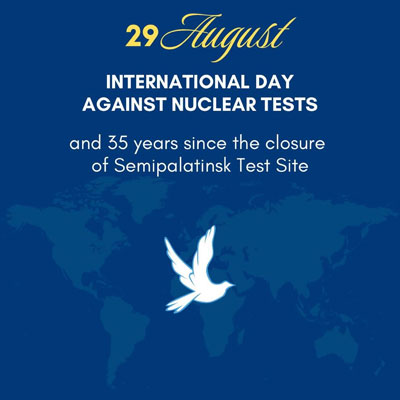
On 29 August 1991, Kazakhstan took a decision of historic significance for nuclear disarmament: it closed the Semipalatinsk Nuclear Test Site.
Thirty-five years later, the former test site remains an important part of Kazakhstan’s history and of the international conversation on nuclear testing and disarmament. Its story is not only about the nuclear tests conducted there. It is also about the people who lived through them, the movement that called for their end, and the choice Kazakhstan made after independence to pursue security without nuclear weapons.
The Semipalatinsk Test Site
The Semipalatinsk Nuclear Test Site was established by the Soviet authorities in 1947 in the eastern Kazakh steppe. Construction of the test site began that year, and on 29 August 1949, the Soviet Union conducted its first nuclear test there, marking the beginning of more than four decades of nuclear weapons testing in Kazakhstan.
The site covered a vast area of approximately 18,500 square kilometres and became the principal Soviet testing ground for nuclear weapons. Between 1949 and 1989, more than 450 nuclear explosions were conducted there, including atmospheric and underground tests. The last nuclear explosion took place on 19 October 1989.
READ ALSO: Abolish Testing, Our Mission - ATOM
For the Soviet Union, the Semipalatinsk Test Site was a key facility in the development and testing of nuclear weapons. For the population living in and around the region, decades of nuclear testing had direct and lasting consequences. However, the highly classified nature of the Soviet nuclear programme meant that local communities had limited information about the scale and nature of the activities taking place at the site. Residents could witness flashes, explosions and ground tremors, and in some cases were temporarily evacuated, without being fully informed about the tests or their potential risks.
The Movement That Demanded an End to Testing
By the late 1980s, growing openness in the Soviet Union made it possible for the issue to be discussed publicly.
In February 1989, prominent Kazakh writer and public figure Olzhas Suleimenov called for an end to nuclear testing in Kazakhstan. The Nevada–Semipalatinsk anti-nuclear movement was established later that year.
The movement brought together writers, scientists, intellectuals and ordinary citizens. Its activities included public meetings, demonstrations and marches calling for an end to nuclear testing and for greater attention to the people and environment affected by the Semipalatinsk site.
The movement helped build public pressure for an end to nuclear testing, and the final nuclear explosion there took place on 19 October 1989. But the site itself remained open.
The decisive step came on 29 August 1991. On that day, Nursultan Nazarbayev, then President of the Kazakh Soviet Socialist Republic, signed a decree formally closing the Semipalatinsk Nuclear Test Site. The closure preceded Kazakhstan’s declaration of independence on 16 December 1991.
The closure was therefore more than the end of a testing programme. It was an early indication of the security choices that Kazakhstan would make as an independent state.
Choosing a Different Path
Following the dissolution of the Soviet Union, Kazakhstan inherited a significant nuclear arsenal on its territory, comprising more than 1,000 nuclear warheads. Kazakhstan chose not to retain these weapons and instead pursued security as a non-nuclear-weapon state.
Kazakhstan acceded to the Treaty on the Non-Proliferation of Nuclear Weapons as a non-nuclear-weapon state in 1994. It signed the Comprehensive Nuclear-Test-Ban Treaty in 1996 and ratified it in 2002. Kazakhstan also supported the creation of the Central Asian Nuclear-Weapon-Free Zone, which entered into force in 2009.
These steps established nuclear non-proliferation and disarmament as a consistent part of Kazakhstan’s foreign policy.
From Semipalatinsk to the United Nations
In 2009, Kazakhstan proposed that 29 August be recognised internationally as a day dedicated to raising awareness of the consequences of nuclear testing and the need for its cessation.
On 2 December 2009, the United Nations General Assembly unanimously adopted Resolution 64/35, declaring 29 August the International Day against Nuclear Tests. The date was chosen to commemorate the closure of the Semipalatinsk Nuclear Test Site in 1991, and the first observance took place in 2010. The resolution was initiated by Kazakhstan and adopted without a vote.
The International Day against Nuclear Tests is dedicated to raising public awareness about the effects of nuclear weapon test explosions and other nuclear explosions and the need for their cessation. For Kazakhstan, 29 August is also a reminder of the decision taken 35 years ago to close the Semipalatinsk Test Site.
A Human Story from Semipalatinsk

Karipbek Kuyukov, a Kazakh artist and anti-nuclear activist, has devoted much of his life to raising awareness of the consequences of nuclear testing.
Kuyukov was born in 1968 in the village of Yegindybulak, in the region affected by the Semipalatinsk nuclear tests. He was born without arms. His parents lived in the area during the years of nuclear testing, and his condition has been attributed to their exposure to radiation from the tests.
Kuyukov became an artist, painting with his lips and the toes of his feet. His works focus on the consequences of nuclear testing and have brought the experience of Semipalatinsk to audiences in Kazakhstan and abroad.
He has served as an Honorary Ambassador of The ATOM Project and is also a Goodwill Ambassador of the Republic of Kazakhstan. Through his art and international advocacy, Kuyukov continues to call attention to the humanitarian consequences of nuclear testing and the importance of preventing its recurrence.
The Legacy of Semipalatinsk
The history of Semipalatinsk does not stand against the peaceful use of nuclear science. Nuclear technologies have important applications in medicine, energy, agriculture and scientific research. Kazakhstan continues to support their responsible use for peaceful purposes.
At the same time, the experience of Semipalatinsk demonstrates the human and environmental consequences of nuclear weapons testing. Kazakhstan’s response was to close the test site, give up the nuclear weapons inherited after the dissolution of the Soviet Union, and make nuclear non-proliferation and disarmament a consistent part of its foreign policy. It has since contributed to international efforts to end nuclear testing, including through the establishment of 29 August as the International Day against Nuclear Tests.
Thirty-five years after the closure of the Semipalatinsk Test Site, Kazakhstan’s position remains clear: the benefits of the atom should be directed towards peaceful purposes and human progress, while nuclear weapons should never be used against people.