


From Refilwe to the North Pole
South African Learner Makes History on Russia’s Icebreaker of Knowledge
By Kester Kenn Klomegah, Moscow Bureau Correspondent, The Diplomatic Society and Rosatom
2 September 2026
From a classroom in Refilwe, east of Pretoria, to the frozen reaches of the Arctic, Ntsako Sithole has taken an extraordinary journey that places a young South African at the intersection of science, education, international cooperation and exploration.
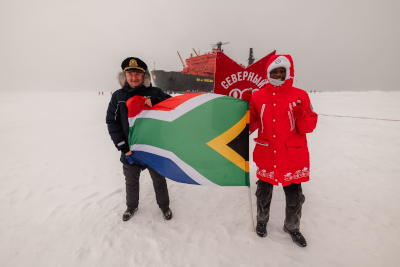
The learner from Chipa-Tabane Comprehensive High School was the sole South African selected to participate in the Icebreaker of Knowledge Arctic expedition, joining young people from around the world aboard Russia’s nuclear-powered icebreaker 50 Let Pobedy on a ten-day voyage to the North Pole.
Selected from approximately 5,000 applicants representing 22 countries, Ntsako earned his place through a demanding three-stage international selection process that tested knowledge of natural sciences, nuclear energy and Arctic exploration, culminating in creative projects examining how nuclear technologies are shaping the contemporary world.
The expedition returned to the Russian port of Murmansk on 13 August, following a remarkable journey that gave its participants first-hand exposure to one of the world's most challenging environments and to some of Russia's most advanced nuclear and Arctic technologies.

Captain Ruslan Sasov of 50 Let Pobedy described the expedition as an important investment in the next generation, noting that bringing talented young people together through such experiences contributes to their development and allows them to turn ambitions and dreams into reality.
For Ntsako, the experience was both scientific and deeply personal. “This trip still feels almost surreal to me. The sheer scale of the Arctic ice caught me off guard – no photo could have prepared me for it. I’ve studied nuclear energy for years, but it was only here, next to a ship that has run on nuclear power alone for years, that I truly grasped its potential. This expedition only strengthened my desire to build my future in this field.”
The scientific and educational programme aboard the vessel exposed participants to practical applications of science and technology, including an aerospace laboratory. Working alongside scientists, they participated in experiments involving the launch of a radiosonde designed to support communication in remote Arctic areas and along the Northern Sea Route, as well as testing a recoverable stratospheric platform.
The North Pole itself provided the defining moment of the expedition. At the 90-degree northern latitude, there is no landmass beneath the ice, but an ocean covered by drifting sea ice. For Ntsako, accustomed to the Highveld winter of Pretoria, the Arctic environment offered a dramatically different world – one of near-constant daylight, vast expanses of ice and the possibility of encountering polar wildlife.
The expedition also marked the 200th occasion on which a surface vessel had reached the North Pole, adding another historic dimension to an already remarkable journey.
A symbolic international circle dance was held at the 90-degree point, bringing together young participants from different countries at one of the world's most remote locations.
From a Refilwe classroom to an international scientific community
The significance of Ntsako's achievement journey illustrates the possibilities that international educational programmes can create for young people, particularly those from communities that may otherwise have limited access to international scientific networks and advanced technological environments.
His return to South Africa was celebrated with a special reception at Chipa-Tabane Comprehensive High School, where fellow learners, teachers and members of the Refilwe community gathered to welcome him home. The celebrations reflected not only pride in an individual achievement, but the wider aspirations of a community seeing one of its young people engage with the world at the highest level.
Ryan Collyer, CEO of Rosatom Central and Southern Africa, said Ntsako's achievement was earned on merit and demonstrated the potential of programmes that connect young African learners with international opportunities. He said the most memorable moment was Ntsako's return home, when the community gathered to hear his stories of the nuclear icebreaker, the Arctic and the polar bears. “These programmes aren’t just about the science or the travel – they are about the hope a single young person can bring back to their home,” Collyer said.
Ntsako's participation was facilitated through Rosatom's international education and skills programmes, which provide opportunities for students across Africa to engage with the nuclear sector and related fields.
The broader educational relationship between South Africa and Russia is also developing. In March 2026, Rosatom and the South African Nuclear Energy Corporation (Necsa) signed a memorandum relating to personnel cooperation, creating further opportunities for South African students and young specialists to access educational and professional opportunities at leading Russian technical universities.
Such initiatives are particularly relevant as South Africa considers the future of its energy, scientific and technological capabilities. Developing the next generation of scientists, engineers and technical specialists is not only an educational priority, but an important component of national development.

The Icebreaker of Knowledge project is supported by Rosatom and is designed to promote natural sciences and nuclear technologies, identify and encourage talented young people, develop their abilities and provide career guidance. The programme brings together students aged 14 to 16 from different countries, with the strongest participants earning the opportunity to join the Arctic expedition.
The international selection process began on 5 May and comprised three stages. Participants first competed in a science quiz covering natural sciences, breakthrough technologies, nuclear energy and Arctic exploration. The second stage involved webinars with nuclear industry experts, providing participants with insight into advanced technologies and the role of nuclear energy in the future of science and the global economy.
The finalists were then required to present creative projects on the theme “How Nuclear Technologies Are Changing the World Today.” Their work was assessed by an international jury drawn from the nuclear industry, science, education, Arctic affairs and science communication. Over seven seasons, more than 470 young people from around the world have participated in Rosatom's Arctic expeditions.
For South Africa, however, the story of this year's expedition has a distinctly local face. It is the face of a young learner from Refilwe who looked beyond the boundaries of his classroom, competed against thousands of students from around the world, travelled to Russia and stood at the top of the world.
His journey from Chipa-Tabane Comprehensive High School to the North Pole is a powerful reminder that the most important destinations in international cooperation are sometimes not places on a map, but the opportunities created for the next generation.