


Kazakhstan Ready to Further Strengthen Eternal Comprehensive Strategic Partnership with China – President Tokayev
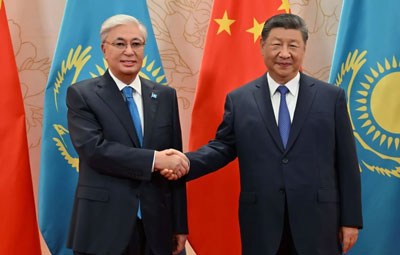
BISHKEK, 1 September 2026 (Xinhua) — Relations between Kazakhstan and China are currently at an unprecedentedly high level. Astana is ready to consistently strengthen its eternal comprehensive strategic partnership with Beijing, giving it new substance and opening up new horizons for cooperation, President of Kazakhstan Kassym-Jomart Tokayev said recently in an exclusive written interview with Xinhua.
The President noted that Kazakhstan and China share an extensive border and centuries of good-neighborly relations.
“As a well-known Kazakh proverb says, ‘Жолы бірдің – жүгі бір’ (‘Those who walk the same road share a common destiny’). Such relations between our two countries serve the fundamental interests of our peoples and are an important factor in maintaining peace and stability across the entire Eurasian space,” he said.
Tokayev expressed his sincere gratitude to Chinese President Xi Jinping for his friendly attitude toward Kazakhstan.
“Our ongoing political dialogue has become a key pillar of the Kazakh-Chinese strategic partnership,” he added.
“Our strategic partnership has become truly comprehensive, encompassing all key areas — from trade, investment, energy and transport to industrial cooperation, agriculture, digitalization, healthcare, science, education and culture,” the President emphasized.
Tokayev said bilateral trade continues to set new records, with China ranking first among Kazakhstan’s foreign trade partners.
Transport and logistics have become one of the strategic areas of cooperation. Kazakhstan is a natural link between East and West.
“Together with our Chinese partners, we are turning this geographical advantage into modern transport and logistics infrastructure of Eurasian scale,” he said. “The development of the Belt and Road megaproject and the Trans-Caspian International Transport Route, the construction of new railway lines, the expansion of dry ports and logistics terminals, and the modernization of border infrastructure are creating a fundamentally new configuration of transport links between Asia and Europe.”
According to the Kazakh leader, the Trans-Caspian International Transport Route, or Middle Corridor, holds a particularly important place in bilateral cooperation and is becoming a vital link in transportation between China and Europe.
“Our common task is to make this route as competitive as possible. Therefore, we attach particular importance to the introduction of ‘smart customs’, the digitalization of document management, the synchronization of information systems and the automation of border procedures,” the Head of State emphasized.
Cooperation between Kazakhstan and China is reaching a new qualitative level, Tokayev said. Today, it covers an increasingly broad range of areas, extending from traditional cooperation in the real economy to the development of partnerships in the digital economy.
He stressed the growing importance of the technological dimension of bilateral cooperation. China holds leading positions globally in artificial intelligence, digital technologies, robotics, new energy and high-tech manufacturing, while Kazakhstan has embarked on an accelerated digital transformation.
Kazakhstan has declared 2026 the Year of Digitalization and Artificial Intelligence.
“During my recent visit to Shanghai to attend the World Artificial Intelligence Conference, I held substantive meetings with the heads of leading Chinese technology companies. We identified mutual interest in implementing joint projects in the digital economy, smart manufacturing, e-commerce, scientific research and human capital development. Technological cooperation can become one of the most important areas of a new stage in Kazakh-Chinese relations,” he added.
Tokayev emphasized that artificial intelligence should serve the development of all humanity. States should have fair access to modern technologies, knowledge and computing resources.
“On this issue, our approaches are aligned with those of China. In July this year, in Shanghai, Kazakhstan joined 29 founding states of the World AI Cooperation Organization (WAICO). This is a significant step toward establishing an open and effective international system for coordinating countries’ efforts in the field of artificial intelligence,” he said.
Kazakhstan and China are also actively cooperating on the international stage.
“We share similar positions on strengthening the central role of the United Nations, upholding the principles of international law, promoting mediation and genuine multilateralism, as well as the peaceful settlement of conflicts,” Tokayev noted.
He stressed that Kazakhstan firmly adheres to the One-China policy and opposes violations of the principle of the territorial integrity of states.
“Kazakhstan will continue to coordinate with China within the framework of the United Nations, the Shanghai Cooperation Organisation (SCO) and the Conference on Interaction and Confidence-Building Measures in Asia (CICA), and fully supports cooperation in the ‘Central Asia–China’ format,” he said.
The President noted that the SCO is celebrating its 25th anniversary this year. The organization has managed to preserve what is most important — the “Shanghai Spirit,” based on mutual trust, equality, dialogue, respect for cultural diversity and a commitment to joint development.
He described these principles as a “standard” for international cooperation.
Tokayev also noted that next year will mark the 35th anniversary of the establishment of diplomatic relations between Kazakhstan and China.
Alongside official political and economic ties, direct contacts between the peoples of the two countries have also developed actively. The 2026 Cross-Cultural Year of Kazakhstan and China has provided a vivid demonstration of this trend.
The Head of State noted that tens of thousands of Kazakh students are currently studying in China, while an increasing number of Chinese citizens are choosing universities in Kazakhstan. Branches of leading Chinese universities and Luban Workshops are successfully operating in Kazakhstan, while academic mobility and inter-university cooperation programs continue to expand.
The introduction of a mutual visa-free regime has provided significant momentum to tourism. In 2025, the number of Chinese tourists visiting Kazakhstan reached 962,000, a 47 percent increase compared with 2024, Tokayev added.
“We want to show our Chinese friends Kazakhstan in all its diversity — modern Astana and ancient Turkistan, the mountains of Almaty and the unique landscapes of Mangystau, the Great Steppe and the heritage of the Great Silk Road, as well as our music, national instruments, cuisine and traditions of hospitality.
“At the same time, Kazakhstan is discovering China with great interest — a country of ancient civilization that today offers an impressive example of development,” the President concluded.