

Spouse of Ambassador Extraordinary and Plenipotentiary of Indonesia to Russia, Fitria Wibowo Tavares: "BRICS membership has certainly highlighted our position"
In an exclusive interview with TV BRICS, the diplomat discusses how Indonesia’s accession to BRICS influenced the country’s economic and trade relations
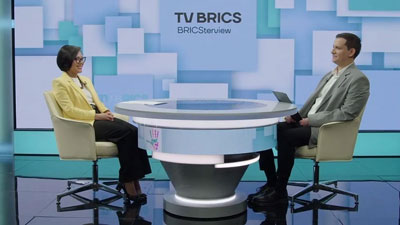
TV BRICS - 23 April 2026
Fitria Wibowo Tavares, a diplomat in service since 2003. She holds a master’s degree in law from Victoria University of Wellington. Her work focuses primarily on international trade. Her interests include literature, foreign cultures, music, fashion, and art. She is also a collector and curator of Indonesian textile exhibitions.
In particular, she has organised Indonesian batik exhibitions in Russia in partnership with several Russian institutions and museums. She is the spouse of the Ambassador Extraordinary and Plenipotentiary of Indonesia to Russia.
You are a diplomat with experience in international trade. How has Indonesia’s accession to BRICS influenced the country’s economic and trade relations? And what impact do you expect the free trade agreement signed with the Eurasian Economic Union in December 2025 to have on the Republic’s trade turnover?
First of all, I would say this is a work in progress, and we are still at the very beginning of our membership in BRICS. The very reason we joined is that we see immense potential. As a participant in the Bandung Conference, it was only natural that at some point we would join BRICS, and this has been high on our agenda for quite some time.
In terms of economic and trade relations, there is significant potential across all pillars, not just trade and economics, although these are particularly important for Indonesia and were among the key reasons for joining. It is not only about the opportunities we see, but also about how we can contribute to and shape the grouping as a whole.
There are ideas and inputs we can offer to the BRICS architecture that would benefit not only Indonesia but the entire group. In terms of enhancing our standing and amplifying our voice, BRICS membership has certainly highlighted our position. Rather than acting alone, we are now part of a group widely regarded as highly influential.
The coordination mechanism within BRICS has proven valuable. In international organisations and multilateral forums, there is strength in numbers.
By joining BRICS, this has become one of the key advantages of our participation. As for the Eurasian Economic Union, the trade agreement we have just signed is still at the stage of drafting and implementing arrangements.
Even before signing the agreement, we already had established relations with the Union’s member states. However, this agreement has significantly expanded market access for us, not only in key sectors such as palm oil, rubber, textiles and footwear, but also in terms of diversifying both products and markets. We have long discussed diversification, and this agreement represents a concrete step towards achieving that goal.
What key partnerships and agreements, in your view, could become a strategic priority for Jakarta? We can consider sectors such as digitalisation, renewable and green energy, or nickel supply chains. Which of these could take cooperation to the next level?
I would say digitalisation is certainly one of the priorities. This is something we are continuously discussing with various countries, drawing on expertise to better harness the opportunities of the digital era. There are also extensive discussions around AI – how to use it sustainably, with appropriate safeguards in place, and how it can support the development of our industries and trade.
So yes, digitalisation and green energy are high on our agenda, along with ensuring continued downstream development while at the same time expanding market access.
Indonesia is actively developing green technologies, including solar farms, wind parks, and environmentally friendly industrial zones. Can sustainability become a competitive advantage for Asian economies in the global market?
I believe this is the way forward. We are continuously discussing climate change and how to address it, and green technologies offer practical solutions.
In terms of competitiveness, they enable more efficient production and provide greater access to markets with stricter environmental standards. As more countries introduce such regulations, adaptation becomes essential.
Green technologies also drive innovation, benefiting the industry as a whole. It is important to continue making production more environmentally friendly, sustainable, and efficient, especially given resource constraints. There is clearly growing market demand for this, and it also enhances brand value.
You've been a diplomat for over 20 years and have observed how bilateral relations between states have been complemented by work within groups and organisations such as BRICS, the Shanghai Cooperation Organisation, and the Eurasian Economic Union. At the same time, the era of digitalisation has arrived. How has the work of a diplomat changed in the context of multilateralism and digitalisation, and how has this affected the importance of personal, face-to-face interactions?
In many ways, it has made our work easier, especially given the growing need for discussions and negotiations. Digital tools allow us to meet anytime and anywhere while also improving public outreach and communication. Social media makes the dissemination of information more efficient – it is a useful promotional tool, cost-effective, and enables us to reach a wide audience more directly. In that sense, it has made our work more efficient and, in some respects, more effective.
However, personal interaction remains essential, particularly for building trust and confidence. There is no true substitute for face-to-face engagement. Meaningful discussions and negotiations often still need to take place in person, as certain aspects cannot be fully replicated in a virtual format. Ultimately, both formats are important, but for diplomats, direct personal contact remains especially valuable, even if it is not always possible.
You are a person of art. You collect and organise exhibitions of Indonesian textiles, particularly batik, which is listed by UNESCO as an intangible cultural heritage. How in your opinion is it possible to simultaneously preserve the authenticity of traditional crafts and make them relevant in today's world?
I think it is very possible. As batik has demonstrated, it is indeed possible, and that is exactly what we have done. Traditionally, batik is a sacred art form, containing a great deal of symbolic meaning. It was used mainly for ceremonial purposes, such as traditional or official events.
However, this has changed following its recognition as intangible cultural heritage. Once it was designated as such, there was a surge in demand, as the entire nation felt a strong sense of pride.
This demand led to increased production and accessibility. It was not only a domestic phenomenon – globally, interest was also growing. As a result, we had to find innovative and creative ways to make batik relevant in everyday life. That is exactly what we have done. It is no longer just an art form expressed on textiles; it has evolved into everyday clothing and objects. The patterns and motifs are now used across a wide range of items. It is very possible. It needed to remain relevant in today’s world, and that is precisely what has happened.
How did audiences in the Russian regions where the exhibitions took place perceive Indonesian art? As far as I know, you have visited Vologda, the Tver Region, the Chuvash Republic, and the Republic of Dagestan. What can you tell us about this?
We have been very honoured to present our art in Russia. The country is renowned for its rich artistic tradition and expressive culture, so the opportunity to showcase our heritage here has been truly unique. The response was exceptionally warm – we could not have hoped for a better reception from the Russian public. There is a deep appreciation for art in Russia, which makes audiences open, receptive, and curious about new artistic forms. I saw a genuine interest in learning more about our culture. It has been a real privilege, and we are very grateful for the opportunity to share what we have from our part of the world in such a culturally rich country.
Returning to batik, you also organised an exhibition entitled “Two Countries. Loyalty to Tradition”, where Indonesian batik was presented alongside gold embroidery from the Russian city of Torzhok. What, in your view, unites these art forms, given the geographical and cultural distance?
Yes, I also found this particularly interesting when we were invited to exhibit in Torzhok. At first glance, these art forms may seem very different. However, they share a common foundation – the use of textiles as a medium of artistic expression. Both traditions convey artistic ideas through fabric while preserving time-honoured techniques. That, I believe, is the thread that connects them.
Among your areas of interest is fashion. Several years ago, you took part in presenting a collection by an Indonesian designer based on a zero-waste concept to the Russian public. Can fashion become a tool for sustainable development in Southeast Asia today?
Yes, certainly – and increasingly so. Fashion can contribute to sustainable development through the use of more sustainable materials. It also encourages a shift away from fast fashion, which consumes significant resources and energy and often lacks durability. The concept of slow fashion is becoming more attractive.
There is also a growing emphasis on environmentally friendly, non-toxic materials, such as natural fibres, as well as more ethical and fair labour practices. In this sense, fashion can indeed serve as a tool for sustainable development.
We were very pleased with how the collection was received in Moscow. We have also discussed further collaboration with several schools in the city, which is very encouraging.
Let us return to cultural exchange. Indonesia hosts Days of Russian Spiritual Culture, while Moscow hosts Days of Indonesian Culture. How do such events help us better understand each other and strengthen relations?
I believe that “decoding” cultural codes is essential, as it helps reveal what people have in common. This, in turn, strengthens relationships. It is about interpreting culture, values, and shared perspectives, which leads to deeper mutual understanding.
Such events play an important role in bringing people together. Indonesia and Russia, in fact, share many similarities – both are diverse, multi-ethnic societies. Recognising this creates opportunities to learn from one another.
For example, when looking at batik, it is important not only to see it as an art form but also to understand the meaning behind its symbols. Interestingly, some of these symbols have parallels in Russian culture. This process of cultural interpretation helps bring people closer together.