

‘Palestine 36’: The true Palestinian narrative in a time of shameful silence of the human conscience.
By Ambassador Reyad Al-Akbari, Head of the League of Arab States in South Africa
24 April 2026
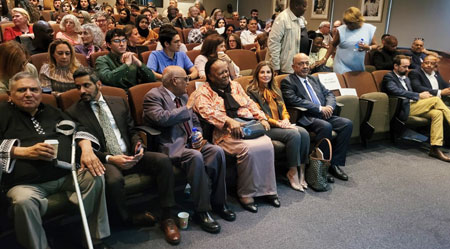
On the evening of Tuesday, 21 April 2026, I had the honor of attending the screening of the film “Palestine 36” (Film Screening), upon an invitation from Hanan Jarrar, Ambassador of the State of Palestine to Pretoria.
The screening was hosted by the Embassy of Palestine in Pretoria together with the Nelson Mandela Foundation in observance of Palestinian Land Day and Prisoner’s Day as well as Freedom Month in South Africa. On 27 April 1994 South Africans began a new democratic journey. Notably, it was on December 4, 1997 during the International Day of Solidarity with the Palestinian People that Nelson Mandela said, “We know too well that our freedom is incomplete without the freedom of the Palestinians.”
The comprehensive address delivered by Dr Naledi Pandor, former Minister of International Relations and Cooperation of South Africa and Chairperson of the Nelson Mandela Foundation, conveyed profound meanings and eloquent lessons, embodying a progressive human thought that reflects the authenticity and purity of the South African position on current international issues, particularly South Africa’s principled and genuine solidarity with the Palestinian people.
The evening transcended the boundaries of a cultural event to become an occasion rich with deep intellectual, political and artistic dimensions. It directly addressed questions of freedom and justice, invoked the memory of history as it ought to be, and revisited the question of whether the time has long passed to do justice to the Palestinian narrative and to free it from the distortions of misinformation, falsehood, and lies that have afflicted it for more than eight decades.
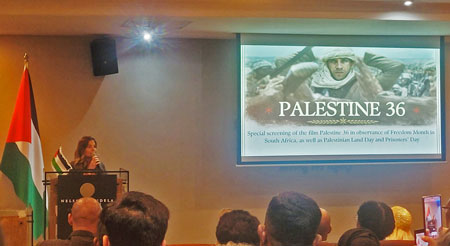
The choice of the Nelson Mandela Foundation in Johannesburg to host this screening carries notable symbolic significance, reflecting the intersection of the Palestinian and South African experiences in confronting colonialism and systems of racial discrimination in both countries. The venue, with its profound symbolism tied to the legacy and noble values of Nelson Mandela, prompted attendees to once again recall the values of freedom and justice for which Mandela and the people of South Africa struggled and sacrificed, as an inherent human right that is indivisible and inalienable. In this context, the relevance of Nelson Mandela’s statement becomes clear: “Freedom is indivisible,” as does the enduring wisdom of Desmond Tutu, who said: “If you are neutral in situations of injustice, you have chosen the side of the oppressor.”
The film “Palestine 36” was produced as a historical drama in 2025, written and directed by Annemarie Jacir, one of the pioneers of contemporary Palestinian cinema. Her style is distinguished by moving away from direct discourse in favor of a subtle and powerful human narrative that captures daily details and explores through them the human traits and characteristics of the characters who embodied the events of the film.
It presented to the viewer historical events that were unknown not only to the general public, but also to an important segment of Arab and foreign intellectuals. The direction, cinematography and performances were captivating and impactful, enabling the viewer to delve deeply into the reality of the practices of Zionism and British colonialism, including crimes of apartheid, racism, occupation, displacement and brutal repression. It refutes the Zionist and Western falsification of history, restores the value of memory, and documents the suffering and resistance of the Palestinian people. As Yasmine Al Massri, one of the film’s protagonists, stated: “This film conveys the human experience of the Palestinian people to the world.”
The film returns to the deep roots of the Palestinian tragedy, revealing the role played by colonial powers, particularly Britain, in shaping an unjust geopolitical reality whose repercussions and grave consequences persist to this day. It documents a pivotal period in which the brutality of colonialism and the arrival of fascist Zionist mobs and groups into the land of Palestine intersected with the legitimate resistance and steadfastness of a people whose land was occupied, along with the severe humanitarian consequences that accompanied this reality. British support for Zionist gangs and militias, alongside the suppression of the Palestinian Revolt (1936–1939), paved the way for what would later be known as the Nakba.
The film recounts the events of the Palestinian Revolt of 1936, which marked the beginning of the largest and longest uprising against British rule in Palestine during its mandate period, which lasted nearly thirty years. It saw participation from Palestinians across all social classes, while its national spirit spread through the press, schools and cultural institutions. As the resistance expanded, the British authorities imposed martial law, deployed more than twenty thousand soldiers, brought in tanks and aircraft, and launched widespread campaigns of arrest, exile and brutal repression.
Despite this, they failed to subdue a people who had early understood the wisdom of the well-known saying by Abu al-Qasim al-Shabbi: “For freedom’s crimson door… is knocked upon by every blood-stained hand.”
It can be said that this remarkable cinematic work represents a significant contribution to consolidating the Palestinian narrative and ensuring its continuity and recognition within the collective memory across generations. In “Palestine 36,” history is not presented as a fragmented tale, but as an integrated vision open to understanding roots, truth, memory and hopes that will never fade. The film returns to the year 1936 as a foundational moment in the formation of Palestinian political consciousness, where the beginnings of confrontation with British colonialism and the racist settler Zionist project took shape. In my view, and within the context of the efforts that must be intensified to preserve and strengthen Arab national identity among Arab youth, enabling students at various educational levels to watch this film and similar artistic and literary works is of utmost importance in a time of turmoil, storms and threats facing our Arab world.
The film’s director skilfully employed archival materials, reinforcing awareness of the importance of professional documentation and its vital role. This was paralleled by a beautiful depiction of the elements of unity within the Palestinian people and the richness and unique diversity of its components. Among the film’s achievements is that it rethinks the vital role that literature, arts, science, culture and media must play in upholding truth and defending the values of freedom and justice.
The film “Palestine 36” reopens the question of writing history through the lens of strict adherence to ethical values and standards that do not permit false neutrality nor accept complicity through silence. It does not present the story as a passing narrative, but as a civilizational test of the human conscience and a revealing mirror of the essence of justice when stripped of selectivity, hypocrisy, double standards and interests devoid of principles.
The film sheds a remarkable artistic light on understanding the Palestinian narrative in its historical and human context, as the true story of a people whose land and rights were forcibly taken from them. This unfolds at a critical and decisive historical moment in which the credibility of the eroding human conscience is being tested, and in which the shameful silence of what is called the “civilized world” is condemned in the face of what is considered one of the most just causes throughout human history: the struggle of the Palestinian people as they cling to their land in pursuit of their freedom, dignity, and independence.
History teaches us that colonialism, occupation, apartheid, genocide and the crimes of starvation and displacement are not inevitable fates nor eternal outcomes, but rather fragile and inhumane systems imposed by brute force outside the natural course of history, and therefore destined to decline and disappear. Justice, no matter how long it takes, even if delayed, does not forget; history does not forgive; and victims are never erased from the memory of history. A day will inevitably come when the full truth is restored, when the banners of freedom are raised high, and when perpetrators and criminals are brought before the scales of accountability and justice, without immunity and without exception above the law.