


Removing Barriers for Women in Agribusiness - Tunisia - South Africa Perspectives
International Year of the Woman Farmer
By Anisha Pemjee
23 April 2026
A timely dialogue by the Embassy of the Republic of Tunisia in Pretoria brought together policymakers, entrepreneurs and development stakeholders to advance a shared agenda on women’s empowerment in agriculture. The event, hosted by Ambassador of Tunisia, Karima Bardaoui, highlighted both the opportunities and structural challenges facing women across agricultural value chains, while reinforcing the importance of cooperation between Tunisia and South Africa.
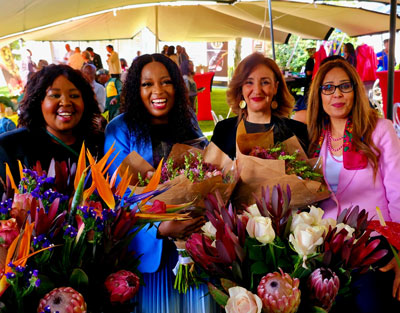
The programme combined high-level panel discussions with practical engagement, as women farmers and crafters showcased their produce and products. The exhibition component served as a reminder that women are not only participants in the agricultural economy, but active drivers of innovation and local enterprise development.
In her opening remarks, Ambassador Bardaoui framed the gathering as an example of “practical diplomacy”, noting that “we are not only exchanging ideas, we are building bridges between policy and practice, between vision and impact.” She emphasized that empowering women, particularly in rural economies, is both a social and economic priority, adding that “it is a powerful area of convergence between Tunisia and South Africa, and more broadly across our African continent.”
Delivering the keynote address, Deputy Minister of Small Business Development, Jane Sithole situated the discussion within a broader continental and global framework. Referencing the designation of 2026 as the International Year of the Woman Farmer, she highlighted the critical but often under-recognised role of women in agrifood systems.
(photos: Sibulele Musie/Department of Small Business Development)
“Women farmers are central to food security, nutrition and economic resilience,” Sithole said, stressing that Africa’s development trajectory cannot be realised without their full participation. She pointed to persistent structural barriers, including limited access to finance, restricted market access and gaps in technical training, noting that “if we are serious about inclusive growth, we must move beyond acknowledging these barriers to systematically dismantling them.”
Importantly, Sithole drew attention to regulatory and administrative constraints at the local level. She emphasised the need to reduce unnecessary red tape, citing cases where longstanding enterprises are hindered by rezoning requirements. She also called for development frameworks to be more responsive to local realities, stating that traditional leadership structures should be considered, particularly in rural areas where they play a central role in economic activity.
The discussions at the embassy echoed themes raised at the recent National Local Economic Development Summit 2026, where government and stakeholders committed to a more coordinated approach to economic development. The LED Summit Pledge and Declaration set out a programme aimed at translating policy into measurable outcomes at the municipal level, addressing persistent challenges such as unemployment, inequality, spatial disparities, infrastructure limitations and institutional capacity constraints.
Minister of Small Business Development, Stella Ndabeni emphasised at the summit that the declaration represents a shift towards a more integrated and results-driven model for local economic development. The alignment between the embassy dialogue and the summit outcomes was evident, particularly in the shared focus on implementation, collaboration and inclusive growth.
Sithole reinforced this approach, noting that empowering women in agribusiness is not a peripheral concern but an economic necessity. “Empowering women in agribusiness is not a social obligation, it is an economic imperative,” she said, calling for stronger partnerships between government, the private sector, development finance institutions and regional bodies such as the African Union.
Beyond policy discussions, the event created space for direct engagement between women entrepreneurs and potential partners and customers. This practical dimension aligned with Ambassador Bardaoui’s emphasis on connection and collaboration, as participants were encouraged to build networks and explore opportunities for cross-border cooperation.
As both countries continue to refine their approaches to inclusive agricultural development, the dialogue in Pretoria demonstrated that shared challenges can be met with shared solutions. The convergence of policy, practice and partnership signals a growing recognition that women are central to Africa’s agricultural future, and that unlocking their full potential is essential for sustainable economic transformation.