29 April 2026 Issue 349 - Freedom to Enterprise
|
|
|
|---|
|
| Removing Barriers for Women in Agribusiness - Tunisia-South Africa Perspectives |
|
|
|---|
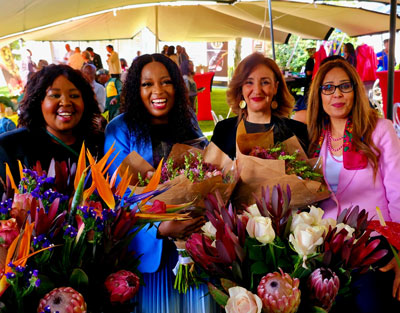
Pictured (l-r) Nomthandazo Peyise, owner of Petal Poetry, Deputy Minister Jane Sithole, Ambassador Karima Bardaoui and Hasna Tizaoui, Deputy Head of Mission of the Embassy of Tunisia (photo: Sibulele Musie/Department of Small Business Development) |
|
|---|
A timely dialogue by the Embassy of the Republic of Tunisia in Pretoria brought together policymakers, entrepreneurs and development stakeholders to advance a shared agenda on women’s empowerment in agriculture. The event, hosted by Ambassador of Tunisia, Karima Bardaoui, highlighted both the opportunities and structural challenges facing women across agricultural value chains, while reinforcing the importance of cooperation between Tunisia and South Africa. The programme combined high-level panel discussions with practical engagement, as women farmers and crafters showcased their produce and products. The exhibition component served as a reminder that women are not only participants in the agricultural economy, but active drivers of innovation and local enterprise development. In her opening remarks, Ambassador Bardaoui framed the gathering as an example of “practical diplomacy”, noting that “we are not only exchanging ideas, we are building bridges between policy and practice, between vision and impact.” She emphasized that empowering women, particularly in rural economies, is both a social and economic priority, adding that “it is a powerful area of convergence between Tunisia and South Africa, and more broadly across our African continent.”
|
|
|---|
|
| Freedom to Enterprise: South Africa at 32 - Progress, Paradox and the Path Forward |
|
|
|---|
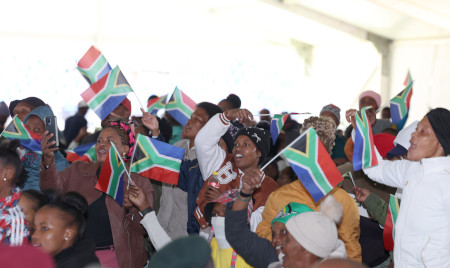
2026 Freedom Day Celebrations at the Dr Rantlai Molemela Stadium in Bloemfontein, Free State Province (photo GCIS) |
|
|---|
As South Africa marks 32 years of democracy this Freedom Day, the nation stands at a crossroads shaped by extraordinary progress and persistent contradiction. The story of these three decades is neither one of failure nor triumph alone, it is a complex narrative of resilience, reform and unfinished business. The end of apartheid ushered in one of the most admired constitutional democracies in the world. Political freedom was secured through sacrifice, negotiation and vision. Since 1994, millions have gained access to housing, education, healthcare and other basic services. A new Black middle class has emerged. Women have advanced into leadership across government, business and civil society. South Africans, once excluded from the global economy, now participate in international markets, diplomacy and innovation. Yet political freedom has not fully translated into economic justice. South Africa remains one of the most unequal societies globally. The structural legacy of apartheid, spatial inequality, concentrated wealth and unequal access to opportunity continues to define lived reality. Policies like Black Economic Empowerment (BEE) and Affirmative Action were designed to correct these imbalances. They have succeeded in creating a class of empowered professionals and business leaders, but they have also revealed limitations including the concentration of benefits, perceptions of elite capture and insufficient broad-based impact. |
|
|---|
|
'Palestine 36': The true Palestinian narrative in a time of shameful silence of human conscience |
|
|
|---|
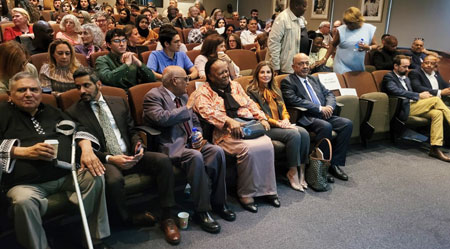
Pictured front row (l-r) ANC Veteran Mohammed Dangor, Ambassador of Saudi Arabia Faisal Al-Harbi, Ambassador of the Arab League Reyad Al-Akbari, Chairperson of the Nelson Mandela Foundation Naledi Pandor, Ambassador of Palestine Hanan Jarrar, Former Minister of Justice of Palestine Mohammed Shalaldeh, Ambassador of Cuba Fakri Rodriguez Pinelo and Ambassador of Nicaragua Danilo Chang Cash (photo: TDS) |
|
|---|
By Ambassador Reyad Al-Akbari, Head of the League of Arab States in South Africa
On the evening of Tuesday, 21 April 2026, I had the honor of attending the screening of the film “Palestine 36” (Film Screening), upon an invitation from Hanan Jarrar, Ambassador of the State of Palestine to Pretoria. The screening was hosted by the Embassy of Palestine in Pretoria together with the Nelson Mandela Foundation in observance of Palestinian Land Day and Prisoner’s Day as well as Freedom Month in South Africa. On 27 April 1994 South Africans began a new democratic journey. Notably, it was on December 4, 1997 during the International Day of Solidarity with the Palestinian People that Nelson Mandela said, “We know too well that our freedom is incomplete without the freedom of the Palestinians.” The comprehensive address delivered by Dr Naledi Pandor, former Minister of International Relations and Cooperation of South Africa and Chairperson of the Nelson Mandela Foundation, conveyed profound meanings and eloquent lessons, embodying a progressive human thought that reflects the authenticity and purity of the South African position on current international issues, particularly South Africa’s principled and genuine solidarity with the Palestinian people.
|
|
|---|
| Senqu Bridge a powerful symbol of cooperation and shared development |
|
|
|---|
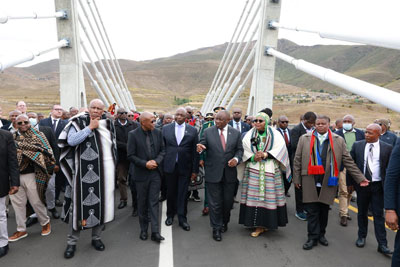
President Ramaphosa and King Letsie with officials at the official opening of the Senqu Bridge (photo: GCIS) |
|
|---|
President Cyril Ramaphosa has underscored the strength and longevity of relations between South Africa and Lesotho, describing the Senqu Bridge as a powerful symbol of cooperation and shared development. Speaking at the official launch of the bridge under the Lesotho Highlands Water Project (LHWP) in Mokhotlong, President Ramaphosa said the structure reflects a partnership built on mutual respect, shared history and a common vision for regional progress.
“The Senqu Bridge is a milestone in our longstanding collaboration. This bridge is testament to the deep-seated relationship between our two countries. “Rising high above the river valley, located more than 2 500 meters above sea level, this bridge has been built to endure. It will serve many generations to come,” the President said. President Ramaphosa, along with His Majesty King Letsie III, officially unveiled the state-of-the-art Senqu Bridge, marking a major milestone in the long-standing partnership between South Africa and Lesotho under the Lesotho Highlands Water Project. |
|
|---|
| | The Shared History, Renewal and Strategic Solidarity between Mauritius and South Africa |
|
|
|---|
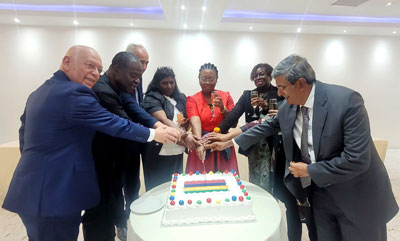
Maria Francesca Mireille Martin, High Commissioner of Mauritius and Acting Director-General at the Department of Justice and Constitutional Development, Kalay Pillay together with Heads of Mission cutting the celebratory cake (photo: TDS) |
|
|---|
The celebration of the 58th National Day of Mauritius (March 12), hosted in Pretoria on 17 April, was an occasion that reflected a deeper resonance to reaffirm the enduring bonds between two nations shaped by history, resilience and a shared vision for the future. Ms Maria Francesca Mireille Martin, whose appointment as High Commissioner to South Africa, signals both continuity and renewal in Mauritius–South Africa relations. A seasoned journalist turned parliamentarian, who rose to serve as Minister of Gender Equality, Child Development and Family Welfare in Mauritius, Martin brings to her diplomatic role a rare blend of media insight, governance experience and cultural fluency. Her passion for languages is evident in her establishment of a translation enterprise which further reflects a commitment to bridging divides, a quality essential in diplomacy. Her remarks on the occasion were both reflective and forward-looking, grounded in the theme of Mauritius’ national identity: “In Peace, Justice and Liberty.” These values, she noted, are embedded in the Mauritian ethos, shaped by a multicultural society that mirrors South Africa’s own “rainbow nation” identity.
|
|
|---|
| Zimbabwe - SA: Better and Stronger Together |
|
|
|---|
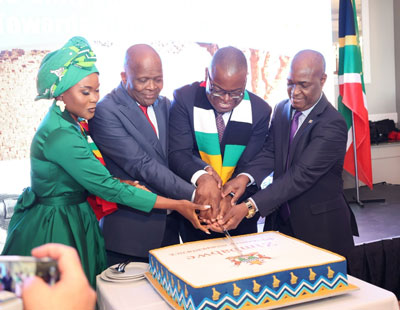
Pictured (l-r) Priviledge Mazemo, Deputy Minister Mondli Gungubele, Minister Amon Murwira and Ambassador Lovemore Mazemo (photo supplied) |
|
|---|
The relationship between Zimbabwe and South Africa is often framed through politics and economics, but its true depth lies in a shared civilizational story, one that stretches back millennia before colonial borders divided the region. Archaeological discoveries such as Great Zimbabwe Kingdom and Mapungubwe reveal a sophisticated pre-colonial world of trade, governance and cultural exchange. These sites stand as memory of an interconnected, highly skilled society that once thrived across what is now southern Africa. Today, that historical continuity is finding renewed relevance in a rapidly shifting global order. Zimbabwe’s National Day (April 12) celebrations, held annually on Zimbabwe Independence Day, provide a moment for reflection and recalibration. At the 46th anniversary reception in Pretoria, hosted by Ambassador Lovemore Mazemo, this sense of resurgence was palpable. The occasion, attended by South African officials including Deputy Minister of Communications and Digital Technologies, Mondli Gungubele, acknowledged the strength diplomatic and cultural ties binding the two nations. |
|
|---|
Minister Lamola urges SADC region to shift from policy to action
|
|
|
|---|
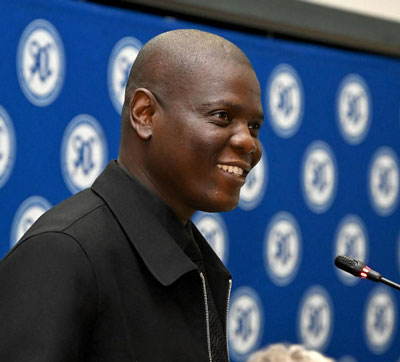
International Relations and Cooperation Minister Ronald Lamola has called for a decisive shift from policy commitments to implementation as South Africa chairs the Southern African Development Community (SADC) amid growing global uncertainty. Delivering closing remarks at an interdepartmental workshop on the Regional Indicative Strategic Development Plan (RISDP) 2020 – 2030 at the O.R. Tambo Building in Pretoria on Friday, Lamola said the region’s primary challenge was no longer a lack of frameworks, but the failure to effectively execute them. “The feedback I have received confirms that the SADC region is not constrained by a lack of frameworks, vision or institutional architecture. The core challenge is implementation,” he said. The workshop, supported by the European Union and the SADC Secretariat, brought together senior government officials, representatives of State-owned enterprises, development finance institutions and senior officials from the SADC Secretariat in Gaborone, Botswana, to develop a strategy and identify priorities for South Africa’s chairship of SADC. |
|
|---|
The Environment is Everything, Leadership, Conservation and Collaboration at SANBI
|
|
|
|---|
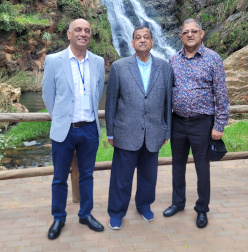
The value of Diplomacy and the Environment - Kirtan Bhana and Adv. Ajay Sooklal of The Diplomatic Society joined Minister Singh for the day's event (photo: TDS)
|
|
|---|
Set against the dramatic backdrop of the 70-metre Witpoortjie Falls, cascading into the lush expanse of the Walter Sisulu National Botanical Garden, a recent gathering hosted by the South African National Biodiversity Institute (SANBI) underlined a simple but urgent truth, the environment is not separate from human progress, it is its foundation. Nestled near the Cradle of Humankind, the Garden is a scenic retreat that represents a living intersection of natural heritage, scientific research and sustainable development. Since its establishment in 2004, SANBI has played a central role in safeguarding South Africa’s biodiversity, facilitating access to ecological data, shaping policy, building capacity and maintaining national botanical and zoological gardens that showcase the country’s rich natural assets. The event, led by Deputy Minister of Forestry, Fisheries and the Environment, Narend Singh, was designed as a reflective experience for leaders navigating high-pressure environments. Removed from the noise of daily operations, participants engaged with nature as a tool for clarity, resilience and improved decision-making. |
|
|---|
|
|